Friday, April 30, 2010
Robin Blaser, Henry Corbin & James Hillman

Revised and Expanded Edition. Edited by Miriam Nichols. Foreword by Robert Creeley. With a New Afterword by Charles Bernstein.
As I've mentioned before (here) Blaser draws on Corbin both in this volume and in his Collected Essays. You can find these quotes at Google Books, or preferably, in your own copy...
On page 238, the quote is from Man of Light, p. 4.
On page 339, from Hillman's "Thought of the Heart."
On page 500, from Creative Imagination, p. 203.
For those who may not know, Hillman's Eranos Lecture "The Thought of the Heart" is an extended response to Corbin and a must read for all with an interest in Corbin's influence. Hillman's essay can be read here.


Thursday, April 29, 2010
Resid Hafizovic on Henry Corbin

Faculty of Islamic Studies, Sarajevo University
54 Cemerlina Street, Sarajevo, Bosnia-Herzegovina.CV & Bibliography here.
October 2009: Dr. Resid Hafizovic, professor at Sarajevo University has been selected as best researcher in Islamic human sciences and will be awarded this year’s Farabi award for his book “Human face in the mirror of mystic literature”. See this article.
- "Henry Corbin’s Anti/philosophy of anti/history," Afterword to Henry Corbin’s En islam iranien, I-IV, Bemust, Sarajevo 2001. (in Bosnian)
- "Philosophy of exile," Afterword to Henry Corbin’s La philosophie iranienne islamique – XVIIè et XVIIIè siècle, “Ibn Sina Institut”, Sarajevo 2002. (in Bosnian)
It's interesting to note that Corbin's 4 volume masterwork is now available in Bosnian, but not (yet) in English.
It would be wonderful if someone would translate these pieces by Hafizovic for us.
Wednesday, April 28, 2010
Simerg - Ismaili Insights from Around the World

This is a website and blog devoted to "all things Ismaili" and there is a very great deal on the site worthy of attention. Highly recommended.
Photo by Sarite Sanders - from this wonderful photo essay.
Tuesday, April 27, 2010
James Hillman on Jung, The Red Book & Active Imagination

The description of the lecture is as follows:
The emergence of C.G. Jung’s Red Book from years of storage in a Swiss vault has re-kindled interest in active imagination. This method of self-exploration involves actively engaging one’s own imagination in dialogue, through writing, art, or the spoken word.
In this 3-hour DVD, James Hillman —noted author, psychologist, and the first Director of Studies at the Jung Institute in Zurich — introduces the method and delves deeply into the therapeutic value it offers in an increasingly noisy and demanding world.
Hillman considers the history and theory of active imagination in Jung, its relationship to making art, and offers examples for scrutiny and discussion. He discusses the fear of inviting demons and opening wounds, and addresses the difference between the voices of inner figures and auditory hallucinations. The major re-examination of Jung’s original ideas and inspiration doesn’t stop there, though. Hillman goes on to examine the role of imagination in contemporary culture, and whether imagination itself might need re-imagining.
Hillman’s seminar was taped December 9, 2009, in front of a sold-out audience at the Pacifica Graduate Institute in Santa Barbara, CA.
Monday, April 26, 2010
Avicenna Colloquium in Paris
Avicenne (Ibn Sînâ) aujourd’hui : sciences et philosophie
Colloque organisé par :
la Délégation Permanente de la République d’Ouzbékistan auprès de l’UNESCO
l’Ambassade d’Ouzbékistan à Paris
et l’Institut du monde arabe
Institut du monde arabe, vendredi 30 avril 2010
Auditorium, 14h-18h. Entrée libre Annonce Avicenne-1
Colloque organisé par :
la Délégation Permanente de la République d’Ouzbékistan auprès de l’UNESCO
l’Ambassade d’Ouzbékistan à Paris
et l’Institut du monde arabe
Institut du monde arabe, vendredi 30 avril 2010
Auditorium, 14h-18h. Entrée libre Annonce Avicenne-1
Monday, April 19, 2010
Ancien cimetière, Rue Gallieni, 95160 Montmorency, France
 I have been asked more than once where Henry Corbin's final resting place is. Thanks to Aziz Ibrahim we have the answer. This is from the obituary published in Le Monde, October 10, 1978:
"The orientalist Henry Corbin, who died on October 7, 1978, was buried in the cemetery of Champeaux, Rue Gallieni, in the city of Montmorency, Val d' Oise."
I would of course hope that some intrepid pilgrim will eventually send a photo of the grave site. [Someone did: see this post.]
Photo: JARDIN DE JEAN-JACQUES ROUSSEAU, MONTMORENCY
You can zoom in on "A" on the map below: Rue Gallieni, 95160 Montmorency, France
View Larger Map
Sunday, April 18, 2010
15th EXESESO Conference - April 24-25 - Exeter, England
Out of Egypt
15th EXESESO Conference
24th-25th April 2010
Centre for the Study of Esotericism
Venue: Institute for Arab and Islamic Studies
Further details from:
Professor Nicholas Goodrick-Clarke
Director, Centre for the Study of Esotericism (EXESESO)
Dept. of History
School of Humanities & Social Sciences (HUSS)
Tel + 44 (0) 1626 779941
E: n.goodrick-clarke@exeter.ac.uk
web: http://centres.exeter.ac.uk/exeseso/
The program is given in full in the 9 page document below. It includes a lecture by Dr. Angela Voss on "Henry Corbin and the Mundus Imaginalis."
EXESESO Conference (April 2010) Out of Egypt
The program is given in full in the 9 page document below. It includes a lecture by Dr. Angela Voss on "Henry Corbin and the Mundus Imaginalis."
Anticline - by Clayton Eshleman

One of the epigraphs to Clayton Eshleman's remarkable new book is from Mulla Sadra via Henry Corbin's Spiritual Body & Celestial Earth :
"Of all the realities that man sees and contemplates in the world beyond, those which delight, like houris, castles, gardens, green vegetation, and steams of running water - as well as their opposites - the horrifying kinds of which Hell is composed - none of these is extrinsic to him, to the very essence of his soul, none is distinct or separated from his own act of existing." Spiritual Body & Celestial Earth, 165
Eshleman at Poets.org
Sulfur Journal Homepage (Interview on the ending of Sulfur)
Kenneth Warren in his recent review of Grindstone for The Denver Quarterly writes: "For roughly half a century, Clayton Eshleman has embraced, like nobody else in American poetry, a massive practice of self-creating engagement with emotionally stirring artists, poets and psychologists. By way of editing, lecturing, teaching, translating, travelling, and writing, Eshleman has formed an interdisciplinary body of work, which through complex relationship with others feeds and radiates a powerfully realized madcap love for the rough and tumble of human experience, imagination, and instincts."
"Nobody is like him in a struggle. With ornery stubbornness, Clayton Eshleman has kept visiting the dark occasions, and brought back for us poems unlike anybody else’s. At times he makes the wildness of most poetry seem merely effete. I know of no poet who has fed so richly from the thingliness of the world beneath his feet, none who so resists the glamour of beliefs. He is a shaman without a single superstition." ––Robert Kelly
A very fine and interesting review here.
"Of all the realities that man sees and contemplates in the world beyond, those which delight, like houris, castles, gardens, green vegetation, and steams of running water - as well as their opposites - the horrifying kinds of which Hell is composed - none of these is extrinsic to him, to the very essence of his soul, none is distinct or separated from his own act of existing." Spiritual Body & Celestial Earth, 165
Eshleman at Poets.org
Sulfur Journal Homepage (Interview on the ending of Sulfur)
Kenneth Warren in his recent review of Grindstone for The Denver Quarterly writes: "For roughly half a century, Clayton Eshleman has embraced, like nobody else in American poetry, a massive practice of self-creating engagement with emotionally stirring artists, poets and psychologists. By way of editing, lecturing, teaching, translating, travelling, and writing, Eshleman has formed an interdisciplinary body of work, which through complex relationship with others feeds and radiates a powerfully realized madcap love for the rough and tumble of human experience, imagination, and instincts."
"Nobody is like him in a struggle. With ornery stubbornness, Clayton Eshleman has kept visiting the dark occasions, and brought back for us poems unlike anybody else’s. At times he makes the wildness of most poetry seem merely effete. I know of no poet who has fed so richly from the thingliness of the world beneath his feet, none who so resists the glamour of beliefs. He is a shaman without a single superstition." ––Robert Kelly
A very fine and interesting review here.
See more on Anticline at Black Widow Press
Friday, April 16, 2010
Jami's Salaman and Absal

What I wish… is to flee all alone with Azra into a desert, is to seek my native country in solitude and to pitch my tent beside a spring, keeping far from friend and enemy alike, soul and body both in peace, safe from men. May I be able to walk more that two hundred parsangs in any direction without finding human footprints. And then may every hair of my head, every hair on my body, become so many eyes, and may the one object of my sight be Azra, so that I may turn to her with thousands of eyes and contemplate her face forever. Ah! better yet, may my contemplative condition be abolished. What I seek is to be delivered from duality, is to become She. As long as duality remains, distance remains, the soul is branded with the iron of separation. When the Lover enters the retreat of Union, it can contain but One alone. Peace! (Avicenna, p. 215)
Edward Fitzgerald's translation of Jami's poem.
Readers of Corbin's book may find this essay of interest: "Jāmī's Salāmān and Absāl" by Iraj Dehghan. Journal of Near Eastern Studies, Vol. 30, No. 2 (Apr., 1971), pp. 118-126.
Jami's Salaman & Absal
Image from Jami's Rose Garden: Rosary of the Pious, 16th century, Arthur Sackler Gallery, Folio 146a-b.
Wednesday, April 14, 2010
The Demon and the Angel
 I've been forced to think a good deal lately about daimons and demons, gods and angels, which leads me always to Lorca and Rilke. And much to my surprise and delight, I have happened upon another little gem of a book in which Corbin and the mundus imaginalis figure prominently. Here we find Lorca, Rilke, Ibn Arabi, Yeats, Keats and a host of others in a small tour-de-force on the sources of creative imagination.
The Demon and the Angel: Searching for the Source of Artistic Inspiration, by Edward Hirsch.
Hirsch writes,
"It is helpful to think of the mundus imaginalis as a transcendence deployed in language. It is the specific place where St. John of the Cross composes his Spiritual Canticles, where Arthur Rimbaud enters a rational delirium and Hart Crane systematically deranges the senses, where Gerard de Nerval formulates visions and Robert Desnos simulates trances, where William Blake canonizes voices and Samuel Taylor Coleridge troubles dreams, where W. B. Yeats listens to unknown instructors speaking through his wife's unconscious and James Merrill contacts spirits through a Ouija board, where Wallace Stevens imagines that God the the imagination are One and Rainer Maria Rilke starts taking dictation from angels." (p. 108)
Monday, April 12, 2010
Reconfiguring Romanticism

Reconfiguring Romanticism: An Eight-Part Series on KPFA San Francisco
The full program is available HERE for an eight-part series on Poems for the Millennium, volume 3, The University of California Book of Romantic & Pre-Romantic Poetry, prepared by Jack Foley for presentation on Cover to Cover, his longrunning program on KPFA-FM (Pacifica Radio) in San Francisco. Show times are Wednesdays from 3:00 to 3:30 p.m. beginning on April 14, barring occasional changes or preemptions.
Poems for the Millennium Volume 3 (from the publisher): The previous two volumes of this acclaimed anthology set forth a globally decentered revision of twentieth-century poetry from the perspective of its many avant-gardes. Now editors Jerome Rothenberg and Jeffrey C. Robinson bring a radically new interpretation to the poetry of the preceding century, viewing the work of the romantic and post-romantic poets as an international, collective, often utopian enterprise that became the foundation of experimental modernism. Global in its range, volume three gathers selections from the poetry and manifestos of canonical poets, as well as the work of lesser-known but equally radical poets. Defining romanticism as experimental and visionary, Rothenberg and Robinson feature prose poetry, verbal-visual experiments, and sound poetry, along with more familiar forms seen here as if for the first time. The anthology also explores romanticism outside the European orbit and includes ethnopoetic and archaeological works outside the literary mainstream. The range of volume three and its skewing of the traditional canon illuminate the process by which romantics and post- romantics challenged nineteenth-century orthodoxies and propelled poetry to the experiments of a later modernism and avant-gardism.
Friday, April 9, 2010
Castoriadis on the Imaginary
I've just had a chance to read a really excellent piece by Todd Lawson which should be published soon. I'll post a note (I hope) when this volume is released: "Shaykh Ahmad al-Ahsā’ī and the World of Images" by Todd Lawson in Shi'ite Trends and Dynamics in Modern Times (1750-1911) / Courants et dynamiques shi‘ites à l’époque moderne (1750-1911). Orient-Institut of Beirut & IFRI [Beiruter Text und Studien, 115], Beirut. Denis Hermann & Sabrina Mervin (eds.) Forthcoming.
 Among the gems in Lawson's essay is a marvelous reference to Cornelius Castoriadis (also here) (1922-1997) the Greek philosopher and psychoanalyist, who I've heard of but never read. Lawson writes that "we occasionally find a validation of the imaginal in contemporary intellectual discourse" and quotes Castoriadis as follows:
[P]hilosophers almost always start by saying: “I want to see what being is, what reality is. Now, here is a table; what does this table show to me as characteristic of a real being?” No philosopher ever started by saying: “I want to see what being is, what reality is. Now, here is my memory of my dream of last night; what does this show me as characteristic of a real being?” No philosopher ever starts by saying “Let the Requiem of Mozart be a paradigm of being”, and seeing in the physical world a deficient mode of being, instead of looking at things the other way around, instead of seeing in the imaginary, i.e., human mode of existence, a deficient or secondary mode of being.[1]
[1] Cornelius Castoriadis, “The Imaginary Creation in the Social Historical Domain”, in: Disorder and Order: Proceedings of the Stanford International Symposium (Sept. 14-16, 1981), Edward P. Livingston, ed., Saratoga: Anma Libri, 1984, 146-161, this is from p. 148. See also Castoriadis, World in fragments: writings on politics, society, psychoanalysis, and the imagination, David Ames Curtis, ed. and trans., Stanford, California: Stanford University Press 1997 [originally published as Monde morcelé: Les Carrefours du labyrinthe Paris: Seuil 1990].
Thursday, April 8, 2010
The Vincent Ferrini/Charles Olson Writer's Place

Writer's House Slated for Gloucester
Contact Henry Ferrini
www.ferriniproductions.com
www.polisIsthis.com
5 Wall Street
Gloucester, MA 01930
978-281-2355
PHOTO: Peter Anastas, Charles Olson and Vincent Ferrini, left to right, at 126 East Main Street (c.1965. Mark Power)
Gloucester may soon be home to a new cultural and literary center. When Gloucester’s Poet Laureate Vincent Ferrini died on Christmas Eve 2007, many of his friends in Gloucester and elsewhere hoped his house could be purchased and turned into a center where artistic activities could be shared with the community. Today this idea is very close to becoming a reality. Plans are progressing to establish The Vincent Ferrini/Charles Olson Writers Place at 126 East Main Street, in Gloucester, Massachusetts. This former home of Vincent Ferrini (1913-2007) lies across the harbor from Charles Olson’s (1910-1970) 28 Fort Square home. These two poets, known as the consciences of our city for over half a century, wrote about Gloucester with enlightened passion and energy. Organizers of this project believe it is only fitting that a place that honors their work and keeps their vision alive be established. Since Ferrini’s death Paul Sawyer, an old friend of Vincent’s who lives in California, has been advocating for the purchase of the house. This spring, Sawyer, a Unitarian-Universalist Minister, called Vincent’s nephew filmmaker Henry Ferrini to report that he has pancreatic cancer and has been given a year to live. With that time he wanted to put his energy toward helping to create a Vincent Ferrini/ Charles Olson Writers Place at Vincent’s East Main Street studio. The poet’s nephew was moved by Paul’s decision. “Paul’s decision has motivated so many people close to Vincent, Charles and Paul to work to make this a reality,” Ferrini said. To date the group has raised $23,000 and hopes to raise ten times that amount during the upcoming year. This would enable the organization to own the house outright, repair the building and begin to develop programs for the site, including public readings, writing workshops and residencies for local and visiting writers. According to Ferrini, the timing for this project could not be more perfect. “This year is the Centenary of Charles Olson’s birth,” he says, “and attention is focused on the poet.” The group hopes that by Vincent’s centenary in 2013 the project will be up and running, presenting programs, providing a writer’s retreat and functioning as one of the most innovative educational and cultural organization in the city. Tax-deductible contributions for the establishing of the Vincent Ferrini/Charles Olson Writers Place can be made to the Charles Olson Society and sent to Henry Ferrini, 5 Wall Street, Gloucester, MA 01930
Wednesday, April 7, 2010
The Painted Ceilings of Cappella Palatina (Palermo, Sicily)
In the NOTE ON ILLUSTRATIONS from Corbin's Spiritual Body and Celestial Earth, pp. xxxi-xxxii, he discusses the Palatine Chapel at Palermo (see this earlier post: The Green Bird & the Resurrection Body). This April 13th lecture should be of some interest:

Islamic Art for Christian Patrons The Painted Ceilings of Cappella Palatina (Palermo, Sicily), circa 1140  Located within the Palazzo dei Normanni (Palace of the Normans), the Cappella Palatina (Palatine Chapel) is the finest example of Arab-Norman art in Palermo, Sicily. Built by Roger II in 1130 to 1140, the chapel is decorated with exceptional mosaics and paintings of saints and biblical stories as well as scenes of Arab and Norman court life. The palace was originally built for the Arab emirs and their harems in the ninth century on a site where Roman and Punic fortresses once stood. Centuries later, the conquering Normans fully restored the palace and added to its splendor. In the mid-sixteenth century, the abandoned palace was again restored, this time by the ruling Spanish viceroys, and today it serves as the seat of Sicily's government. Dr. Jeremy Johns is professor of art and archaeology of the Islamic Mediterranean and serves as the director of the Khalili Research Centre at the University of Oxford, England. He is a world expert on Norman Sicily. |


Monday, April 5, 2010
Jung's Red Book in Washington

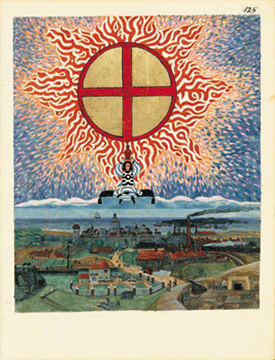
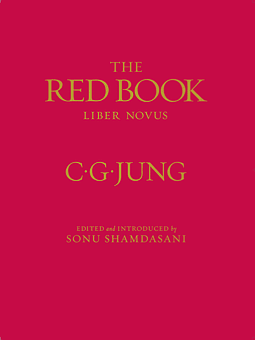
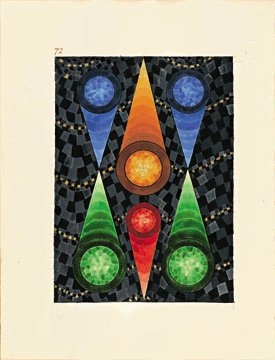
This note from the ARAS Newsletter and the Jung Society of Washington: Beginning on June 17 and ending July 31, 2010 the U.S. Library of Congress, in collaboration with the Jung Society of Washington, in one of only three venues in the United States, will centerpiece the original illuminated manuscript of C. G. Jung's The Red Book in the Thomas Jefferson Building of the Library. The exhibit will include Jung's manuscript of Memories, Dreams, Reflections, several Jung-Freud letters,and many other items of real interest.
On Saturday, June 19, the Library of Congress will host a Red Book Symposium. Speakers includes Sonu Shamdasani, James Hillman, Ann Ulanov, John Beebe, Tom Kirsch, Beverley Zabriskie, and others.
On Saturday, June 19, the Library of Congress will host a Red Book Symposium. Speakers includes Sonu Shamdasani, James Hillman, Ann Ulanov, John Beebe, Tom Kirsch, Beverley Zabriskie, and others.
Friday, April 2, 2010
L'Ame de l'Iran

Poche - Broché, 2009, 227 pages
at amazon.fr
L'Âme de l'Iran, grand classique de l'iranologie, rassemble en un dialogue rare les meilleurs spécialistes de la civilisation perse, l'une des plus anciennes, et aujourd'hui encore au coeur de l'histoire mondiale.
" Patrie des philosophes et des poètes ", selon l'expression d'Henry Corbin, l'Iran est au carrefour de deux continents spirituels. En rappelant tout l'héritage de la Perse, de l'ancienne religion de Zoroastre jusqu'à l'islam chi'ite, et en saisissant au vol l'âme de cette civilisation qui fit se rencontrer et se mêler tant de cultures, les auteurs célèbrent les retrouvailles de l'Orient et de l'Occident en leur berceau commun.
Daryush Shayegan, dans sa préface, souligne la valeur toujours actuelle de ce volume aux intervenants prestigieux.
Thursday, April 1, 2010
ARAS Newsletter Featuring the Red Book
Some readers will be interested in the quarterly ARAS Newsletter, which can be subscribed to for free at their website. I append a replica of the current issue below - apologies for the background - you can have a readable version by subscribing:

ARAS Connections
Image and Archetype
• 2010 • Issue 1 •
  | Visit ARAS Online |
 | |
| |
ARAS Connections
Image and Archetype
• 2010 • Issue 1 •
| |
|


| |
| |
| This newsletter comes to you from ARAS, a non-profit organization. Visit our web site. Become an ARAS Online member by joining online. If you do not wish to receive these e-mail newsletters in the future, please reply with the words "Remove Me" in the subject line. Copyright © 2009 ARAS. All Rights Reserved. | |
| |
| |
Subscribe to:
Posts (Atom)


 Posts
Posts


