Monday, March 16, 2009
Notes on Corbin's Shadow - Part 1
 I have for a long time felt an obligation to address some of the charges made against Corbin by his critics but have not yet been able to write the extended essay that this demands. Many of these questions have been discussed at least indirectly in my books but it seems appropriate to make some explicit statements and gather them in one place. Although I hesitate to raise such complex issues in an informal context, I want to make known some of my current thoughts on subjects that are of great importance for anyone engaged in the study of Corbin's work.
Most straightforward to answer is the claim that Corbin is at least implicitly anti-semitic because of his privileging of gnosis over Law. The issue arises because Judaism is often regarded as primarily a religion of the Law. Corbin is quite clearly wary of "legalism" in all of the Abrahamic faiths, and most of his criticisms are directed explicitly at Muslims of various sorts. But his critiques of the "doctors of the Law" are entirely ecumenical in spirit and aimed at fundamentalists of all persuasions. The early context for his attitudes was provided by the philosophical and theological tensions between Protestants and Catholics, and it is above all the institutionalization of doctrine into dogma that is the subject of his critiques. And though he is less enthusiastic about it than some would prefer, Corbin is entirely aware of the fact that there can be no inner meaning to a religion that has no outer appearance. It is not that he argues there can be no binding divine law, but rather that he is extremely suspicious of any human attempts to impose a specific reading of such a law on others. He argues that whenever there is a mediating individual such as a priest or a Master, or a mediating social structure such as a Church that comes between the individual and the Lord we must be very much on our guard. [In the first version of this post I didn't even mention the fundamental fact that Corbin's entire opus is devoted to showing the unity of the three Abrahamic faiths. To suggest even a suppressed anti-antisemitism entirely misses the meaning of his life's work.]
It has been suggested that Corbin was an ideological Iranian nationalist and a supporter of the Shah and his repressive regime. It is now widely known that Reza Shah Pahlavi was put in place after the British and Americans conspired to bring down the democratically elected but Soviet-leaning government of Mohammad Mossadegh, in part to help prevent the nationalization of the Iranian oil fields. (See for instance The CIA in Iran from the New York Times.) Corbin's ties to the Shah and to the Mellons, who were investors in American oil companies, are indisputable. What is in question is the meaning of these connections and the lessons we should draw from them. Guilt by association holds no weight, although I remain open to learning more about his relation to these people. We all break bread at one time or another with those from whom we perhaps should keep our distance, and association need not imply complicity. However there are deeper issues here. As Norman O. Brown has commented, in many areas Corbin simply refused to see any political implications whatever in the subjects of his study. I think this is deeply troubling and it points to one of the most profound dangers inherent in Corbin's approach - one of which we should be entirely conscious. As I have written elsewhere:
"It is often not at all clear in reading Corbin that there is any politically important component in the history of the Shi'ites. In fact he often remarks that it is when Shi'ism does come to political power that it is most in danger of betraying its inner trust. Success on the political front is the "most formidable and paradoxical ordeal that an esoteric religion may undergo." It is in fact just the "sacralization" of institutions that is the prime symptom of metaphysical "secularization." He goes so far as to say "The very idea of associating such concepts as 'power' and the 'spiritual' implies an initial secularization." In the West the failure of the priesthood to gain secular power was the cause of the projection of "a fiction of that same power into the supernatural." His exclusively spiritual view of things makes him a poor guide to political or social history. Norman O. Brown remarks that "Corbin, indispensable in other ways, refuses to see any political dimension whatsoever" in Ismaili or Shi'ite history. It is perhaps unfair to accuse him of being politically naïve when his purpose is not to write political history. Yet it is wise to be aware of the limitations inherent in an exclusively spiritual perspective on history, particularly in view of the fact that the central issue here is the source of legitimate authority in matters of the soul. A spirituality that is blind to political realities is in danger of falling into folly.
And yet it may be that this is precisely the point we can take from his work. Whatever his shortcomings as a social historian, Corbin's writings can be understood as political in the deepest sense. By showing that a metaphysics of individuation is necessary to counter the threat of totalitarianisms, he makes it clear that any spirituality that holds itself aloof from the merely temporal is doomed to the ineffectuality of the abstract. Through his attempt to reinstate the Image in its rightful place in the scheme of things, Corbin attempts to restore balance to the lives of each of us and thereby to the social world as well. James Hillman has seen this aspect of his work clearly. In reference to the nightmares of terrorism in the contemporary Islamic world he says:
"Corbin said to me one time, 'What is wrong with the Islamic world is that it has destroyed its images, and without these images that are so rich in its tradition, they are going crazy because they have no containers for their extraordinary imaginative power.' His work...can be seen as political action of the first order: it was meeting terrorism, fanaticism, nihilism right at its roots in the psyche."
(from The World Turned Inside Out)
That being said, we should be clearly aware of the fact that Corbin often seems generally blind to the political uses of spiritual symbols, and this is indeed naïve and dangerous. Corbin is uniformly dismissive of an exclusively historical approach to spiritual matters, regarding it, rightly I think, as yet another form of fundamentalism which robs us of our humanity. And yet it would be a terrible mistake to ignore the insights of the critical theorists of the last century who have revealed so powerfully the psychological, social and political roots and implications of all of our acts. Not to acknowledge this is to be wide open to all the political and psychological repressions that Corbin, in his own way, is so concerned to fee us from. Corbin's "hermeneutics of unveiling" simply must be balanced with the "hermeneutics of suspicion." The former without the latter begets an ignorant and naïve spirituality; the latter without the former leads to nihilism.
With regard to Corbin's "Iranian nationalism" I think the same comments apply. His clear intention is to open up the world of Iranian spirituality, stretching back to Zoroaster, for all the world to see. He saw it as providing a perspective which was available almost nowhere else and believed that without it our conception of the primary human spiritual potential would be profoundly diminished. He saw, particularly in Suhrawardi, a union of the imaginative and the philosophical which is at best rare in world history. If an enthusiasm for this vision and the spiritual world which is its context leads to a blindness to the negative implications of political nationalism (and I am not at all convinced that it did in his case) then this is something we should be careful to guard against.
A closely related issue is the more general claim that Corbin's a-historical approach and his fondness for emphasizing cross-cultural similarities and "spiritual affinities" is simply a careless "syncretism" which dispenses with and ignores the critical-historical discrimination of modern scholarship. Corbin is dismissive of critiques which disparage this approach and replies that he is uncovering essential spiritual realities that lie behind the historically contingent facts of literal history. It is, he claims, the hiero-history that reveals the face of the divine reality. This dispute is thus part of the perennial antagonism between "Platonism" in various forms and a more "Aristotelian", or in the modern world, historical and materialist philosophy. Corbin was indeed a "Platonist" in the broad sense, and Platonism is not, to put it mildly, currently in favor among philosophers in the West. This dispute is far too broad to enter into here - I have tried in my books to suggest how Corbin's approach may be understood within the context of modern thought. Here I will only point out that one way of seeing the conflict, though it is an over-simplification, is to contrast Corbin's "Platonic" spiritual individualism with the impersonal tenor of a purely historical and material reductionism such as one finds for instance in Darwinism or a neurophysiological approach to the human being. A common charge against "Platonic" idealism or a mythological and archetypal view of reality is that these are (or can be construed as) "essentialist" worldviews. The problem with essentialism is at least twofold: it assumes that there are such "essences" that can identify and define the complex and changing beings that make up reality, and therefore it suggests that these identities can perhaps be discovered by us. The first is a philosophical problem. The second is a political one. Even if we grant that something like essences exist and can define, and thus constrict and control individual things like people, the political question concerns who is to do the defining. Thus essentialism so understood is one more fundamentalism that can be used to justify political and social control and repression. So essentialism is feared by some as providing justification for constraints on individuality and freedom. Corbin's argument is in some respects the opposite: he fears the disappearance of the person into the unanchored flow of historical and material contingency that is the matrix within which modern science, and in fact much modern thought, operates. He would have regarded the postmodernism of Derrida and others as a continuation in another guise of this same fall into chaos and incoherence. There are points to be scored on each side. One of the reasons that Corbin was drawn to Ibn 'Arabi is relevant here. William Chittick has pointed out that there are senses in which Ibn Arabi's worldview is strikingly postmodernist. His spiritual individualism, which influenced Corbin immensely, provides a way to see spiritual and moral truths as both individually absolute and historically relative. And it is critical to keep in mind that, as Corbin stresses, what we think of as the individual is really the ego, and the eternal Self is nothing at all like the finite and limited ego of the terrestrial human being. Thus the "essence" of the individual may not be at all the changeless and immutable Form that a simplistic "Platonism" suggests, but rather the perpetually changing and ascending soul of the mystic vision.
Another critique of Corbin relates to the character of his scholarly approach. There is no such thing as entirely objective and dispassionate scholarship. Yet modern scholarship is based on an attempt to achieve a degree of objectivity, and academic scholars engaged in the study of other cultures are generally diligent in trying to correct for their own biases and maintain a certain emotional distance from the subjects of their investigation. Corbin has been widely viewed as being engaged in something rather different. William Chittick, while sympathetic to Corbin and his work, has written of Creative Imagination in the Sufism of Ibn 'Arabi, "Corbin's rhetorical flourishes and passion for his subject put his work into a unique category... [He] is concerned with his own philosophical project... Any reader of Creative Imagination soon begins to wonder where Ibn al-Arabi ends and Corbin begins. The lines are not clear, especially if one does not have access to the Arabic texts. Certainly we come to realize the Ibn al-Arabi is a precious larder from which all sorts of delicious vittles can be extracted. But most people familiar with the original texts would agree that Corbin has highly individual tastes." (The Sufi Path of Knowledge, 1989, xix.). Corbin's work as editor and translator has to be distinguished from his work as a powerful and creative philosopher and theologian (although his translations too have been critiqued as reading his own ideas into the texts themselves). There is no doubt that Corbin was engaged all along in something other than philological scholarship, however much his scholarly activities added to our knowledge of the traditions he studied. As he wrote at the age of seventy, "To be a philosopher is to take to the road, never settling down in some place of satisfaction with a theory of the world, not even a place of reformation, nor of some illusory transformation of the conditions of this world. It aims for self-transformation, for the inner metamorphosis, which is implied by the notion of a new or spiritual rebirth. The adventure of the mystical philosopher is essentially seen as a voyage which progresses towards the Light." (The Voyage and the Messenger, 140.) It might be that we should understand Corbin's appropriation of the Islamic tradition in somewhat the same way that we view Heidegger's use of the pre-Socratics, or any Christian theologian's creative re-reading or "mis-reading" of the Bible. In any case the reader of Corbin should be aware that his project is an explicitly hermeneutic one, and therefore different from that of those indispensible scholars whose work has a rather different purpose. [This discussion occurs within the larger context not only of theology & philosophy versus philological and textual scholarship, but of the controversy over "Orientalism" sparked by Edward Said's work. This is a topic on which I do not feel competent to comment, though it is of considerable significance here. Two rather good wikipedia entries provide an entry into the literature: Edward Said and Orientalism.]


Tuesday, March 10, 2009
Sufi News and Sufism World Report
 I call your attention to two essential resources: The Sufi News and Sufism World Report blog, Editor-in-Chief, Dr. Alan Godlas of the Department of Religion at the University of Georgia; Dr. Godlas also maintains the superb Islam and Islamic Studies Resources page. Both are not to be missed.
Book of Prayers. August-September, 1715. Opaque watercolor, ink and gold on paper.H: 23.5 W: 41.1 cm .Turkey. Purchase--Smithsonian Unrestricted Trust Funds, Smithsonian Collections Acquisition Program, and Dr. Arthur M. Sackler, S1986.482
Monday, March 9, 2009
Henry Corbin in the 1930's - The German Translations
In the 1930s Corbin produced translations of Suhrawardi from the Persian, essays for Hic et Nunc on Kierkegaard, Luther and other topics, and a large number of critical reviews of works including ones by Brentano, Bultmann and Dilthey. He also translated a number of key essays in theology and philosophy from German. Maria Soster has written an excellent piece on Corbin's early work: Henry Corbin in the 1930's: Questions and Perspectives, (Translated by Christine Rhone). She writes:
A short text entitled “Annexe II: Nature des travaux à poursuivre en Allemagne” [Annex II: Nature of the works to pursue in Germany] dates from the end of 1934 or the beginning of 1935 and describes the prospects of the research that Henry Corbin intended to develop in Berlin (he was in Germany from October 1935 to June 1936). In this paper, we find the following: “Pursuit of an inquiry on the genesis of the grounds determining the orientation of Existenzphilosophie in all contemporary German philosophy. We can understand the ground of ‘existence’, in Heidegger as in Jaspers, as the result of an inevitable confrontation between that which is called the ‘crisis of historicism’ and the exigency of a self-understanding having true ontological significance. This problem of man at grips with ‘his’ history determines ‘the idea of anthropology in the philosophy of existence.’” Thus, the problem of existence and that of its historicity become the question of the concept of man for the philosophy of existence. Man is called into question, and with him, his history, because, as we shall see in the texts, man is not in history. On the contrary, history as potentiality-of-being is in man and simultaneously determines his past, present and future. (This similarly concerns the tradition that appears in Corbin’s reading of Suhrawardī. There, in discussing ‘existential time’, Corbin points out that “A philosopher can only be his own time, and in that alone consists his true ‘historicity’”, and furthermore that “there is a living tradition, that is, a transmission into acts, only by constantly renewed acts of decision”).
I have gathered together the list below from the Complete Bibiography at amiscorbin.com
Henry Corbin: Translations from the German - 1932-1939
 Karl Barth, « Misère et grandeur de l’église évangélique » (titre français donné par le directeur de la revue). – Trad. de l’allemand par H. Corbin, Foi et Vie 39, juin, 1932. Barth was known in the 1930s primarily for his Commentary on the Epistle to the Romans. [I would appreciate hearing from anyone who knows the title of the original German text which Corbin translated. - T.C.]
 Martin Heidegger, « Hölderlin et l’essence de la poésie », trad. de l’allemand par H. Corbin, Mesures 3, 15 juill. 1937, pp. 120-143. ["Holderlin and the Essence of Poetry"]
_____. Qu’est-ce que la métaphysique ? Suivi d’extraits sur l’être et le temps et d’une conférence sur Hölderlin. – Trad. de l’allemand par H. Corbin avec un avant-propos et des notes. Paris, Gallimard (coll. « Les Essais », VIII), 1938, In-8°, 250 p. [What Is Metaphysics? Being Extracts on Being and Time and a conference on Holderlin]
_____. « Phénoménologie de la mort », fin § 52 et § 53 in : Sein und Zeit (L’être et le temps). Halle am Saale, M. Niemeyer, 1927. - Trad. de l’allemand par H. Corbin, Hermès 3e série (1), Bruxelles, janv. 1938, pp. 37-51. ["Phenomenology of Death" - from Being and Time]
 Karl Jaspers, « La Norme du jour et la passion pour la nuit », chap. 3 ; pp. 102-106, in : Philosophie, t. 3, Metaphysik. Berlin, J. Springer, 1932.- Trad. de l’allemand par H. Corbin, Hermès 3e série (1), Bruxelles, janv. 1938, pp. 51-68. ["The Norm of Day and the Passion for the Night," from Philosophy, Vol. 3]
 Johann Georg Hamann, « Aesthetica in nuce. Rhapsodie en prose kabbalistique », trad. de l’allemand par H. Corbin, Mesures, janv. 1939, 27 p. ["Aesthetics in a Nutshell: A Rhapsody in Kabbalistic Prose," English text of this fascinating essay available here (pdf)] Corbin's translation appears in Henry Corbin, ed. by Christian Jambet.
 Abraham Heschel, « La Prophétie », traduction de l’allemand (Die Prophetie) par H. Corbin, Hermès 3e série (3). Bruxelles, nov. 1939, pp. 78-110. [Prophecy]
And for a brief but interesting mention of Corbin at the Bibliotheque Nationale, see "Arnaud Dandieu and the Epistemology of Documents," (2007) by Christian Roy at Papers of Surrealism, 7, 2007.
Wednesday, March 4, 2009
Corbin & Nietzsche
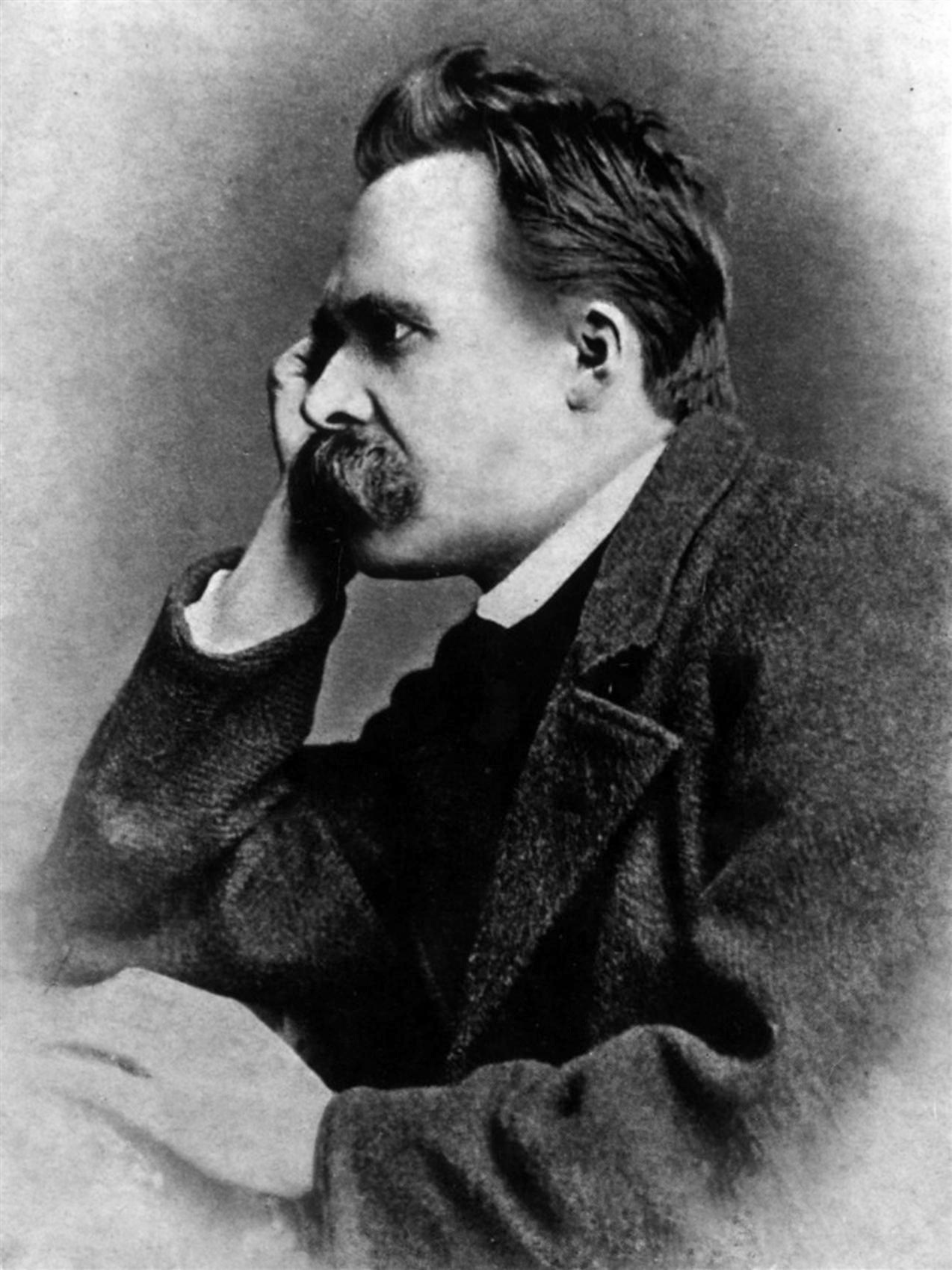 One of the most profound and striking aspects of Corbin's account of Western secularism and a-gnosticism is his analysis of Nietzsche's nihilism. Nietzsche announces the death of God first in The Gay Science in the voice of the Madman, and later in Thus Spake Zarathustra in the voice of Zarathustra (Zoroaster) himself. This world-shattering event is a dei-cide, for "we have killed Him." For Nietzsche this death marks a new beginning and heralds the possibility of a heretofore unknown freedom for humanity from forms of control and repression that have dominated the history of the world. Nietzsche hoped to usher in an age where fundamentalists of all kinds have no more ground to stand on - no transcendent Truth on which to base their claims for power. It is an exhilarating and dizzying prospect, and not one to be scornfully dismissed. Yet Corbin argues that what we know from the Sufis and others in the mystical traditions is that such a move is catastrophic unless one can transcend the "lower soul," the all-too-human ego. For all his visionary power as a philosopher and his startling insights as a psychologist, Nietzsche's attempt to live beyond good and evil and to face the blackness of the Abyss that opens in the absence of God is a failed initiation. This disaster is an ever-present possibility in the religions of the Abrahamic tradition.
A Failed Initiation
In his metaphysical anthropology and physiology the 13th century Iranian mystic Alaoddawleh Semnani described a “series of subtle organs…each of which…is the typification of a prophet…whose role and action it assumes… [E]ach of these…is marked by a colored light…[which] informs the mystic as to his spiritual state.” The penultimate stage of ascent through these “seven prophets of your being” is Jesus. His color is luminous black. In the Qur’an “it is said that Jesus, as the prophet before the last of the prophets of our cycle, was the herald of the last prophet, i.e., of the advent of the Paraclete.” Jesus thus presages the “stage of the divine center (Mohammad) which is brilliant green.” This is the emerald splendor of the complete fulfillment of personal initiation.
For Semnani, the Jesus of your being marks “exactly the perilous distracting stage whereat Christians in general and certain Sufis in Islam have been misled.” Corbin says of Semnani’s critique that “everything takes place as though this Sufi Master’s aim were to perfect the Christian ta’wil [hermeneutic], that is, to ‘lead it back,’ to open the way at last to its ultimate truth.”
Corbin draws together all the threads of his mystical, metaphysical and psychological themes to declare a pivot point for the mystical seeker, and for the history of the Western world. In order to avoid the catastrophes of dementia, nihilism, idolatry and the annihilation of the person in social and collective anonymity, the soul must achieve the “mystical poverty, mystical nakedness” which completely eliminates “intoxication,” or, in Jung’s terminology, the dangers of inflation. One must overcome the lower modes of perception – the allurements of the lower states of the soul must be overcome and transcended. A profound misunderstanding of the true situation is common to dogmatic Christianity, certain Sufis, and to Nietzsche, who stands as the representative of nihilistic modern man. Corbin writes:
 "By a striking comparison, Semnani establishes a connection between the trap into which the Christian dogma of the Incarnation falls by proclaiming homoousia and by affirming that ‘Isa ibn Maryam [Jesus, son of Mary] is God, and the mystical intoxication in which such as Hallaj cry out: ‘I am God.’ These dangers are symmetrical. On the one hand the Sufi, on experiencing the fana fi’llah, mistakes it for the actual and material resorption of human reality in the godhead; on the other, the Christian sees a fana of God into human reality. This is why Semnani perceives on the one side and other the same imminent threat of an irregularity in the development of consciousness. The Sufi would need an experienced shaykh to help him avoid the abyss and to lead him to the degree that is in truth the divine center of his being…where his higher, spiritual Self opens. If not, the spiritual energy being wholly concentrated on this opening, it can happen that the lower ego is left a prey to extravagant thoughts and delirium. The ‘scales’ are then completely unbalanced; in a fatal moment of looking back, the newborn higher Self succumbs to what had been overcome and perishes in the moment of triumph. And this is just as true in the moral domain as in respect to the metaphysical perception of the divine and of being. It is a premature rupture in the process of growth, a ‘failed initiation.’ One could say that the mortal danger described by Semnani on both sides is the very same situation with which the West came face to face when Nietzsche cried out: ‘God is dead.’ ” (The Man of Light in Iranian Sufism, 127-128).
Corbin writes at more length of Semnani's physiology in En Islam Iranien, Volume 3, Book 4.
(Adapted from Green Man, Earth Angel: Ch. 3 Black Light.)
Photo: Friedrich Wilhelm Nietzsche in 1888.
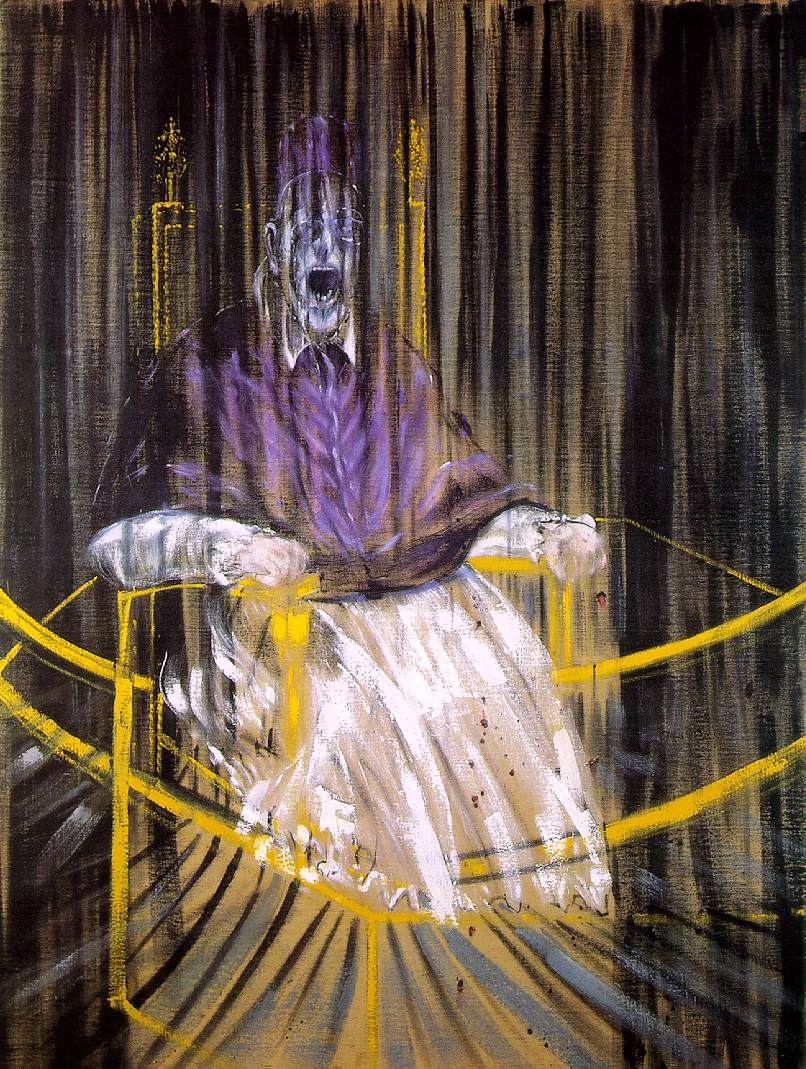
Francis Bacon, Study After Velazquez's Portrait of Pope Innocent X, 1953 (Velasquez's painting here.)
Tuesday, March 3, 2009
Islam in China
 Henry Corbin had a particular interest in the Sufism of Central Asia (see for instance The Man of Light in Iranian Sufism). Sachiko Murata and William Chittick have contributed enormously to the study of the relations between the realm of Islam and its eastern neighbors. The books below are indispensable for anyone with an interest in these issues.
Chinese Gleams of Sufi Light: Wang Tai-yu's Great Learning of the Pure and Real and Liu Chih's Displaying the Concealment of the Real Realm. by Sachiko Murata. With a New Translation of Jami's Lawa'ih from the Persian With a New Translation of Jami's Lawa'ih from the Persian by William C. Chittick. From the publisher: The first study in English of Islamic thought in China, this book shows that this tradition was informed by both Sufism and Neo-Confucianism; translations of two classic works are included. Chinese Gleams of Sufi Light investigates, for the first time in a Western language, the manner in which the Muslim scholars of China adapted the Chinese tradition to their own needs during the seventeenth and eighteenth centuries. The book surveys the 1400-year history of Islam in China and explores why the four books translated from Islamic languages into Chinese before the twentieth century were all Persian Sufi texts. The author also looks carefully at the two most important Muslim authors of books in the Chinese language, Wang Tai-yu and Liu Chih. Murata shows how they assimilated Confucian social teachings and Neo-Confucian metaphysics, as well as Buddhism and Taoism, into Islamic thought. She presents full translations of Wang's Great Learning of the Pure and Real--a text on the principles of Islam--and Liu Chih's Displaying the Concealment of the Real Realm, which in turn is a translation from Persian of Lawa'ih', a famous Sufi text by Jami. A new translation of Jami's Lawa'ih' from the Persian by William C. Chittick is juxtaposed with Liu Chih's work, revealing the latter's techniques in adapting the text to the Chinese language and Chinese thought.
The Sage Learning of Liu Zhi: Islamic Thought in Confucian Terms by Sachiko Murata, William C. Chittick and Tu Weiming. Foreword by Seyyed Hossein Nasr. From the publisher: Liu Zhi (ca. 1670–1724) was one of the most important scholars of Islam in traditional China. His Tianfang xingli (Nature and Principle in Islam), the Chinese-language text translated here, focuses on the roots or principles of Islam. It was heavily influenced by several classic texts in the Sufi tradition. Liu’s approach, however, is distinguished from that of other Muslim scholars in that he addressed the basic articles of Islamic thought with Neo-Confucian terminology and categories. Besides its innate metaphysical and philosophical value, the text is invaluable for understanding how the masters of Chinese Islam straddled religious and civilizational frontiers and created harmony between two different intellectual worlds. The introductory chapters explore both the Chinese and the Islamic intellectual traditions behind Liu’s work and locate the arguments of Tianfang xingli within those systems of thought. The copious annotations to the translation explain Liu’s text and draw attention to parallels in Chinese-, Arabic-, and Persian-language works as well as differences.
The Tao of Islam: A Sourcebook on Gender Relationships in Islamic Thought by Sachiko Murata. From the publisher: "The Tao of Islam is a rich and diverse anthology of Islamic teachings on the nature of the relationships between God and the world, the world and the human being, and the human being and God. Focusing on gender symbolism, Sachiko Murata shows that Muslim authors frequently analyze the divine reality and its connections with the cosmic and human domains with a view toward a complementarity or polarity of principles that is analogous to the Chinese idea of yin/yang. Murata believes that the unity of Islamic thought is found, not so much in the ideas discussed, as in the types of relationships that are set up among realities. She pays particular attention to the views of various figures commonly known as "Sufis" and "philosophers," since they approach these topics with a flexibility and subtlety not found in other schools of thought. She translates several hundred pages, most for the first time, from more than thirty important Muslims including the Ikhwan al-Safa', Avicenna, and Ibn al-'Arabi."
Mosque near Kashgar in Xinjiang Province, Western China.
Monday, March 2, 2009
Items of Interest
 An interview with Robert Bosnak on dreams, the imaginal world and Henry Corbin, on Australian Broadcasting's All In The Mind for February 28, 2009. Audio file and transcript available here. "Jungian psychoanalyst and psychotherapist Robert Bosnak is a dream worker. To him dreams are an ecosystem of imaginings - powerful bodily experiences populated by characters with their own intelligences. When you encounter the images of your dreaming mind - do you find one Self, or many?"
From the Transcript:
Natasha Mitchell: Let's climb inside this idea of embodied imagination that you've been working with for some 30 years now. Before we unpack how you use it with clients, where did the idea stem from?
Robert Bosnak: The idea has been around for a long, long time, I would say thousands of years. In my life it comes from a scholar of the visionary tradition in Islam and his name was Henry Corbin. And Corbin said that these entities that we encounter are intelligent, they carry their own intelligence, and that creative imagination is inherently intelligent. And this was a way of looking at the imagination that was particularly strong up until about 800 years ago, and then slowly imagination became the opposite of reality. And that's where I started. ...
Natasha Mitchell: Let's just go back to your inspiration from the French philosopher and professor of Islamic studies, of all things, Henry Corbin. You met him and he had a sense that the west had come to misconstrue the imagination.
Robert Bosnak: Yes, he always was talking about the great cataclysm that happened about 700, 800 years ago when we moved from a philosophy that was based on the fact that there were three realms of reality: the physical reality and the spiritual reality which now we would call the mental reality or the mathematical reality. There was a third reality in between and that was the reality of imagination. Then in about 700, 800 years ago that realm of the imagination as reality dropped out and it became just mind and matter. It moved from imagination being one form of reality into imagination being the opposite of reality—and that he found very tragic.
And From Farshid Kazemi I have the following additions to the bibliography:
Vahid Brown, "A Counter-History of Islam: Ibn 'Arabi within the Spiritual Topography of Henry Corbin," Journal of Ibn Arabi Society,Volume XXXII, Autumn 2002. (Brown adopts Wassertrom's methods and is critical of Corbin's approach to Ibn 'Arabi).
Ismael Velasco, "A Prolegomenon to the Study of Babi and Baha’i Scriptures: The Importance of Henry Corbin to Babi and Baha’i Studies," Baha'i Studies Review, Vol. 12, 2004. (Kazemi comments: "The Babi movement from which the Baha'i Faith emerged, is directly related to the Shyakhi movement (Shaykh Ahmad Ahsa'i), which occupied the last years of Corbin's life.")
Also worth noting is the 11 volume Routledge Library Mini Series on Islam & Sufism (all with hardcover library bindings) which contains a reprint of Corbin's Creative Imagination in the Sufism of Ibn Arabi. Details here.
Folio of calligraphy; 1541-1542 Kamal al-Din , (Iranian, died 974 A.H.)
Safavid period Iran or Afghanistan Purchase, F1929.63 Freer & Sackler Galleries
Friday, February 27, 2009
Corbin on Film and YouTube!
 The Eranos Foundation has posted a short trailer for the Film Eranos - 1951 at their website here. The film was directed by Willy Roelli, with script by Ximena de Angulo-Roelli and Willy Roelli and produced by the C.G. Jung Institute of Los Angeles. Henry Corbin appears on the path about 40 seconds into the trailer, shakes hands, turns to the viewer's right and goes down the stairs.
And many sincere thanks to Farshid Kazemi for sending this fascinating YouTube link for a ten-minute video of Henry Corbin narrating a film about Zoorkhaneh, the traditional Persian martial art and gymnastic exercise. (Photos as still practiced in Isfahan.) It is a delight to see and hear Corbin speak. I hope that someone with a better ear for French than I will translate the narration for us.
The photos of traditional zoorkhaneh below are by Antoin Sevruguin, whose photos of 19th century Iran can be accessed here.


Wednesday, February 25, 2009
Shah Abbas & the Remaking of Iran At The British Museum
 Shah 'Abbas: The Remaking of Iran
In association with The Iran Heritage Foundation
19 February – 14 June 2009In February 2009, the British Museum will open the first major exhibition to explore the rule and legacy of Shah ʿAbbas, one of the formative figures in the creation of modern Iran. Shah of Iran from 1587 – 1629 AD, he is remembered as one of the country’s most influential kings and a great military leader, ruling Iran at a time of political renewal, when it succeeded in positioning itself as a world power with a sharply defined national identity.
Shah ʿAbbas came to the throne in 1587, the fifth ruler of the Safavid Dynasty. Through trade, patronage and diplomacy Shah ʿAbbas fostered good relations with Europe and ushered in a golden period in the arts, commissioning beautiful works of art and grand architecture. He was a great builder and restorer of major monuments across the country and this architectural legacy will provide the context in which to explore the themes of his reign. The exhibition will feature luxurious gold-ground carpets, exquisite Chinese porcelains, illustrated manuscripts, watercolour paintings, metalwork and beautiful silks, objects similar to those Shah ʿAbbas gave to important religious sites across Iran. The famous calligrapher Ali Riza ʿAbbasi was a key figure throughout Shah ʿAbbas’s reign and examples of his work will feature prominently in the exhibition.
Shah ʿAbbas was a man with a strong sense of personal piety; though Shiism was declared the state religion of Iran in 1501, it was Shah ʿAbbas who consolidated its preeminence through the rule of law and the suppression of heterodox Shi'i sects and extremist dervish orders. The clerics in the circle of Shah ʿAbbas established the parameters of Shi'i orthodoxy and in so doing strengthened the role of the religious elite throughout Iran.
In association with The Iran Heritage Foundation, the exhibition will feature extraordinary loans, never before seen outside of Iran, alongside loans from Europe and the US. The exhibition is the third in a series examining empire and power in different parts of the globe and follows exhibitions on the First Emperor of China and the Roman emperor Hadrian.
"Shah ʿAbbas was restless, decisive, ruthless and intelligent. This exhibition will provide a rare opportunity to learn about this important ruler. Shah ʿAbbas was a critical figure in the development of Iran and his legacy is still with us today." Sheila Canby, curator of the exhibition
Details and Video HERE.
Shah 'Abbas and cup bearer, 1638, Safavid period
Ink and color on paper
H: 12.4 W: 9.0 cm
Probably Isfahan, Iran
Purchase, F1953.27 Freer & Sackler Galleries.
Tuesday, February 24, 2009
Recent News and Internet Gleanings - Update
 Now Available Online
Forthcoming in 2009
Patrick Laude. An Inner Islam: Insights in Massignon, Corbin, Guénon and Schuon. Albany, New York: State University of New York Press, 2009. Also of great interest are Dr. Laude's previous publications here. Table of Contents: Introduction; Sufism, Shi'ism, and the Definition of Inner Islam; The Qur'an; The Prophet; The Feminine; The Universal Horizon of Islam; The Question of War; Epilogue. From the Introduction: "The current study focuses on two intellectual lineages within the domain of Islamic studies: one ran from the seminal and "revolutionary" contribution of Louis Massignon (1883-1962) to Islamic Studies and was continued, along a significantly different line -more gnostic than mystical, more centered on Shi'ism than on Sunni Islam, by his student Henry Corbin (1903-1978); the second originated with the works of René Guénon (1886-1951) in metaphysics and the study of symbols, and was pursued in a distinct way by the religious philosopher Frithjof Schuon (1907-1998), whose notions of esoterism and tradition have played an influential role in redefining the nature of religious intellectuality among a significant number of contemporary Islamic and non-Islamic scholars. One of the theses put forward in the present book is that these two intellectual lineages are complementary in more than one way: on the one hand, Massignon and Corbin were both deeply rooted in the Christian tradition (Catholic in the former, Protestant in the latter) while being intensely involved in a scholarly redefinition of the academic study of Islam; on the other hand, both Guénon and Schuon developed their works outside of academic institutions and protocols, and were able to illuminate central facets of the Islamic tradition from the point of view of an actual participation in its spiritual economy. This book aims at introducing these four major figures to the English-speaking world by concentrating on their parallel and complementary contributions to a wider and deeper understanding of Islam as an intellectual and spiritual reality... This study addresses pressing questions that are most relevant to our present-day international predicament since studies in Sufism and Islamic spirituality have been widely recognized as most conducive to bridging the gap between Islam and the West, opening the way to fruitful dialogue between Islam and the Christian traditions, reconnecting a section of the younger Islamic intelligentsia with its own spiritual heritage, and providing original answers to the challenges of modernization and fundamentalism by unveiling and explaining the inner and universal dimension of Islam."Miscellaneous Notes:
- Afshin Afshari, The Earth is an Angel and Sohrawardi, at iranian.com.
- Thoughts on Corbin, the mundus imaginalis and visionary art by Eric Davis.
- A short note, Corbin and the History of Philosophical Thought in Iran by Mohammad Mehdi Khalaji at the Foundation for Iranian Studies.
- New Encyclopedia entry on Corbin here. (Much of this text looks suspiciously familiar to me...)
- The Institute of Ismaili Studies has a short biography of Corbin, with links to extended critical appraisals of three of Corbin's books by James Winston Morris: Cyclical Time and Ismaili Gnosis, Temple and Contemplation and History of Islamic Philosophy.
- Sabine Schmidtke on Philosophy in Persia. (On Seyyed Hossein Nasr & Mehdi Aminrazavi (eds.): An Anthology of Philosophy in Persia)
- Michael Vannoy Adams, The Islamic Cultural Unconscious in the Dreams of a Contemporary Muslim Man with references to Corbin.
- The Nature and Uses of the Fantastic in the Fictional World of Naguib Mahfouz by Nedal M. Al-Mousa. J. King Saud Univ., Vol. 5. Arts {2), pp. 105-120 (A.H. 1413/1993). with brief references to Corbin's interpretation of Khidr.
- Islamic Himmah and Christian Charity: An Attempt at Inter-Faith Dialogue by Dr. Özgüç Orhan; with brief mention of Corbin on Ibn 'Arabi.
Review: En Islam Iranien, reviewed by Earl Waugh, History of Religions Vol. 14, No. 4: 322-34 (May, 1975). (I can make this available online as a Google Document to anyone who will send me an email address. Otherwise it is available through JSTOR here for anyone who has access.)
Review: "Islamic Gnosticism: A Systematic Overview" by Peter J. Awn. Reviewed work: Creative Imagination in the Sufism of Ibn 'Arabī by Henry Corbin; Ralph Manheim, History of Religions, Vol. 23, No. 3 (Feb., 1984), pp. 280-282 (review consists of 3 pages).
Ionuţ Daniel Băncilă, "Some Aspects of Manichaeism as Religion of Beauty [in English]," Caietele Echinox (Romania) Issue no.12 /2007. "The study investigates the aspects of Beauty in Manichaean teachings, following certain intuitions by Henry Corbin and Ilya Gershevitch. The Living Soul imprisoned in this material word, the Manichaean dissemination of the Zoroastrian figure of the Virgin of the Good Deeds, as well as the descriptions of the otherworldly ”Gardens of Light” offer as many instances and occasions for the Manichaeans to praise Beauty, although always as situated above and out of this world."
Robert Bosnak, "My Eranos," (With several mentions of Corbin. Bosnak's own work has been profoundly influenced by Corbin). The San Francisco Jung Institute Library Journal, Winter 1987, Vol. 7, No. 1, Pages 25–29.
R. Marcotte, "Phenomenology through the eyes of an Iranologist: Henry Corbin," The Bulletin of The Henry Martyn Institute of Islamic Studies (1995)14,1-2,55-70. The journal's editor states that this article is both an "insightful and comprehensive analysis of the types and schools of thought which helped to shape the views of one of the best known Islamic scholars of the mid-twentieth century". "Although Corbin's methodological approach is devalued by many scholars today, Marcotte points out that his attempt to form a 'spiritual-type phenomenology' offered fresh and challenging ways of interpreting Islamic thought which, despite their inherent limitations, are still worthy of consideration".
Ali Shariat, "Henry Corbin and the Imaginal: A Look at the Concept and Function of Creative Imagination in Iranian Philosophy," Diogenes, Vol. 39, No. 156, 83-114 (1991)
Manuscript Page: Folio from an unidentified text; A winter scene of a Sufi and courtier conversing at a shrine.
mid-16th century. Safavid period. Qazvin or Tabriz, Iran. Freer & Sackler Galleries. Purchase, F1946.13.
Thursday, February 19, 2009
Idols & Icons
 Corbin writes that idolatry is "that two-faced spiritual infirmity which consists in either loving an object without transcendence, or in misunderstanding that transcendence by separating it from the loved object, through which alone it is manifested. These two aspects spring from the same cause: in both cases a man becomes incapable of the sympathy which gives beings and forms their transcendent dimension… The cause may be a will to power, dogmatic or otherwise, which wishes to immobilize beings and forms at the point where man has immobilized himself - perhaps out of a secret fear of the infinite successions of perpetual transcendences...and [the knowledge that]...to be faithful to the Angel is precisely to let ourselves be guided by him towards the transcendences that he announces." - Creative Imagination in the Sufism of Ibn 'Arabi, 134
The light that illuminates an icon comes from within and can reveal all of Creation, Corbin says, as "one immense iconostasis." "Idolatry consists in immobilizing oneself before an idol because one sees it as opaque, because one is incapable of discerning in it the hidden invitation that it offers to go beyond it. Hence, the opposite of idolatry would not consist in breaking idols, in practicing a fierce iconoclasm aimed against every inner or external Image; it would rather consist in rendering the idol transparent to the light invested in it. In short, it means transmuting the idol into an icon." - "Theophanies and Mirrors: Idols or Icons", (from - La philosophie iranienne Islamique aux XVIIIe et XVIIIe Siecles, 364)
The concept of the icon is central to Corbin's work. Any attempt to extend and develop the implications of his vision requires meditation on the meaning of the icon in the modern, and postmodern world. Such a project opens onto a vast landscape. For some pathways into this world there is a fascinating and suggestive syllabus for a course taught at Harvard Divinity School by Nicholas Constas in 2001. I have made this available online as a Google Document: Theology of the Icon. (The page has since disappeared from the internet, and I have not been able to find current contact information for Dr. Constas. If anyone can help with this I would appreciate it.) My tentative sketch of a project linking Corbin's work to aspects of contemporary theology, particularly the work of Jean-luc Marion, can be read here as a Google Document. Part of this larger project would involve consideration of theology and the arts, including film. I begin a selected Bibliography below.
Idols & Icons in Modern Theology
Jean-luc Marion, The Idol and Distance, God Without Being, The Crossing of the Visible, Being Given, In Excess and The Erotic Phenomenon.
Film as Icon
Gerard Loughlin, "Within the image : film as icon," in Johnston, Robert K. Reframing Theology and Film: New Focus for an Emerging Discipline. Grand Rapids, Mich: Baker Academic, 2007.
Gunnlaugur A. Jónsson, and Þorkell Ágúst Óttarsson. Through the Mirror: Reflections on the Films of Andrei Tarkovsky. Newcastle, U.K.: Cambridge Scholars Press, 2006.
Still image from Andrei Tarkovsky's Nostalghia.
Tuesday, February 17, 2009
Corbin & Platonism
 Henry Corbin's relation to Platonism and Neoplatonism is too varied and complex to be simply surveyed. But in the intellectual autobiography that Corbin provides in his late interview with Phillipe Nemo he describes something of the place that Platonism occupies in his spiritual and philosophical universe:
"Thus it was that one day, and I believe it was in the course of the year 1927-1928, I spoke with [Louis] Massignon of the reasons that had drawn me, as a philosopher, to the study of Arabic, and the questions I had with regards to the connections between the philosophy and mysticism of a certain Suhravardi (or at least of what I then knew of him by way of a rather meagre German resume)… That day Massignon received an inspiration from the Heavens. He had brought back with him, following a voyage in Iran, a lithographed edition of the principal work of Suhravardi, Hikmat al-Ishrâq: “The Oriental Theosophy”. With the commentaries it was a large volume of more than five hundred pages. “Here, he said to me, I believe that there is something in this book for you”. That “something” was the presence and company of the young Shaykh al-Ishraq and it is something that has not left me over the course of my lifetime. I have always been a Platonist (in the broadest sense of the term, of course). I believe one is born a Platonist, just as one can be born an atheist, a materialist, etc. It is a question of the impenetrable mystery of pre-existential choices. In any case, the young Platonist that I was could not help but burn at the very contact of he who had been the “Imam of the Persian Platonists”.
By my encounter with Suhravardi, my spiritual destiny in my passage through this world was sealed. This Platonism of his expressed itself in terms belonging to the Zoroastrian angelology of Ancient Persia and in so doing illuminated the path I had been searching for. Having made this discovery there was no more need to remain torn between Sanskrit and Arabic. Persia was right there in the centre, as median and mediating world. For Persia, the old Iran, is not only a nation or an empire, it is an entire spiritual universe, a hearth and meeting place in the history of religions. Moreover this world was ready to receive and welcome me. Henceforth the philosopher that I was passed into the rank and file of the Orientalists. Later on, after a long period of instructive experience, I was to explain why it seemed to me that in future it would be the Philosophers and not the Orientalists who would be the only ones capable of assuming responsibility for the “oriental philosophy.” - From the Interview with Phillipe Nemo
On Corbin's view, much of the enormous philosophical merit of Suhrawardi lies in the fact that he was the first to attempt to provide an ontological foundation for the reality of the mundus imaginalis, or the imaginal world. To provide such a foundation there must be available a cosmology which disappeared from mainstream Western experience with the triumph of the Aristotelianism of Averroes and the demise of the Neoplatonic cosmology of Avicenna, which Corbin dates to the 12th century. (On this see Avicenna and the Visionary Recital, Alone with the Alone, and The History of Islamic Philosophy).
Corbin held in high regard a figure nearly forgotten in Western philosophy except among specialists. The Neoplatonist philosopher Proclus born in Constantinople in 412 C.E., had an enormous influence on Platonist thought both East and West. Nicolas of Cusa and Hegel may be counted among his admirers. In his Commentary on Plato's Parmenides Proclus discusses the symbolic meaning of the dramatic setting of that dialogue. Corbin condenses this as follows:
"On the one hand there are the philosophers of the school of Ionia; [they] have studied every aspect of Nature, but they have scarcely given thought to spiritual matters... And there are, on the other hand, philosophers of the Italian school, represented above all by Parmenides and Zeno. These are exclusively concerned with things of the intelligible order. Between the two is the Attic school, which holds a middle position, because, under the stimulus of Socrates and Plato, a synthesis has been made between the findings of the other two schools... [T]he middle ground is symbolized by Athens, by whose mediation awakened souls ascend from the world of Nature to that of nous, intellect...
 "These [Ionians] are types of those souls who have descended into this world who are really in need of the aid of the daimons... This is why they abandon their house, the body: they emigrate to Athens..., they set out on the way from ignorance to knowledge, from agnosis to gnosis... They come for the Goddess, whose sacred peplum is carried in the theoria, or procession of the Panatheneia in celebration of victory over the Titans who unloose chaos. The aim of the Parmenides is precisely to unite everything to the One, and to demonstrate how all things proceed from the One. To come [to Athens] is, for them, to know that it is within the soul that the battle of the giants takes place, in which [Athene] is victorious. Athens is an Emblematic City." [Corbin, Emblematic Cities, 13-14]
Corbin draws on Proclus again, in passages where he describes the movements of the flower, the Heliotrope, as it keeps its face turned towards the sun. Proclus writes,
"For, in truth, each thing prays according to the rank it occupies in nature, and sings the praise of the leader of the divine series to which it belongs, a spiritual, or rational or physical or sensuous praise; for the heliotrope...[produces] a hymn to its king such as it is within the power of a plant to sing." [Alone with the Alone, 106].
Proclus saw clearly "the essential community between visible and invisible things." Corbin writes,
"This common essence...is the perception of a sympathy, of a reciprocal and simultaneous attraction between the manifest being and his celestial prince... Taken as a phenomenon of sympathy, this tropism in the plant is at once action and passion: its action...is perceived as the action...of the Angel...whose name for that very reason it bears... And this passion...is disclosed in a prayer, which is the act of this passion through which the invisible angel draws the flower toward him... But since sympathy here is also a condition and mode of perception...we must also speak of the poetic or cognitive function of sympathy..." [Alone with the Alone, 106-7]
(The above is excerpted from The World Turned Inside Out).
In an essay presented at the Eranos Conference in 1976, Corbin described the Angel Holy Spirit as the figure who shatters monolithic monotheism.This is because our only access to the One God is by means of our own individual Lord - we are destined to angelomorphosis as partners with our Angel. Each of us has a Lord as there are uncountable stars in the heavens. Corbin quotes with approval from the novel Erewhon Revisited, by the nineteenth century Anglican, Samuel Butler. The narrator tells us that the Erewhonians had been told about astronomy, and that
"all the fixed stars were suns like our own, with planets revolving round them, which were probably tenanted by intelligent living beings... From this they evolved the theory that the sun was the ruler of this planetary system, and that he must be personified, as they personified the air-god, the gods of time and space, hope, justice, and the other deities... They retain their old belief in the actual existence of these gods but they now make them all subordinate to the sun. The nearest approach that they make to our own conception of God is to say that He is the ruler over all the suns throughout the universe - the suns being to Him much as our planets and their denizens are to our own sun. They deny that He takes more interest in one sun and its system than another. All the suns with their attendant planets are supposed to be equally His children, and He deputes to each sun the supervision and protection of its own system. Hence they say that though we may pray to the air-god & etc, and even to the sun, we must not pray to God. We may be thankful to Him for watching over the suns, but we must not go further."
This "pluralist cosmic theism" sketched by Butler is foreshadowed, according to Corbin, by the late Neo-Platonist Syrianus, who was Proclus' master. Syrianus wrote,
 "If one reaches a grasp of the Sun and the Moon, each of the properties that this definition will have attributed to each of these beings, will belong to all the suns (and all the moons), even where there would be ten thousand suns, for in their Idea they would all be identical one with the others."
This grand cosmology explains why every encounter with the Angel, as Corbin says,
"puts us in the presence of a known and limited God (known because limited, and vice versa): Angel-Holy-Spirit, Angel-Adam, Sun of our world, - and of a God unknown and unknowable, God of Gods, of which all the universes and all the galaxies are the sensorium."
(The above is excerpted from After Prophecy).
In Apophatic Theology as Antidote to Nihilism Corbin writes in more detail about the connections between Proclus and the pluralist metaphysics he is describing:
"Clearly, we can now see that what is at issue here is what has traditionally been referred to in philosophy as the « principle of individuation ». Once more citing our article: « We know that the dominant ontology and anthropology of Western humanity are centered quite precisely upon the invincible affirmation of the reality of the ego (in all its forms) and of the reality of individual forms in general. This belief seems to us to be correlative to a mutilation of being », because it has its origin and essence in « negativity or the principle of individuation identified with the reality principle ». Here again, the adoption of such a position appears to us a very serious matter. Such a decision is marked, indeed stained, by the same confusion denounced by our Iranian metaphysicians of the Avicennian tradition, to whit, the confusing of the transcendental unity of Being or Existence (wahdat al wojud) with an impossible, contradictory and illusory unity of existents or existent being(s) (mawjud, Latin ens). These Avicennian metaphysicians vigorously denounced this same confusion committed by the practitioners of a particular brand of Sufism, one that would occupy precisely the position defined by Georges Vallin as belonging to Oriental humanity. On the other hand, on this point our Iranian philosophers are in agreement with the metaphysics of Being professed by the great neoplatonist, Proclus : [I am referring to] the connection or relationship between the Henad of Henads and the Henads that lend their unicity to the multiplicity of singular existents that they pose in the act of being by making each in its turn one being, [or, by investing each in turn with its own singularity]. For Being can only be existent within the multiplicity of individual beings. To affirm the reality of individual forms is therefore in no way a mutilation of Being, but is on the contrary its revelation and fulfillment. To confound the order of Being with the order of beings is a fatal confusion. The principle of individuation is a positioning and positing of the existent. If one sees in this nothing but negativity then one has set one's course towards metaphysical catastrophe.
….
I had the privilege, last May, of participating in a conference at the Institute of Philosophy at the University of Tours, which had as its theme "The Human and the Angel". Simply pronouncing such a theme these days sounds like a challenge directed towards common opinion and received ideas. Indeed, it is because it is a challenge that such a theme contains and conceals precisely that secret path upon which one may find the answer to the question I am now posing: "What is the person?" On this path, it is to our Iranian philosophers --to whom I have long owed a great deal-- that I will appeal in showing how the answer to this question appears to me, and finally how I see the message of Iranian philosophy as it applies to our present conference.
 I find this answer by referring to a concept that is fundamental to the anthropology of pre-Islamic Zoroastrian Iran, that of the Fravarti (the correct pronunciation of that which is written fravashi ; and in Persian forûhar). In Zoroastrianism the word designates the celestial archetype of each being of light --their superior Self, their guardian Angel. This celestial archetype belongs to their very being because it is each one's singular celestial counter-part. The concept is so fundamental to Zoroastrian personalism --as the very law of being-- that Ohrmazd himself, his Archangels (Amahraspandân) and all the Angel-Gods (Izad, cf. the Dii-Angeli that we find in Proclus) also have their respective fravartis. It is this fravarti that gives the person his or her true dimension. A human person is a person only by virtue of this celestial, archetypal, angelic dimension. This angelic dimension is the celestial pole without which the terrestrial pole of its human dimension is completely depolarised, reduced to vagabondage and perdition. The drama then, would be the loss of this pole, the loss of this celestial dimension, because the entire fate or destiny of the person is engaged in this drama."
In The Paradox of Monotheism Corbin expands again on negative theology and the "polytheism" of Proclus:
"The Parmenides for Proclus is the Theogony that his very own "Platonic Theology" was to elaborate upon further. Plato's Parmenides is in some ways the Bible, the Sacred Scripture of the eminently Neoplatonic, negative, apophatic theology. Negative theology, via negationis (tanzih in Arabic) rejects the cause beyond all causes, the absolute One beyond all the Ones; being beyond all existent beings etc. Negative theology is presumed precisely by the investment of being in all existent beings of the One in the Many etc. All the while appearing to destroy affirmative theology of the dogmatic consciousness, it is negative theology that in effect safeguards the truth it bears; and this is the second instance of the "paradox of monotheism". The term is well known to both Greek and Arab Neoplatonists. In both cases it is resolved by simultaneity, the at once present [comprésent] One-God and the many divine Figures. Comparison of the process in these two cases has yet to be attempted.
Let us say that in the system envisioned by Proclus, there are the One and Many Gods. The One-God is the henad of henads. The word One does not name what it is but is the symbol of the absolutely Ineffable. The one is not One. It does not possess the attribute One. It is essentially unificent [unifique], unifying, constitutive of all the Ones, of all the beings that can only be existents by being each time an existent, i.e. unified [made one], constituted in unities precisely by the unifying One. This sense of unifying of the One is what Proclus meant by the word henad [principal of unity]. When this word is used in the plural form, it does not denote productions of the One but manifestations of the One, "henophanies". Those in addition to Unity, are the divine Names and these Names govern the diversity of beings. It is from beings that are their partners that it is possible to know the divine substances, that is to say the Gods that are themselves inconceivable. We have already compared the theory of the divine Names and celestial hierarchies in Proclus and in Pseudo-Dionysius the Areopagite.
 There is much to be learned from an in-depth comparison of the theory of divine Names and theophanies that are the divine Lords -- I mean to say the parallelism between Ibn Arabi -- the ineffability of God who is the Lord of Lords and the multiple theophanies that constitute the hierarchy of the divine Names -- and Proclus: the hierarchy originating in the henad of henads manifested by these henads themeselves, and permeating all levels of the hierarchies of being: there are the transcendant Gods; the intelligible Gods (at the level of being); the intellective-intelligible-Gods (at the level of life); the intellective Gods (at the level of intellect); the hypercosmic Gods (leaders and assimilators); the intracosmic Gods (celestial and sub-lunar); there are the superior beings: archangels, angels, heroes, daimons. However, these multiple hierarchies presuppose the One-Unique that transcends the Ones, because it unifies them; the being that transcends existents because it essentiates them; life that transcends the living because it vivifies them. In Proclus, harmony results from the encounter in Athens between philosophers of the Ionian School from Clazomenea and those of the Eleatic School, namely Parmenides and Zeno of Elea - all gathered for the Panathenian Festival. In Ibn Arabi's school of thought, harmony is achieved by the confrontation between monotheism of the naïve or dogmatic consciousness and theomonism of the esoteric consciousness; in short the acceptance of the exoteric or theological tawhid (tawhid wojudi). This is precisely the form that the paradox of the One and the Many takes in Islamic theosophy." - Henry Corbin
 In the mystical theology that Corbin describes for us, the vision of the Angel is a revelation of divine Love and Beauty. The beauty of the Divine can only manifest in the form of creatures. Whenever we encounter a being of beauty we are seeing the Beauty of the transcendent Lord. Human and divine beauty are not opposed. Corbin wants to avoid any hint of an ascetical Christian moralism that would deny divine meaning to human love or to the sensuous beauties of creation. The experience of love is profoundly sacramental. It is the sacred occasion where Flesh is made holy and the means by which the opposition between Spirit and Matter is abolished. He says,
 "In place of the negative connection that we habitually understand between Christian asceticism and the Greek consciousness of beauty, it is necessary to speak here of a valorization that confers a prophetic function on beauty."
Beauty is the essential divine attribute and human love leads to the vision of the unique Lord who is the Angel. Such a love is purified of all merely carnal, possessive instincts, all utilitarian ends, all obsessions and neurotic "needs." Such a chaste love is an ecstasy before the revelation of divine beauty in a being of beauty, a theophany. At the limit of this experience of love is the experience of Divine Unity: The Divine being is simultaneously the Loved, the Lover and the Love itself.
 Selected Bibliography and Internet Resources
* The central text in Corbin's work is En Islam Iranien Vol 2: Suhrawardi and the Platonists of Persia (English translation). Available in the original French from amazon.fr here.
* On Suhrawardi see this excellent summary review with a link to this superb Bibliography by Dr. Stephen Lambden, including many of Corbin's critical editions and works.
* Parviz Morewedge, Neoplatonism and Islamic Thought, SUNY Press, 1992.
* On Avicenna: this excellent website.
* On NeoPlatonism.: Introductory Article by Edward Moore of the St. Elias School of Orthodox Theology.
* Pauliina Remes, Neoplatonism, University of California Press.
* International Society for Neoplatonic Studies
* On Plotinus
* Pierre Hadot, Plotinus, or The Simplicity of Vision, 1994.
* Margaret Miles, Plotinus on Body and Beauty, 1999.
* On Proclus, see this excellent bibliography
Illustrations
1 Bust of Plato.
2 The sculpture is from the east frieze of the Parthenon (East V, 31-35): The presentation of the peplos of Athena. British Museum. Image from Institut für Klassische Archäologie.
3 Cluster of Galaxies from the Hubble Space Telescope.
4 Faravahar (Fravarti) from Persepolis.
5 Archangel Michael, Folio from Aja'ib al-makhluqat (Wonders of Creation) by al-Qazvini; Archangel Michael (Mikayyil); early 15th century. Iraq or Eastern Turkey. Al-Qazwini's Wonders of Creation is an encyclopedic work on the cosmology and geography of the world. The text was composed in thirteenth-century Iraq, and is divided into two main sections that discuss heavenly and earthly bodies. According to al-Qazwini, the angel stands on the overflowing sea of the seventh heaven and is in charge of humans and the presence of wisdom and knowledge in souls. His attendants rule over the entire world and have power over resurrection and generation. The representation of the archangel, dressed according to fourteenth-century norms, also implies a certain humility and gentleness, thus adding to our understanding of this powerful, heavenly creature.
6 Two Lovers, Safavid period (1501-1722), Attributed to Iran, court of Shah `Abbas the Great (r. 1588-1629)
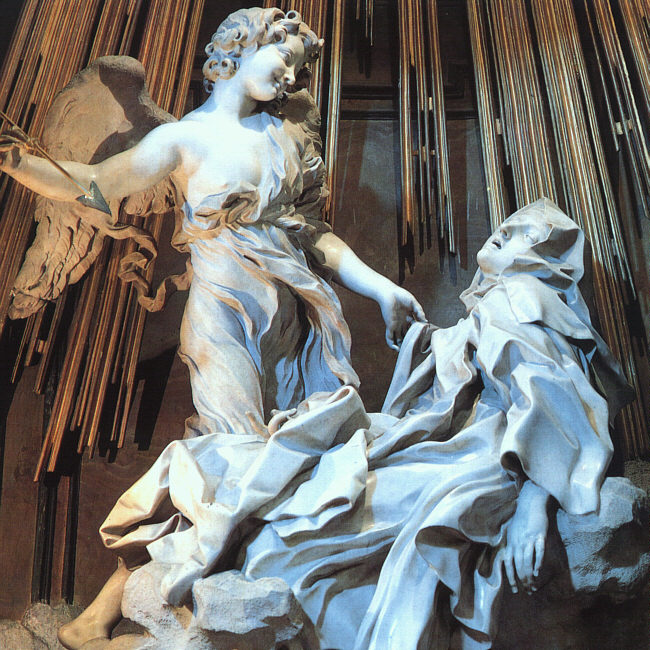
7 Gianlorenzo Bernini, The Ecstasy of St. Theresa, 1647-52.
8 Auguste Rodin, Cupid & Psyche, 1905
Thursday, February 12, 2009
Symposium on Islamic Art - Cordoba, November 2009
 HAMAD BIN KHALIFA SYMPOSIUM ON ISLAMIC ART
And Diverse Are Their Hues: Color in Islamic Art and Culture
November 2-4, Cordoba, Spain
Organized by Sheila S. Blair and Jonathan M. Bloom
Full Details at their website.
The Program includes Samir Mahmoud on Color, Symbolism, and the Mystic Quest: the Spiritual Exegesis of Color in Sufism. Mahmoud is the author of From Heidegger to Suhrawardi: An Introduction to the Thought of Henry Corbin
Subscribe to:
Posts (Atom)


 Posts