Monday, March 18, 2019
Corbin & Poetry
Here is a link to a new working document I'm putting together on Henry Corbin's relation to Art & Poetry worldwide.
If you have additions or corrections please don't hesitate to contact me:
tcheetham@gmail.com
Visionary Recitals After Corbin
A Source Book
Tom Cheetham


Sunday, March 3, 2019
Corbin on Tolkien (originally posted in 2009)

"…Is it right to speak, as is often the case, of the pessimism of Gnosis? Such a judgment assumes that one has forgotten what the struggle of the Gnostic is about, what its origin is and what its outcome will be. This outcome makes it clear that if gnosis despairs of this world it is in the form of a desperatio fiducialis, a confident desperation… Where then is the optimism of this despair rooted?
For this optimism is in contrast with the grandiose but hopeless perspective of the heroic Nordic epic, with its eschatological vision of Ragnorak, the Fate of the Gods. There too the gods are the allies of men, and both together are partners in the same struggle against monstrous cosmic powers; but they know that they will finally be killed by these monstrous powers, and that after that the world will be destroyed. “The victors are Chaos and Insanity, but the Gods who will be defeated consider that the defeat is not a refutation… They offer absolute resistance, perfect, because without hope…” [W.P. Ker, The Dark Ages, 1904] Certainly the predominance of Darkness is not a refutation of the Light. But inversely, when the Light prevails over Darkness, is this a refutation of Darkness? Does Darkness allow itself to be refuted? Will the Light simply be its refutation?
I would like to reply to these questions with the aid of a recent work, Tolkien’s Lord of the Rings. I think that this is the first time since the conclusion of the Grail cycle that there has appeared in the West an epic at once heroic, mystic and Gnostic, the narrative events of which can enchant the wise both young and old because they will recognize its hidden meaning. Throughout the epic is dominated by the theme of the maleficent Ring mislaid in the country of Light. This ring continually incites the best among the beings of the Light to submit to the temptation it represents: the will to power. Indeed the temptation is great to use the evil will to power in the service of the Light. Moreover it is not in the Darkness that the temptation of the Darkness can become virulent, but in the realm of light. It is in the world of Light that the drama, which for all gnoses initiates cosmogony, has its origin.
But the world of Light absolutely must not resort to the evil will to power in order to ensure its victory over Darkness. To resort to that desire would be to ensure the triumph of the Darkness. It is not even enough to hide, to bury the Ring in some secret and unknown place in the realm of Light: its malefic influence will continue to operate. It must be not simply rejected but destroyed. But to destroy is a negative action, and the world of Light does not permit negativity.
The weapon of the light is of another order: it is to compel the Darkness to destroy itself, to accomplish its negation by the negation of its own negativity. To destroy the evil Ring, representative of the will to power, is to cast it back into Darkness, so that the Darkness destroys what has issued from it. A fearless hero, overcoming the most terrifying apparitions and traps, must carry the Ring back to its place of origin: to the furnace which is in the crater of the mountain of the Lord of the Shadow, in the land of Darkness. When the hero finally casts the Ring into the abyss, the world of Light is delivered from the evil will to power. This is the theme of Tolkien’s epic.
What the hero performs in this epic appears as a Quest in reverse of the Quest for the Holy Grail. But at the same time this Quest seems to be a necessary prelude, a Quest without which the Quest for the Grail cannot succeed. Parsifal’s speech, at the end of Book XV of Wolfram von Eschenbach’s epic, warns us that “no one can obtain the Grail except him whom God himself has appointed.” From this time. Wolfram tells us, “this word traveled across all lands, that no one could win the Grail by fighting for it, and so, many knights gave up searching for it.” For the Elect are not appointed by God to become ‘possessors’ of the Grail by force of arms. They must first of all renounce such possession, and this is to destroy their will to power through their own powerlessness. Only then can they attain the vision of elsewhere to which they must commit themselves. “This is why the Grail still remains hidden to all eyes,” Wolfram tells us.
We know what he means: it is hidden to all eyes of the flesh. The epic of the Grail ends in occultation. Parsifal carries it back to a mystical East…that is not on our maps, or it is taken from this world and withdrawn to the “spiritual Palace” (Galahad). Must we then speak of the pessimism of the Grail cycle? To do so would be to forget…what is the nature of the struggle that opens to way towards the Grail, and what the eyes are that perceive this way. The world in which the Grail is occulted is still visible to the eyes of fire, and that is why there will always be secret Knights-Templar who pursue the Quest for the Grail… [F]or it is not with the weapons of the will to power but through knightly service that one is a partner of a God in exile and that one sets free the sparks of light imprisoned in… the world of shadows and defilement…"
(Translation slightly altered.)
Orodruin, Mount Doom, Mordor.
Thursday, February 28, 2019
Online Corbin Course #2 - Sign up Now!!!

Visionary Recitals
Henry Corbin and the Angelic Function of Beings
An Online Course with Tom Cheetham
We meet for 3 hours, once a week for 8 weeks.
Tuesdays 3-6 pm New York Time
March 12 - April 30, 2019
Register or inquire about details by contacting me directly:
tcheetham@gmail.com
Tuition:
$50 per live class session - $400 for the course
*Sliding scale—reduced rates available*
Payment via Paypal
Audio & Video recordings available for registered students.
You do not have to attend a live session.
Tuesday, February 5, 2019
TA’WIL: IN PRACTICES OF LIGHT Narjis Mirza

Narjis Mirza, Auckland University of Technology
Performance Philosophy Journal Vol 4 no 2, 2019
Image 1: Narjis Mirza, Light Installation 2018 (photo credit Sam Hartnett)
Light in its unqualified sense bears many meanings according to the multitude, some meanings are equivocal, some literal and some metaphorical, such as light of the sun, light of the moon, light of the lamp, the light of intellect, the light of faith, the light of piety, the light of a ruby, the light of gold, the light of turquoise. (Sadra 2004, 35)
It is through light that we are able to reach out to the not-yet known, to the indistinct potential and the unrealised. Artist Derek Ventling suggests that light is a source for “continuous negotiation with our surroundings” (Ventling 2017, 19). The ephemeral force of light contours our perception and defines our physical and spatial surroundings. Light is significant for both art practice and philosophy. In the book The Practice of Light, Sean Cubitt ruminates on the performance of light and the “potential that lies curled up inside.” Light begins in the invisible black and performs as a mediation between the known and unknown world (2).
Sadr-ud-Din Muhammad Shirazi, famously known as Mulla Sadra, a 17 th-century Persian Muslim philosopher, begins his exegesis on the “light verse”[1] of the Quran by contemplating the multitude of meanings of light. Sadra draws light away from its physical temporal meanings towards a divine spiritual entity (al Munawwir) “that realizes all existence” (Sadra 2004, 43). Sadra equates existence with light by saying “the reality of light and existence is the same thing” (21).
There is a long history for the use of light to present God’s presence towards creation. Cubitt tracks a genealogy of such a light in early artworks dating as far back as the 1400s. He writes, “Light was a perfect symbol of God illuminating everything yet itself invisible” (Cubitt 2014, 46). As a contemporary artist, I use light as a research tool to trace the resonance of the unseen. For me, light is a medium of immense potential, that structures our perception of the visual world. Light is in constant movement, transient and transcendental.... READ THE ARTICLE
Thursday, January 3, 2019
Corbin and Poetry in America: another in the endless series...

Diane di Prima:
Visionary Poetics and the Hidden Religions
David Stephen Calonne
You can read pp 171-174 on Henry Corbin at Google Books
Saturday, December 22, 2018
Trifecta! Corbin / Twombly / Olson
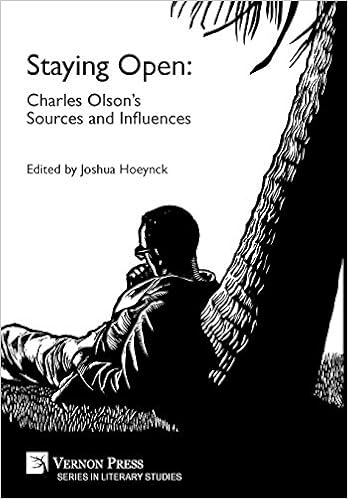
Staying Open: Charles Olson’s Sources and Influences
Joshua S. Hoeynck (Ed.)
Acknowledgements
Introduction
Chapter 1 Projective Verse and pedagogy
Michael Kindellan
Chapter 2 Olson’s poetics and pedagogy: influences at Black Mountain College
Jeff Gardiner
Chapter 3 Olson’s Dérive, near-far Boulez
Michael Jonik
Chapter 4 “By ear, he sd.”: open listening with Charles Olson and John Cage
Alexander Ruggeri
Chapter 5 “Mu-sick, mu-sick, mu-sick”: Olson’s stammer and the poetics of noise
Seth Johnson Forrest
Chapter 6 Shadow on the rock: morphology and voice in Olson’s later Maximus poems
Jeff Davis
Chapter 7 Charles Olson and his “post-modern” exploration
Joshua Gardner
Chapter 8 “what insides are”: history—gravitational and unrelieved
Kirsty Singer
Chapter 9 Revising the stance of “Projective Verse”: Charles Olson’s ecological vision of Alfred North Whitehead’s cosmology
Joshua Hoeynck
Chapter 10 Olson, Peirce, Whitehead, and American process poetics
Daniel D. Fineman
Chapter 11 Maximus and Aboriginal Australia: antipodean influences on the archaic proprioceptive epic
Nathanael Pree
Chapter 12 An Archaeologist of Morning in the Mayab, 1951
Dylan Clark
Coda
Index
Tuesday, December 18, 2018
The Persianate World
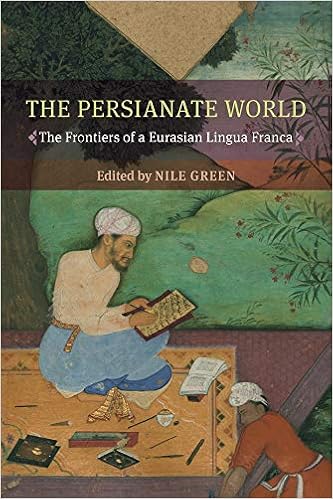
Green, Nile. [Ed.]
The Persianate World: The Frontiers of a Eurasian Lingua Franca.
University of Californai Press,
2019.
"Persian is one of the great lingua francas of world history. Yet despite its recognition as a shared language across the Islamic world and beyond, its scope, impact and mechanisms remain underexplored. A world historical inquiry into pre-modern cosmopolitanism, The Persianate World traces the reach and limits of Persian as a Eurasian language in a comprehensive survey of its geographical, literary, and social frontiers. From Siberia to Southeast Asia, and between London and Beijing, this book shows how Persian gained, maintained, and finally surrendered its status to imperial and vernacular competitors. Capturing the Persianate as process, fourteen essays trace Persian's interactions with Bengali, Chinese, Turkic, and Punjabi, to identify the forces that extended 'Persographia,' the domain of written Persian. Spanning the ages' expansion and contraction, The Persianate World offers a critical survey of both the supports and constraints of one of history's key languages of global exchange"

The Persianate world. Rethinking a shared sphere.
Abbas Amanat; Assef Ashraf [Eds.]
Leiden : Brill 2018.
Iran studies, 18.
"The Persianate World: Rethinking a Shared Sphere is among the first books to explore the pre-modern and early modern historical ties among such diverse regions as Anatolia, the Iranian plateau, Central Asia, Western Xinjiang, the Indian subcontinent, and southeast Asia, as well as the circumstances that reoriented these regions and helped break up the Persianate ecumene in modern times. Essays explore the modalities of Persianate culture, the defining features of the Persianate cosmopolis, religious practice and networks, the diffusion of literature across space, subaltern social groups, and the impact of technological advances on language. Taken together, the essays reflect the current scholarship in Persianate studies, and offer pathways for future research."
Sunday, December 16, 2018
Tom Cheetham - Upcoming Events

February 15, 2019
The Flame of Things
Lessons in Pyrotechnics
Lexington Community Education
Lexington, Massachusetts
REGISTER
April 26 & 27, 2019
The Spirit of Fire and the Missing Yellow:
Imagination & the Lumen Natura
C.G. Jung Society of Montreal,
Montreal, Quebec
September 13-15, 2019
The Rowe Center
Rowe, Massachusetts
Attending to Earth
An Approach to a Psychoecology
Monday, December 10, 2018
New from Mohammad Rustom
THIS IS A REALLY INTERESTING INTERVIEW:
Neo-Orientalism and the Study of Islamic Philosophy:
An Interview with Professor Mohammed Rustom
Mohammed Rustom and Soroosh Shahriari
Journal of Islamic and Muslim Studies,
Vol. 3, No. 1 (May 2018), pp. 112-119
After attending Professor Rustom's advanced seminar on Ibn Sina at Carleton University in winter 2017, doctoral candidate Soroosh Shahriari of McGill University, Canada, "brought up the possibility of. .. [posing] some 'hard' questions concerning the contemporary study of Islamic philosophy." Rustom's in-depth knowledge of the method and spirit of traditional Islamic education and Islamic metaphysics helps us navigate the complexities inherent in the study of Islamic philosophy in the modern academy.
ʿAyn al-Quḍāt between Divine Jealousy and Political Intrigue
Journal of Sufi Studies 7 (2018) 47–73
Mohammed Rustom
Carleton University (Canada)
mrustom@connect.carleton.ca
Abstract Modern scholars have been interested in the great Persian Sufi martyr ʿAyn al-Quḍāt Hamadānī (d. 525/1131) for over six decades. Despite this fact, many aspects of his life and thought still remain terra incognita. Our knowledge of the circumstances sur-rounding his death is a case-in-point. Although we have a fairly good understanding of the factors which led to ʿAyn al-Quḍāt’s demise, there are other “causes” which simul-taneously complement and problematize this understanding. Chief amongst these are the underlying reasons for ʿAyn al-Quḍāt’s critique of the Seljuk government, as well as something which ʿAyn al-Quḍāt saw as a more subtle cause for his death several years before his anticipated state execution.
Sunday, December 9, 2018
Corbin Course Deadline
Register by December 20 to guarantee your place.
tcheetham@gmail.com

Henry Corbin - Turkey, 1942
All the World an Icon
An Introduction to the Thought of Henry Corbin
An Online Course with Tom Cheetham
We meet once a week for 8 weeks in either of two sections:
Section 1: Tuesdays 2:30pm EST [7:30pm GMT] !
Begins January 8, 2019
- for those in Europe -
Section 2: Wednesdays 7pm EST [12am GMT] !
Begins January 9, 2019
- for those in W. Hemisphere -
Register or inquire about details by contacting me directly:
tcheetham@gmail.com
Tuition: $50 per 90-minute live class session. $400 for the course.
*Sliding scale: No one will be turned away because of inability to pay.*
Tuesday, December 4, 2018

"The Orientalist" - A Documentary About Henry Corbin!!!!!

From the Tehran Times
Orientalist Henry Corbin subject of “The Eastern” director’s new film
December 2, 2018
TEHRAN – Masud Taheri, the Iranian director of the documentary film “The Eastern” about Japanese expert on Islam Toshihiko Izutsu, plans to make his new film on French philosopher, theologian and Orientalist Henry Corbin (1903-1978).
The film entitled “The Orientalist” will be co-produced by the Documentary and Experimental Film Center and Chehrdad Film, Taheri said in a press release on Saturday.
“The documentary is typically a sequel to ‘The Eastern’ and will focus on the thoughts of Henry Corbin who, like Izutsu, was tracking illumination in the East,” he added.
“Iran was the common ground between the two philosophers who came together in the country before the victory of the Islamic Revolution for most of the months of a year to discuss various issues,” he stated.
Shooting of the documentary will begin in the near future and is expected to be completed in late spring.
Joan Copjec on Corbin & Schelling and more!

Cloud, Precinct of the Theological-Historical
Joan Copjec
Psychoanalysis and History, Volume 20 Issue 3, Page 277-291,
ISSN 1460-8235
Available Online Nov 2018
Keywords: imaginal world, Cloud, tautegory, expression, Corbin, Lacan, Laplanche, Freud, Schelling, abyss, Abgrund, après-coup, Nachträglichkeit, tautegory
(https://doi.org/10.3366/pah.2018.0269)
Abstract
Regarded by many as the pre-eminent Islamicist of the twentieth century, Henry Corbin is also the subject of much criticism, aimed primarily at his supposed overemphasis on the mythological aspects of Islamic philosophy and his idiosyncratic privileging of the concept of the imaginal world. Taking seriously an unusual claim made by Steven Wasserstrom in Religion after Religion that the redeployment of Schelling's concept of tautegory by Corbin reveals all that is wrong with his work, this essay seeks to defend both the concept and Corbin's use of it. Developed by Schelling in his late work on mythology, the concept of tautegory turns out to be, for historical and theoretical reasons, a revelatory switch point. Not only does it make clear why the imaginal ‘locus’ is key to understanding the unity of God – the oneness of his apophatic and revealed dimensions – it also gives us profound insights into the links connecting Islamic philosophy, German Idealism, and psychoanalysis, which all take their bearings from the esoteric or mystical idea of an unconscious abyss.
Sunday, December 2, 2018
THE FIVEASH LEGACY LECTURE with Tom Cheetham
Lexington Community EducationLexington, Massachusetts
February 15, 2019, 7pm
The Flame of Things: Lessons in Pyrotechnics
[I]maginal love … does not reach only towards unifying as we have been so tediously taught. When we love, we want to explore, to discriminate more and more widely, to extend the intricacy that intensifies intimacy.—James Hillman
Many of us have lost contact with the primal immersion in reality where all things are marvellous and strange, both familiar and unexpected. That world is saturated with an incandescent fire, as in the first morning of creation. There are many ways to recover the beginner’s mind that reveals the flame of things. If we imagine the fiery heart to be the organ of both Imagination and sensation, as certain traditions have held, we can know the nature of our task. Fire is magical and dangerous. It is spirit and life, conflagration and despair. It is hearth and hellfire both. Our challenge is to master the pyrotechnics of art and of alchemy, of knowledge and of love. Then we might enact new forms of life that reveal the wonder and mystery in all things. In this lecture author Tom Cheetham will try to help us take a few small steps towards that end.
 Tom Cheetham is the author of five books on the imagination in religion, psychology, the arts and sciences, and one book of poems. He is a Fellow of the Temenos Academy in London, and was Adjunct Professor of Human Ecology at the College of the Atlantic, and Associate Professor of Biology and Environmental Studies at Wilson College. He teaches and lectures in the US and Europe. He and his wife live on a homestead in rural Maine. They have two grown children.
Wednesday, November 28, 2018
Online Class: An Introduction to Henry Corbin - Jan-Feb 2019
Henry Corbin - Turkey, 1942
All the World an Icon
An Introduction to the Thought of Henry Corbin
An Online Course with Tom Cheetham
We meet once a week for 8 weeks in either of two sections:
Section 1: Tuesdays 2:30pm EST [7:30pm GMT] !
Begins January 8, 2019
- for those in Europe -
Section 2: Wednesdays 7pm EST [12am GMT] !
Begins January 9, 2019
- for those in W. Hemisphere -
Register or inquire about details by contacting me directly:
tcheetham@gmail.com
Tuition: $50 per 90-minute live class session. $400 for the course.
*Sliding scale: No one will be turned away because of inability to pay.*
!!!PODCAST PATRON DISCOUNT!!!
DEDUCT 12 MONTH'S PATRONAGE FROM TUITION
Recordings of the live classes will be available for all registered students.
You do not have to attend a live session.
Texts & Schedule
Henry Corbin. Alone with the Alone: Creative Imagination in the Sufism of Ibn'Arabi. Translated by Ralph Manheim,Princeton: Princeton University Press / Bollingen Series XCI, [1969], 1997.
Tom Cheetham. The World Turned Inside Out: Henry Corbin and Islamic Mysticism, Spring Journal Books, New Orleans, LA, 2003. Suggested reading.
WEEK
|
Corbin
|
Cheetham
|
1
|
Introduction
|
Chapter 1
|
2
|
Chapter I
|
Chapter 2
|
3
|
Chapter 2
|
Chapter 3
|
4
|
Prologue & Chapter 3
|
Chapter 4
|
5
|
Chapter 4
|
Chapter 5
|
6
|
Chapter 5
|
Chapter 6
|
7
|
Chapter 6
|
Chapter 7
|
8
|
Epilogue
|
Chapter 8
|
Subscribe to:
Posts (Atom)


 Posts
Posts


