Friday, September 5, 2008
Kathleen Raine on Henry Corbin
 "'Tradition' as understood by followers of Guénon, for all their insistence on 'revealed' knowledge and the metaphysical order, seem unconnected to the living source itself and highly suspicious of those very inner worlds from which it ultimately derives. That inner world both Blake and Jung affirm and both appreciated the value of the alchemical symbolism and the alchemical 'work' of self transformation ... I find what is missing from the work of Guénon and his followers in the writings of Henry Corbin...whose term 'imaginal' describes the order to which Blake's Prophetic Books belong - as it does Jung's world of psyche and its archetypes. Corbin understands that sacred tradition is itself without meaning outside that context... Corbin thus harmonizes what one might call the Protestant vision of Blake and Jung, their insistence on discovering the truth 'within the human breast,' and the recognition of a tradition of sacred knowledge embodied in every civilization and all mythologies".
Kathleen Raine, Golgonooza: City of Imagination. Last Studies in William Blake, Lindisfarne Press, Hudson, N.Y., 1991, 4.
William Blake. Jacob's Ladder. Watercolor, c. 1800. British Museum. From wikimedia.


Henry Corbin in Temenos and The Temenos Academy Review
We have this complete list courtesy of Stephen Overy of the Temenos Academy.
Link to the Temenos Academy Review here
(Note that Temenos and the Temenos Academy Review are two separate Journal series.)
Articles
Towards a Chart of the Imaginal
Prelude to the Second Edition of 'Corps Spirituel et Terre Céleste de l'Iran Mazdéen à l'Iran Shi'ite'
Temenos 1, pp.23-36 (1981)
Translated by Peter Russell
Epistle on the State of Childhood
by Sohravardi
Translated by Liadain Sherrard
with Introduction, Presentation and Notes by Henry Corbin
Temenos 4, p.53-76 (1983)
The Theory of Visionary Knowledge in Islamic Philosophy
Temenos 8, pp.224-237 (1987)
Translated by Liadain Sherrard
Emblematic Cities
Temenos 10, pp. 11-24 (1989)
Translated by Kathleen Raine
On the Meaning of Music in Persian Mysticism
Temenos 13, pp. 49-52 (1992)
Translated by Kathleen Raine
Traditional Knowledge and Spiritual Renaissance
Temenos Academy Review 1, pp. 29-45 (1998)
Translated by Kathleen Raine
From Heidegger to Suhrawardi
Temenos Academy Review 6, pp. 119-143
Translated by Kathleen Raine (2003)
Youthfulness and Chivalry in Iranian Islam (Part I)
Temenos Academy Review 11 (2008)
Translated by Christine Rhone
Youthfulness and Chivalry in Iranian Islam (Part II)
Temenos Academy Review 12 (2009)
Translated by Christine Rhone
Reviews
Henry Corbin and the Hermeneutics of Light
Review of 'The Man of Light in Iranian Sufism'
Temenos 1, pp. 229-236 (1981)
By Peter Lamborn Wilson
Guardian of the Temple
Review of 'Temple and Contemplation'
Temenos 8, pp. 242-246 (1987)
By Peter Lamborn Wilson
Friday, August 29, 2008
Harmonia Abrahamica
 Henry Corbin devoted his life to articulating a vision of the essential harmony of all of the religions of the Book, the vision of what he was to call in his late work the Harmonia Abrahamica. It is based on a Christology radically different from the one that became dogma. It requires a return to the Christology of the Ebionites, who had no doctrine of the Trinity, or of the substantial union of the divine and human in Jesus. For these Jewish-Christians, Jesus was a manifestation of the celestial Son of Man, the Christos Angelos, who was consecrated as Christ at his baptism. Jesus then takes his place in the lineage of the True Prophets. Corbin writes
“for Ebionite Christianity…sacred history, the hierology of humanity, is constituted by the successive manifestations…of the celestial Anthropos, of the eternal Adam-Christos who is the prophet of Truth, the True Prophet. We count seven of these manifestations, eight if we include the terrestrial person of Adam himself. They are Adam, Noah, Enoch, Abraham, Isaac, Jacob, Moses, Jesus… . The fundamental basis of this prophetology is therefore the idea of the True Prophet who is the celestial Anthropos, the Christus aeternus, hastening from christophany to christophany 'toward the place of his repose.' Now, this is the same structure that Islamic prophetology presents, with this difference, that the succession of christophanies is no longer completed with the prophet Jesus of Nazareth, but with the prophet of Islam, the 'Seal of the Prophets' whose coming Jesus himself announced, and who is the 'recapitulation' of all the prophets… .” (Corbin, 1977, 11)
Thus Mohammad has been identified with the figure of the Paraclete in the Gospel of John. Among the Shi'ites, the Twelfth Imam, the Hidden Imam, is sometimes identified with this final manifestation of the True Prophet, the central figure of the Eternal Gospel.
The death of Christ then signifies something utterly different from what we have come to accept. Corbin relates with evident approval the story of Christ's death told in the Medieval Gospel of Barnabas. Jesus is taken up by the Angels, before Good Friday. Judas Iscariot, transformed to resemble Jesus, is arrested and killed upon the Cross. And so His followers believe that He has died. It must be this way, since, Corbin argues,
“in making of him the 'Son of God' it is Man himself that humanity has equated with God, and it was only possible to expiate this blasphemy through succumbing to the belief that his God was dead. Everything occurs as if the Ebionite-Islamic prophetology here went ahead to denounce and refute the false news of the 'death of God.' ...It is undeniable that this vision overturns from top to bottom some eighteen centuries of the Christian theology of History.” (Corbin, 1977, 15)
Without any illusions about the magnitude of the transformation he is suggesting, this vision is Corbin's answer to those who wonder whether Christianity itself is capable of surviving. It is only by being open to a radically reformed Christianity in harmony with the mystical traditions of the rest of the Abrahamic tradition, that the religion of Christ can find its fulfillment. Only a Christianity based on theophany can survive.
Corbin tells us that the event of the Great Resurrection, the parousia of the Paraclete, which has its origins in the Final Battle proclaimed by Zoroaster, and the expectation of which is in common in various forms to Judaism, Islam and Christianity, is symbolized for Shi'ism in the person of the Hidden Imam. But, Corbin writes, this cosmic Return
"is not an event which may suddenly erupt one fine day; it is something that happens day after day in the consciousness of the Shi'ite faithful... The Advent-to-come of the Imam presupposes...the metamorphosis of men's hearts; on the faith of his followers depends the progressive fulfillment of this parousia, through their own act of being...
"...The parousia of the awaited Imam signifies a plenary anthropological revelation, unfolding within the man who lives in the Spirit." (Corbin, 1993, 71-73)
"The Imam has said: 'I am with my friends wherever they seek me, on the mountain, in the plain, and in the desert. The man to whom I have revealed my Essence, that is to say, the mystical knowledge of myself, has no further need of my physical proximity. And this is the Great Resurrection.'" (Corbin, 1993, 102)
[Citations from Corbin in "Harmonia Abrahamica," preface to Évangile de Barnabé: Recherches sur la composition et l'origine, par Luigi Cirillo, Texte et Traduction par Luigi Cirillo and Michel Frémaux, Paris : Éditions Beauchesne, 1977, and A History of Islamic Philosophy, Trans. L. Sherrard & P. Sherrard, London: Kegan Paul International, 1993.]
Text adapted from The World Turned Inside Out and Green Man, Earth Angel by the author.
The final chapter of my book Green Man, Earth Angel can be read here: "Harmonia Abrahamica: The Lost Speech and the Battle for the Soul of the World."
Illustration: La Pentecôte: Heures d'Étienne Chevalier, enluminées par Jean Fouquet. Musée Condé, Chantilly, R.-G. Ojeda, RMN / musée Condé, Chantilly.
Suzuki, Swedenborg, Ibn 'Arabi
 Delighting in one of the wonderful comparisons of which he was so fond, Corbin recounts a conversation with D. T. Suzuki in Ascona in 1954: "...we asked him what homologies in structure he found between Mahayana Buddhism and the cosmology of Swedenborg in respect of the symbolism and correspondences of worlds: I can still see Suzuki suddenly brandishing a spoon and saying with a smile 'This spoon now exists in Paradise... We are now in Heaven,' he explained. This was an authentically Zen way of answering the question; Ibn 'Arabi would have relished it. " - Creative Imagination in the Sufism of Ibn 'Arabi, 354
For more on this see:
D.T. Suzuki, Swedenborg: Buddha of the North, trans. and introduced by Andrew Bernstein. Afterword by David Loy, West Chester: Swedenborg Foundation, 1996, and Roberts Avens, "The Subtle Realm: Corbin, Sufism and Swedenborg," in Immanuel Swedenborg: A Continuing Vision, ed. Robin Larson, New York: Swedenborg Foundation, 1988. Also pertinent is Sachiko Murata and WIlliam Chittick, Chinese Gleams of Sufi Light : Wang Tai-yü's Great learning of the pure and real and Liu Chih's Displaying the concealment of the real realm ; with a new translation of J¯am¯i's Law¯a'ih from the Persian; with a foreword by Tu Weiming. Albany, NY : State University of New York Press,2000.
Boddhisatvas in the Bezeklik Thousand Buddha Caves in Turfan, on the Silk Road, Xinjiang, western China.
Wednesday, August 27, 2008
Suhrawardi
 "Thus it was that one day - it was, I think, in the year 1927-28 - I spoke to [Louis Massignon] of the reasons that had led me as a philosopher to the study of Arabic, questions that posed themselves to me concerning the connections between philosophy and mysticism, and that I knew, through a scanty resume in German, of a certain Suhrawardi... Then Massignon had an inspiration from Heaven. He had brought back from a trip to Iran a lithographed edition of the major work of Suhrawardi, Hikmat al'Ishraq, 'The Oriental Theosophy.' With commentaries, it formed a large volume of more than 500 pages. 'Take it,' he said to me, 'I think there is in this book something for you.' This 'something' was the company of the young Shaykh al-Ishraq, who has not left me my whole life. I had always been a Platonist (in the broad sense of the term); I believe that one is born a Platonist as one is born an atheist, a materialist etc. Unfathomable mystery of pre-existential choices! The young Platonist that I was then could only t
 ake fire at contact with the one who was the 'Imam of the Platonists of Persia...' ...through my meeting with Suhrawardi, my spiritual destiny for the passage through this world was sealed. Platonism, expressed in terms of the Zoroastrian angelology of ancient Persia, illuminated the path that I was seeking."
in Christian Jambet, (ed.) 1981, Henry Corbin, Cahier de l'Herne, no. 39. Consacré à Henry Corbin, 40-41. English translation of the entire interview with Philip Nemo available here courtesy of Les Amis de Stella et Henry Corbin.
Circular Ornament: Iran, 16th-17th Century. The Freer Gallery of Art & the Arthur Sackler Gallery. "In the name of God, the Merciful and Compassionate."
Manuscript Page, Suhrawardi ms. given to Henry Corbin, from Henry Corbin, ed. Jambet.
Monday, August 25, 2008
Alamut!
 Certainly Corbin knew well that Islam, as any religion, requires a doctrine, a "literal" outside, a Law, which must exist in order for there to be anything in which to conceal the "hidden meanings." Nonetheless, it is clear enough where his sympathies lie. The Ismailis have long been known among detractors and supporters both, for the priority which they give to the esoteric at the expense of the exoteric. Corbin calls to our attention more than once, with a kind of longing, to aone of several symbolic events of the epochal 12th century, the Ismaili Declaration at Alamut.
"Alamut! The stronghold lost in the high solitary summits of the Elburz mountain chain, to the southwest of the Caspian Sea, where, on 8 August 1164, the Great Resurrection was proclaimed... Undoubtedly a proclamation of this type pertains to that spiritual history, the events of which occur unnoticed by external official history, because their implications cannot be suspected by historians whose attention is given exclusively to the latter. In any case, the proclamation of the Great Resurrection was intended to be the triumph of absolute spiritual hermeneutics, since it purely and simply abolished the shari'a and its observances, in order to permit the reign of the spiritual Idea...alone to subsist."
But, he continues,
"Here again, the impatience of the soul provoked a premature anticipation of eschatology... [The major Shi'ite traditions] continued carefully to maintain...the coexistence of the esoteric and the exoteric, for as long as the human condition remains what it is in the present world, the soul cannot manifest itself without being contained in a material body."
Citations from Corbin in Swedenborg & Esoteric Islam, 1995, translated by Leonard Fox, West Chester, PA: Swedenborg Foundation, 95.
Excerpted from The World Turned Inside Out by the author. Also see Christian Jambet, 1990. La Grande rsurrection d' alamut: les formes de la liberte dans le shiisme ismaelien. Francia: Verdier.
The Fortress at Alamut: From the Iranian Cultural Heritage And Tourism Organization, Alamut Cultural Heritage Base
Sunday, August 24, 2008
Spiritual Chivalry
 "Every physical or moral entity, every complete being or group of beings belonging to the world of Light ... has its Fravarti. What they announce to earthly beings is ... an essentially dual structure that gives to each one a heavenly archetype or Angel, whose earthly counterpart he is." - Spiritual Body & Celestial Earth, 9
The Darkness of evil is not a mere absence of Light; it is its contrary, and would exist even in the absence of Light. We ally ourselves with one side or the other. While we cannot destroy the Angel, we can turn away from it, from our responsibility to ourselves and to what is best in us:
"It is not in the power of a human being to destroy his celestial Idea; but it is in his power to betray it, to separate himself from it, to have, at the entrance to the Chinvat Bridge, nothing face to face with him but the abominable and demonic caricature of his 'I' delivered over to himself without a heavenly sponsor.“ - Le Paradoxe du Monotheisme, 246.
 In a theme which stretches from Mazdean Iran to contemporary Shi'ism, "the God of Light has need of the aide of all [of his fravartis]" because the "menace of active nihilism" is terrifying. As in pre-Eternity the Fravartis chose to give up their purely celestial existence and incarnate as Angel-Souls, so we must choose to help combat the horrors of Darkness. There is a mystical solidarity between the paired beings who comprise the cosmic hierarchy: between God and His Fravartis, in the ranks of the Archangels with their bonds of love and devotion, and between the human soul and its Angel. This bond is what the Shi'ites call "spiritual chivalry." It was Corbin's hope that this shared responsibility will ultimately unite the followers of the three Abrahamic religions in a single diversely determined purpose.
Figure 1: Sikandar and the Dragon. Princeton Islamic MSS., Third Series, no. 310. FOLIO: 296:2. From the Princeton Shahnama Project. Figure 2: St. George and the Dragon. Late XVthe Century. From the Russian State Museum. Wikipedia.
Friday, August 22, 2008
The Lost Speech
 "The drama common to all the 'religions of the Book' ... can be designated as the drama of the "Lost Speech." And this because the whole meaning of their life revolves around the phenomenon of the revealed holy Book, around the true meaning of this Book. If the true meaning of the Book is the interior meaning, hidden under the literal appearance, then from the instant that men fail to recognize or refuse this interior meaning, from that instant they mutilate the unity of the Word, of the Logos, and begin the drama of the 'Lost Speech.'" - Henry Corbin
From "L'Initiation Ismaèlienne ou l'Esoterisme et le Verbe," 81. In Henry Corbin, L'Homme et Son Ange: Initiation et Chevalerie Spirituelle, Paris: Fayard, 1983.
Book with Wings - Anselm Kiefer. The Modern Art Museum Ft Worth Texas. Photo by Timothy Boss.
Tuesday, August 19, 2008
Progressio Harmonica
 "One does not penetrate into the Angelic World by housebreaking, one does not move around mentally in the world of Hurqalya by the assistance of a formal logic or of a dialectic which leads from one concept to the next by deduction." - Spiritual Body & Celestial Earth, xix
How one does move in such a world is perhaps best suggested by the dynamics of music and dance. Events in time are exemplars of eternal Events in the time of the Soul, and these can only be evaluated by a measure that varies with their intensity. The harmonies and rhythms of music provide such a measure.
"And this intensity measures a time in which the past remains present to the future, in which the future is already present to the past, just as the notes of a musical phrase, though played successively, nevertheless all persist together in the present and thus form a phrase." - Creative Imagination in the Sufism of Ibn 'Arabi, 35-36
"The homologation of forms in time with forms in space offers a particularly subtle case of isomorphism. It is this, in reality, which leads us to conceive of many modes of spatiality, among which the visual mode, corresponding to sensible perception, is not perhaps even the privileged case. Speech, the Divine Word...is the sonorous incantation which evokes beings and which remains the profound and secret nature of each being. Stabilized in this being, this nature does not reveal itself, however, to the empirical point of view, but to another visual sense, to an interior vision perceiving other spaces. But precisely these spaces, and this psycho-spiritual spatiality, which has other properties than sensible space, require in their turn a homologation of sonorous space to supersensible spaces where the vibrations of the Word propagate as 'arpeggios charged by distant lights.'" - En Islam Iranien, vol.1, 141.
The "theophanic method of discourse" recommended by Ibn 'Arabi is perhaps itself "nothing other than a form or an appeal of the progressio harmonica." "Something in the nature of harmonic perception is needed in order to perceive a world of many dimensions." - En Islam Iranien, Vol. 1, xxviii.
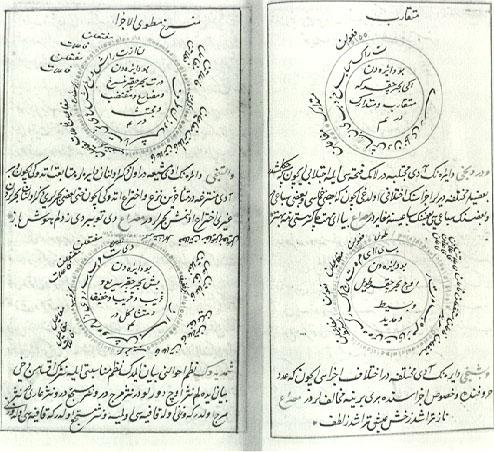
Page from the Topkapi Scroll - Topkapi Museum, Istanbul. Diagrams of metric circles representing rhythmic patterns of sound. Muslih al-Din Mustafa Sururi. From his "Bahr el-maarif" (Sea of knowledge), written for the Ottoman prince Mustafa in 1549, copied in 1585, red and black ink on paper. MS H. 659, Fols. 17v-18r.
Monday, August 18, 2008
The Battle for the Soul of the World
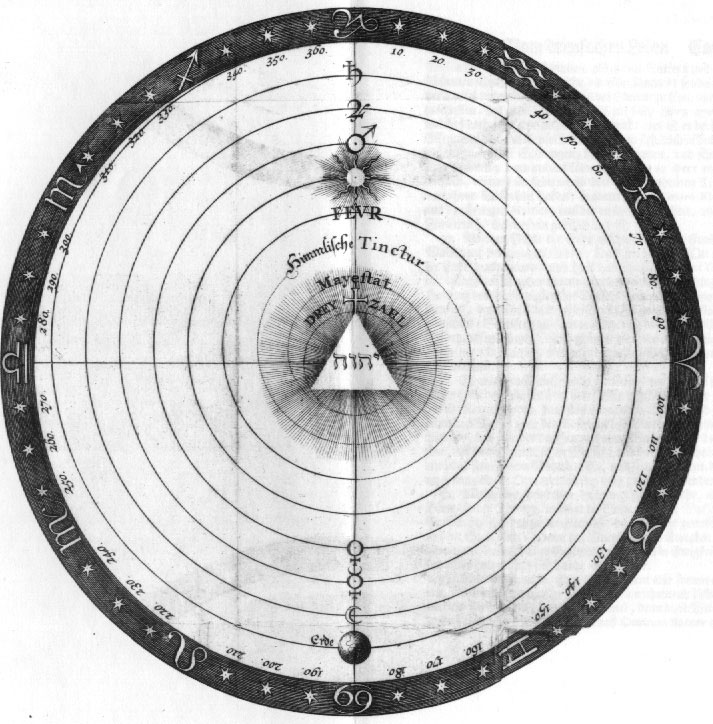 "Our western philosophy has been the theater of what we may call the “battle for the Soul of the World.” … Is it a matter of a battle that has finally been lost, the world having lost its soul, a defeat whose consequences weigh upon our modern visions of the world without compensation? If there has been a defeat, a defeat is still not a refutation." – Henry Corbin, Spiritual Body & Celestial Earth, xiv.
Centrum naturae - Jacob Boehme
Thursday, August 14, 2008
Alchemy is the Sister of Prophecy
 "...The mundus imaginalis is the place, and consequently the world, where not only the visions of the prophets, the visions of the mystics, the visionary events which each human soul traverses at the time of his exitus from the world, the events of the lesser Resurrection and the Greater Resurrection "take place" and have their "place," but also the gestes of the mystical epics the symbolic acts of all the rituals of initiation, litrugies in general with their symbols, the "composition of the ground" in various methods of prayer..., the spiritual filiations whose authenticity is not within the competence of documents and archives, and equally the esoteric processus of the Alchemical Work, in connection with which the First Imam of the Shi'ites was able to say 'Alchemy is the Sister of Prophecy.'" Henry Corbin, Spiritual Body & Celestial Earth, xi.
"We have here a mineralogy, a crystallography, a botany, a zoology whose 'objects' are used and studied as mirrors. The beings of the three Kingdoms are mirrors that render visible the constellations of the superior world..." "The alchemist operates - meditates - on all the metals as the hermeneut practices the symbolic exegesis... of a text." "...[I]t is the true imagination that makes the link between the alchemical operation and the interior transmutation." Henry Corbin, Lectures, 1973 - Quoted by Pierre Lory, Introduction to Corbin, l'Alchimie comme Art Hieratique, Paris: l'Herne, 1986, 11-13.
Image: Alchemists at work, 15th century. British Library, London. From artresource.
Wednesday, August 13, 2008
Khidr
 In Sura XVIII the figure that came to be interpreted as Khidr appears in an enigmatic episode. Moses and his servant travel to "the meeting place of the two seas." There he meets an unnamed messenger. Corbin explains:
"He is represented as Moses' guide, who initiates Moses into 'the science of predestination.' Thus he reveals himself to be the repository of an inspired divine science, superior to the law (shari'a). Thus Khidr is superior to Moses in so far as Moses is a prophet invested with revealing a shari'a. He reveals to Moses the secret mystic truth...that transcends the shari'a, and this explains why the spirituality inaugurated by Khidr is free from the servitude of literal religion."
The function of Khidr as a "person-archetype" is "to reveal each disciple to himself... He leads each disciple to his own theophany...because that theophany corresponds to his own 'inner heaven,' to the form of his own being, to his eternal individuality... Khidr's mission consists in enabling you to attain to the 'Khidr of your being,' for it is in this inner depth, in this 'prophet of your being,' that springs the Water of Life at the foot of the mystic Sinai, pole of the microcosm, center of the world."
"It goes without saying that the form in which each of us receives the master's thought conforms to his 'inner heaven'; that is the very principle of the theophanism of Ibn 'Arabi, who for that reason can only guide each man individually to what he alone is capable of seeing, and not bring him to any collective pre-established dogma..."
If the soul attains to the "Khidr of its being" to its perfection, then "you can indeed do what Khidr does."
"And this is perhaps the secret reason for which the doctrine of Ibn 'Arabi was so feared by the adepts of the literal religion, of the historical faith...of the dogma imposed uniformly on all. He...who is the disciple of Khidr possesses sufficient inner strength to seek freely the teaching of all the masters."
Quotations from Henry Corbin, Creative Imagination in the Sufism of Ibn 'Arabi. (Adapted from The World Turned Inside Out: Henry Corbin and Islamic Mysticism by the author).
Figure: From the Topkapi Scroll, Timurid Persia, 15th or 16th Century C.E., Topkapi Palace Museum, Istanbul. In Kufic script. Upper panel reads "Mohammed, 'Ali" rotated four times; Lower panel: in various patterns: "There is no God but God and Mohammed is his Prophet," "Mohammed" and "God's." See Necipoğlu, Gülru, and Mohammad Al-Asad. 1995. The Topkapı scroll: geometry and ornament in Islamic architecture : Topkapı Palace Museum Library MS H. 1956. Sketchbooks & albums. Santa Monica, CA: Getty Center for the History of Art and the Humanities, 268-9.
Tuesday, August 12, 2008
Orientation
 "Orientation is a primary phenomenon of our presence in the world. A human presence has the property of spatializing a world around it, and this phenomenon implies a certain relationship of man and the world, his world, this relationship being determined by the very mode of his presence in the world. The four cardinal points, east and west, north and south, are not things encountered by this presence, but directions which express its sense, man's acclimatization to the world, his familiarity with it. To have this sense is to orient oneself in the world." The Man of Light in Iranian Sufism, 1.
"Prophetic philosophy looks for the meaning of history not in 'horizons,' that is, not by orienting itself in the latitudinal sense of a linear development, but vertically, by a longitudinal orientation extending from the celestial pole to the earth, in the transparency of the heights or depths in which the spiritual individuality experiences the reality of its celestial counterpart, its 'lordly' dimension, its 'second person,' its 'Thou'." Creative Imagination in the Sufism of Ibn 'Arabi, 81.
"Then it may happen, just as we have learned to understand alchemy as signifying something quite different from a chapter in the history or prehistory of our sciences, that a geocentric cosmology will also be revealed in its true sense, having likewise no connection with the history of our sciences. Considering the perception of the world and the feeling of the universe on which it is based, it may be that geocentrism should be meditated upon and evaluated essentially after the manner of the construction of a mandala. It is this mandala upon which we should meditate in order to find again the northern dimension with its symbolic power, capable of opening the threshold of the beyond." The Man of Light in Iranian Sufism, 3.

The quest for the Orient "is the ascent out of cartographical dimensions, the discovery of the inner world which secretes its own light, which is the world of light; it is an innerness of light as opposed to the spatiality of the outer world which, by contrast, will appear as Darkness." The Man of Light in Iranian Sufism, 5
Figure 1: Turkish Map of Mecca; Manuscript of the Dala'il al-Khayrat (Guides to Good Things), by al-Jazuli, A.D. 1787/A.H. 1201; Ink, opaque watercolor and gold on paper. The Edward Binney, 3rd, Collection of Turkish Art at the Los Angeles County Museum of Art, M.85.237.54. From wikimedia. Figure 2: The New Jerusalem, from The Trinity College Apocalypse. Manuscript on parchment, London? c.1255-60, Cambridge, Trinity College MS R 16 2
The Accursed Tree
 Corbin writes, "The seriousness of the role of the Imagination is stressed by our philosophers when they state that it can be 'the Tree of Blessedness' or on the contrary 'the Accursed Tree' of which the Qur'an speaks, that which means Angel or Demon in power. The imaginary can be innocuous, the imaginal can never be so." Spiritual Body & Celestial Earth, x.
The spiritual path requires that we "must pass through the Darkness; this is a terrifying and painful experience, for it ruins and destroys all the patencies and norms on which the natural man lived and depended - a true 'descent into hell,' the hell of the unconscious.: Avicenna and the Visionary Recital, 159.
Mulla Sadra has written: "Of all the realities that man sees and contemplates in the world beyond, those which delight, like houris, castles, gardens, green vegetation, and steams of running water - as well as their opposites - the horrifying kinds of which Hell is composed - none of these is extrinsic to him, to the very essence of his soul, none is distinct or separated from his own act of existing." Spiritual Body & Celestial Earth, 165
And Najm Razi tells us this: "Know that the soul, the devil, the angel are not realities outside you: you are they. Likewise Heaven, Earth and the Throne are not outside you, nor paradise nor hell, nor death nor life. They exist in you; when you have accomplished the mystical journey and have become pure you will become conscious of that." in Corbin, The Man of Light in Iranian Sufism, 60.
Engraving: The Temptation of St. Anthony, Martin Schongauer, c. 1491. from wikimedia.
Beauty is the Supreme Theophany
 "As for the theophanic function invested in men, it is the secret of the dialectic of love. In the nature of mystic love this dialectic discovers the encounter (con-spiration) between sensory, physical love and spiritual love. Beauty is the supreme theophany, but it reveals itself as such only to a love which it transfigures. Mystic love is the religion of Beauty, because Beauty is the secret of theophanies and because as such it is the power which transfigures. Mystic love is as far from negative asceticism as it is from the estheticism or libertinism of the possessive instinct. But the organ of theophanic perception, that is, of the perception through which the encounter between Heaven and Earth in the mid-zone, the 'alam-al-mithal takes place, is the Active Imagination. It is the active Imagination which invests the earthly Beloved with his "theophanic function"; it is essentially a theophanic Imagination and, as such, a creative Imagination, because creation itself is theophany and theophanic Imagination. From this idea of Creation as theophany … arises the idea of a sophiology, the figure of Sophia aeterna … as she appears in the theosophy of Ibn 'Arabi."
"In place of the negative connection that we habitually understand between Christian asceticism and the Greek consciousness of beauty, it is necessary to speak here of a valorization that confers a prophetic function on beauty."
Henry Corbin, Creative Imagination in the Sufism of Ibn 'Arabi, 98 and En Islam Iranien: Aspects spirituels et philosophiques, Tome III: Les fideles d'amour - Shi'isme et sufisme. Paris: Gallimard, Bib. des Idees, 1972, 16.
Sculpture of Sophia, Ephesus Library, Anatolia (Turkey) 135 C.E. from wikimedia.
Subscribe to:
Posts (Atom)


 Posts


