Thursday, October 23, 2008
Progressio Harmonica: Music and Spiritual Experience
 I call your attention to an excellent essay by Francoise Bonardel (in French) available through Les Amis de Stella et Henri Corbin, "Progressio harmonica et expérience spirituelle chez Henry Corbin."
Also see the posts on this blog from July 30 & August 19.
Photo: The Music Room of the Palace of Ali Ghapou.


Tuesday, October 21, 2008
Request for Information
I would like to compile a list of institutions which are offering or have in the past offered courses on Henry Corbin. If you offer, or have participated in such a course please send a note (in English or French) with all relevant details to tcheetham@gmail.com. - Tom Cheetham
Monday, October 6, 2008
Mary to Myself
 Theophanic prayer is creative - it is a means of bringing into being the Angelic countenance whose Face is actualized by our act of Imagination - and precisely because this Imagination is a divine, personal and personified gift whose powers only we can exercise. Corbin presents Suhrawardi and Ibn 'Arabi, among others in the Islamic tradition, as masters of this power, but he is fond of citing excerpts from the Cherubinic Wanderer by the 17th century Christian mystic Angelus Silesius. Here too we find the idea of companionship and "chivalry" bonding the Angel and the human soul to whom it corresponds. Corbin cites these striking verses:
I know God cannot live one instant without Me:
If I should come to naught, needs must He cease to be.
God's need of me, my need of God,
Are equal in degree.
He helps to bear my being up
And I help Him to be.
Naught is but I and Thou. Were there nor Thou nor I,
Then God is no more God, and Heaven falls from the sky.
Corbin's theology of Angelic mediation makes these remarkable lines more transparent than they can be for traditional monotheism. It is not the "God of Gods" who does not exist without us - it is the Lord, the Angel Holy Spirit whose fiery face opens out into a myriad theophanies to bring to light the diversity of creation. We are necessary partners in this creative, intimate and personal relationship with the transcendent. The bond with the Angel requires everything from us. The Annunciation is not an event in history - it is a call:
"Hail Mary!" so thou greetedst Her:
Yet, Gabriel, what doth this avail
To me, unless thou likewise come
And greet me with the self-same "Hail!"
I must be Mary and myself
Give birth to God, would I possess
-Nor can I otherwise-God's gift
Of everlasting Happiness.
The power of the creative imagination, the gift of Gabriel, the Angel Holy Spirit, enables each of us, if we consent, to give birth to the Angel whose grace allows us to see all the world as an icon. For we give birth not only to God, but to the world itself, transfigured in the light of a personal vision.
Adapted from After Prophecy by the author. Selections from Angelus Silesius, The Cherubinic Wanderer, Selections. Translated and with an Introduction by J. E. Crawford Flitch. London, 1932. (Online at the Internet Sacred Text Archive). Texts here are as follows: I, 8; I, 100; II, 178; II, 102 and I, 23.
Diptych: The Annunciation (The Angel and the Virgin), Macha Chakoff.
Monday, September 29, 2008
The Visionary Recital
 Corbin was a master of the thought of the heart, of the récit, the visionary recital. The récit, as he intends the term, is the archetypal personal narrative. The ability to live this drama of the soul guarantees each of us our individuality. The paradigmatic examples for Corbin are the recitals of Suhrawardi and Avicenna. The collected works of both masters, he tells us, have this in common:
"side by side with extremely solid systematic works, they both contain a cycle of brief spiritual romances, narratives of inner initiations, marking a rupture of plane with the level on which the patencies successively acquired by theoretical expositions are interconnected."
The accounts bear such titles as The Recital of the Bird, The Recital of Occidental Exile, The Crimson Archangel, and The Reverberations of the Wings of Gabriel. These narrative dramas are not subsidiary to the philosophical systems, they are not allegorical tales meant to "illustrate" or explain. Quite the reverse. They perhaps bear the same relation to a "story" as an icon does to a picture. They are in fact the culmination, the summit of the imaginative universe which the rational mind has produced. Corbin says, "By substituting a dramaturgy for cosmology, the recitals guarantee the genuineness of this universe." The recital is not a fiction, it is not an objective history of facts, and it is not an allegory in which personified figures stand for abstract concepts. It is "the soul's own story… the soul can tell it only in the first person."
Text adapted from After Prophecy by the author. Quotations from Corbin, Avicenna and the Visionary Recital.
The "Antioch Chalice", first half of the 6th century, Byzantine; Made in Antioch or Kaper Koraon, The Cloisters Collection. "When it was discovered at the beginning of the twentieth century, this "chalice" was argued to have been found in Antioch … and was ambitiously identified as the Holy Grail, the cup used by Christ at the Last Supper… The identification of the "Antioch Chalice" as the Holy Grail has not been sustained, and its authenticity has even been challenged, but the work has usually been considered a sixth-century chalice meant to be used in the Eucharist."
Thursday, September 25, 2008
Corbin Related Book List
The following list posted on amazon.com may be of interest to some readers: "Henry Corbin's Visionary Spirituality"
Monday, September 22, 2008
The Age of the Spirit
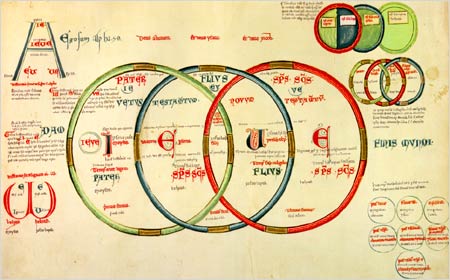
 "What animates the doctrine of the Eternal Gospel of Joachim de Flore (1145-1202), the celebrated founder of the Ordo florensis, is the idea of a development of humanity that is the continuous work of the Holy Spirit and the final end of which will be the reign of the Paraclete announced in the Gospel of John. The state of man at the end of this process realizes the perfect liberty of the Spirit which results from the love awakened by the Holy Spirit in the heart of man… The development of the ‘history of salvation’ by no means consists in the development of a principle immanent in history, progressing in a linear way according to laws that today we call ‘historical causality’. Far from that, the history of salvation is only realized by the active and continuous intervention of the Holy Spirit, a creative intervention that each time breaks anew the course imposed on things by the carnal will and worldly ambition."
"The three Ages of which Joachim de Flore speaks [of the Father, the Son and the Holy Spirit] are not successive periods of historical time…(and Berdiaev observes this in a profound remark...) ... the three Ages represent unities of existential time, interior time… The succession of these Ages plays itself out in the interior of souls, in the mystery of each soul… In historical time in fact these Ages coexist."
Henry Corbin, En Islam Iranien: Aspects spirituels et philosophiques, Tome IV: L'Ecole d'Ispahan - L'Ecole Shaykhie - Le Douzieme Imam, Gallimard, Bib. Des Idees, 1973, 444 & 448.
Joachim de Fiore, Trinitarian Circles from Heiligenlexicon. See also The International Center for Joachimist Studies featuring these pages from the Liber Figurarum. Also this excellent Nikolai Berdiaev source. The Berdiaev text to which Corbin refers is Le sens de la création : un essai de justification de l'homme; traduit du russe par Lucienne Julien Cain; préface de Stanislas Fumet. Bruxelles : Desclée de Brouwer, 1955, 405-6.
Wednesday, September 17, 2008
A Country the Color of Heaven
 In 1939 Henry and Stella Corbin traveled to Istanbul for what was intended as a six-month stay, to collect manuscripts for a critical edition of Suhrawardi. The outbreak of war changed their plans. Corbin served as the only member of the French Institute of Archaeology until the end of the war. When his replacement arrived in September of 1945, the Corbins left Istanbul for Teheran, and they first arrived on the 14th of September, in what he called a country "the color of heaven."
"To affirm the properly Iranian spiritual universe is to state the need for the existence, in the realm of the spirit, of an intermediary world between what the properly Arabic spiritual world and what the spiritual universe of India represent there." – Corbin, Avicenna and the Visionary Recital, 13.
"Persia was situated at the center, a median and mediating world, because Persia, ancient Iran, is not only a nation or an empire, it is a spiritual universe, a focus of the history of religions." - Corbin, in Henry Corbin, edited by Christian Jambet, 41.
Corbin writes that "the specifically Iranian genius is an aptitude for conjoining philosophical research and mystical experience; the refusal to dissociate them gives to each a character so specific we can only deplore that this Irano-Islamic philosophy has been absent from the histories of philosophy. That absence has impoverished our knowledge of humanity." - see Corbin, En Islam iranien, Tome I, x.
"Corbin was extremely sensitive to the topography of Iran, he saw it as the terrestrial and sensible form of the mundus imaginalis." Daryush Shayegan, Henry Corbin: La topographie spirituelle de l'Islam Iranien, Ed. de la Difference, Paris, 1990, 23-24.
Isfahan, Masjid Shah. Mosaics inside the giant dome. Photo by Ali Majdfar from his very fine Iran Photo Gallery.
Friday, September 12, 2008
Henry Corbin On Heidegger
 In the same years that Corbin was studying Turkish, Persian and Arabic he became deeply engaged with the German theological tradition, what he would later call the "lineage of hermeneutics:" Boehme, Luther, Hamann, Schliermacher, Dilthey, Heidegger and Barth. He lectured and delivered papers on Luther, Kierkegaard and Hamann, at the same time publishing translations of Suhrawardi in 1933, 1935, and 1939. In 1930 he first read Heidegger's Being and Time. As with his first encounter with Suhrawardi's Philosophy of Illumination, this was a defining moment in is life. His response to the challenge of Heidegger's dense and difficult German is revealing and probably unique: his copy of Being and Time was marked throughout by glosses in Arabic. In 1939 he published the first translation of any of Heidegger's work in French (a translation with which he was later quite dissatisfied).
Two aspects of Heidegger's work in particular were pivotal for Corbin: his treatment of history, and the central place given to hermeneutics.
"I must say that the course of my work had its origin in the incomparable analysis that we owe to Heidegger, showing the ontological roots of historical science, and giving evidence that there is a historicity more original, more primordial than that which we call Universal History, the History of external events, the Weltgeschichte, History in the ordinary sense of the term... There is the same relationship between historicality and historicity as between the existential and the existentiell. This was a decisive moment."
It was Heidegger who provided the key with which to open the locks closing him off from the other levels of being. "This key is, one might say, the principal tool equipping the mental laboratory of phenomenology." The key is hermeneutics. "The immense merit of Heidegger will always be that he centered the very act of philosophizing on hermeneutics... It is the art or the technique of Understanding."
But Corbin is traveling in wider circles than most Heideggerians. His grasp of hermeneutics and of the phenomenology that it makes possible springs not only from the undoubted originality of Heidegger or Husserl, but from far older, traditional conceptions of Sufism and Shi'ism. Seyyed Hossein Nasr, who taught with Corbin in Teheran for many years writes,
"Corbin...used to translate 'phenomenology'...to the Persian speaking students as kashf al-mahjub, literally 'rending asunder of the veil to reveal the hidden essence,' and considered his method...to be spiritual hermeneutics as understood in classical Sufi and Shi'ite thought." (Nasr, p. 26, n. 13).
Without doubt Heidegger provided the foundation for a bridge between Western philosophy and Islamic theology, but Corbin crosses it without hesitation to move into a more spacious world. He emphasizes that to use the key that Heidegger provided by no means requires us to adopt his mode of presence. "In Heidegger, arranged around this situs is all the ambiguity of human finitude characterized by 'Being-towards-death.'" But "this connection to the world, the pre-existentiell philosophical option...is itself a constitutive element of the Da of Dasein," which we need not take as our own. Once we have truly realized this and become conscious of our unconscious "decision" and therefore of our freedom to decide otherwise, the real meditation on our situation can begin: "From then on there is only to grasp as closely as possible this notion of Presence. To what is human presence present?"
 For the spiritual philosophers of Islam, "the presence that they experience in the world...lived by them, is not a Presence of which the finality is death, a "being-towards-death," but a "being-towards -the-other -side-of -death..." It is the world of the imaginal that opened the way towards horizons that Heidegger "had not foreseen."
On all of this see From Heidegger to Suhravardi: An Interview with Philippe Nemo courtesy of the Friends of Stella and Henry Corbin.
Adapted from The World Turned Inside Out and Green Man, Earth Angel by the author.
Quotation from Nasr in Religion & the Order of Nature. New York: Oxford University Press, 1996
Martin Heidegger in 1920.
Monday, September 8, 2008
The Prophetic Meaning of Beauty

Henry Corbin on Ruzbehan Baqli of Shiraz
The following passages have been selected and paraphrased by Tom Cheetham from Henry Corbin, En Islam Iranien: Aspects spirituels et philosophiques, Tome III: Les fideles d’amour et Shi’isme et sufisme. Livre III: Ruzbehan Baqli Shirazi and the Sufism of the Fideles d’Amour. Paris: Gallimard, Bib. des Idees, 1972. (Only the passages that appear in quotes are direct translations.)
(On these same topics see also Henry Corbin, “The Jasmine of the Fedeli d'Amore: A Discourse on Ruzbehan Baqli of Shiraz,” (A lecture given in Teheran, November 25th, 1958), Sphinx 3 (A Journal for Archetypal Psychology & the Arts) London, 1990, 189-223.)
The question at issue is this: How does the ineffable divine reveal itself to humans? A Shi’ite answer, provided by Qazi Sa’id Qommi, has it that the face that God shows to man is the face that man shows to God, and this is the theophanic Face of the Imam. In the absence of some kind of an intermediary, as if there would be a Christianity without Christ, the mystic stands exposed to the paradox and the rapture of the delusion “I am God!”
For all “Sufis” (Shi’ite or Sunni) there is a common ethos that is proper to Islam as a Prophetic religion. Sufism is the spiritual heart of Islam, not on the margins of the Church as Christian esotericism always is. This ethos is opposed to all “wills to power” and is an ethos “where the attainment of the tranquility of the soul may appear as the supreme paradox.”
The Unhappy Consciousness that is characteristic of Christian consciousness is entirely different from that of the Sufi. Oppositions between sin and justifying faith, faith and science, mysticism and sensuality, divine and human love (making beauty a demoniac trap) – none of these apply. Even the modern secular world is suffused with these same tensions – the guilt complex for instance, or that between historical fact and spiritual, interior truth. All this is based on “historical consciousness”
Sufism has much in common with ancient Judeo-Christianity and could act as a liberator for modern Christians. The Sufi has no consciousness of sin, and is not in need of justification. He is an exile, and the distress and nostalgia he feels is shared with Gnostics of all times. The Sufi is in need of a Guide who can indicate the way home to the origin. The Guide is a Prophet and the function of a Prophet is not only to reveal a Law, but to open the way towards a return to spiritual Truth. There is no conflict between mystical and prophetic religion. On the contrary, mysticism is the truth of prophetic religion.
For the Sufi there is no essential conflict between the historical truth of revelation, the letter of the law, and the inner esoteric truth – this opposition signals rather a passage to be accomplished, on which spiritual birth depends. All true exegesis is spiritual and is an exodus of the soul. The hermeneutic of the Word is always a hermeneutic of the soul.
For the Sufi, there is no need for a social mediator between the soul and God – he has a personal link with the initiator, the Guide, the shaykh, or in Shi’ism with the Imam, par excellence with the Hidden Imam, who corresponds to the Celestial Guide, the Witness in Heaven who is the guarantor of spiritual individuality. This Heavenly Twin is not in any way the apotheosis of the nafs ammara, the natural, appetitive soul, but is rather the Holy Spirit in man, the “pacified soul” of tranquility. And it is to this end that all the spiritual combat of Sufism tends: the transformation of the nafs ammara into the nafs motma’yanna, the pacified soul. And here it is less a question of destruction than of sublimation.
This experience of transformation is the means by which the Sufi resolves the supreme opposition that confronts exoteric monotheism in the form of the dogma of tawhîd, the Unity of God. The result of this spiritual combat marks the passage from the exoteric declaration of Unity to the esoteric experience of Unity. The former is professed by the naïve consciousness as the unity of God as the Ens supremum, the absolute object above and beyond all created objects. This abstract monotheism, which must regard God as a being beyond all beings, the Absolute Object, and thus inevitably external to His creation requires in fact a fundamental and contradictory duality between God and His creation, between the God professed in the faiths, and the souls of the faithful, for who is it that then says “God is One,” if not an other being? It is thus that the pious believers and the dogmatic theologians are in reality polytheists in spite of themselves. This inherent contradiction can only be resolved by the experience of theophany by means of which the veil of created beings becomes a theophanic mirror whereby the invisible is seen by means of the visible. It is here that the connection between archetypal, divine beauty and sensible created beauty must be found.
“In place of the negative connection that we habitually understand between Christian asceticism and the Greek consciousness of beauty, it is necessary to speak here of a valorization that confers a prophetic function on beauty.” (p. 16)
All the Sufis find a special link between each Prophet and Beauty as a divine Attribute and theophany. The Prophet of Islam seen from the Sufi perspective is the prophet of a religion of beauty with essential links to Platonic and Neoplatonic ideals.
But this is no static hierarchy as Platonism and Neoplatonism is sometimes understood by Western scholars. There is no limit to theophanies. The soul finds its “tranquility” in a state of perpetual motion towards the Divine. The Return of the pacified soul is not to an immoveable place of rest, but is an eternal progression that is itself the individual’s proper Home. The Return is not to God “in general” but to the soul’s own Lord. We are speaking of a process of mystical individuation by means of the annihilation and transformation of the possessive, “imperialist” soul in the act of the revelation of God to Himself in the person of the mystic. This is the resolution of the aporia of exoteric Unity: the identity in difference, the identity of He who is revealed and the One to whom the revelation appears.
There is, out of all human experiences, one unique event that leads to this union: human love for a being of beauty. Such a love is purified of all carnal, possessive instincts, all utilitarian ends, all obsessions and neurotic “needs.” Such a chaste love is an ecstasy before the revelation of divine beauty in a being of beauty, a theophany. This cult of Beauty was professed by Ibn ‘Arabi, and in Iran by Ruzbehan Baqli of Shiraz and all of his school. These Corbin calls the Fidèles d’amour in order to highlight their affinities with the Fedeli d’amore of Dante.
Ruzbehan Baqli, a Sunni Muslim, was born in 1128CE in Fars, 140 km from Shiraz where he died in 1209. His life spanned a remarkable century in Islamic spirituality. He was the contemporary of Shihab al-Din Yahya al-Suhrawardi, Najmoddin Kobra and Ibn ‘Arabi, though there is no reason to think that he knew of any of them. He is one of the spirituals most representative of Iranian Sufism, but of a non-Shi’ite Sufism.
(Note: Annemarie Schimmel places Ibn ‘Arabi and Ruzbehan into the wider context of Sufi writings concerning women, love, eros and the body, and her comments provide a cautionary counterpoint to Corbin’s perspective. She also notes the homoerotic connotations which often surround the discussions of the human lover. See Schimmel, “Eros in Sufi Literature and Life.” Pp. 262-288, in Religion and the Body, Edited by Sarah Coakley, Cambridge, England: Cambridge University Press, 1997 - Tom Cheetham).
Beauty understood in this way is experienced as a sacred sign, a sacrament. At the limit of this experience of love, a love that “does not split,” is the esoteric experience of tawhîd: The Divine being is simultaneously the Loved, the Lover and the Love itself. (p. 17)
The phenomenon of theophany must be clearly distinguished from that of incarnation. This theology is profoundly docetic, but Corbin stresses that this “image” of the Divine is no phantasm, but the appearance of that which is truly real. Docetism is nothing less than “spiritual realism” of the highest order. Rather than the dualist opposition between Spirit and Matter, a docetic theology posits what Ruzbehan calls amphibole. (p. 19)
(Note: Carl Ernst says that Corbin’s translation of iltibas as “ambiguity” (here, the Latin amphibole) does not do justice to the rich nuances of the word. It suggests “clothing with divinity” as well as “covering up” and “confusion.” See Carl W. Ernst, Words of Ecstasy in Sufism. Albany, N. Y.: State University of New York Press, 1985, 149, n. 36 - Tom Cheetham).
There is no theophany without a moment of amphibole. When we grasp this we will no longer seek the refuge of “literal faith” nor the certainty of sensory facts. There will be then only one certainty: that which gives the vision of the invisible, the hearing of the inaudible. When the secret of their complicity is deciphered, the amphibole that colors all the things of the world is revealed as nothing other than their inter-relation and interpenetration.
Ruzbehan avoids the double trap of idolatry and abstraction by means of the mystical experience of the esoteric unity of divinity. This mystical verification of prophetic religion requires the perception of the prophetic meaning of beauty. Beauty is not merely one divine attribute among many. It is the essential attribute. God is the source and reality of Eros, and forbids its desecration, wither through sexual libertinage, which is its profanation, or through its negation by means of ascetic denials of beauty and love.
The divine mystery of love lies in the transcendent Unity of love, Lover and Beloved. But this esoteric unity can only be verified in the experience that transcends the contradiction between the God of Moses who is forever invisible (You shall not see me), and the God of whom Mohammad can say “I have seen my Lord in the most beautiful of forms.” In the ecstatic mysticism of Ruzbehan this takes the form of the Heavenly Witness, personified in the plural in the forms of angels, prophets and saints in profound mystic visions, and whose forms correspond to the mode of being of the mystic.
Ruzbehan’s cosmogony is fundamentally similar to that of Avicenna and Ibn ‘Arabi. The Divine Being is a Hidden Treasure that desires to be known, and so creates creatures to be known and to know himself through them. The first of these created beings is here neither the First Intelligence of Avicenna, nor the Breath of the Compassionate of Ibn ‘Arabi, but rather the Spirit. From this primordial Spirit come all the Holy Spirits who are the pre-eternal spiritual individualities of all the beings of Light in Creation.
Every atom of being which is differentiated from the breast of the Spirit is produced by a theophanism that manifests a divine attribute as an ecstasy of God for himself. And so every atom of being is an eye blossoming from His Light, an eye totally absorbed in the contemplation of this light which gives it birth. Creation then as divine contemplation is not an object distinct from this contemplation – it is the very organ of this contemplation.
The test of the Veil is this: at each stage in the hierarchy of creation, when the creatures contemplate the Light that gives them life, they are both different from and identical with that glory. In order to see God, they must be other than God, and yet it is from God that they have their very being – for they are nothing, they have nothing, in themselves. This is their radical poverty. In so far as they are seen in their difference from God they seem self-subsistent, and they then run the risk of becoming idols and so are Veils of the divinity. And yet in truth their being is the gift of God and they are organs by which God contemplates Himself and are not other than He. To overcome the Test of the Veils requires that we not become trapped in the self-subsistent and literal face of any being, that we not idolize it but rather see in it the Face of God.
Though all creatures shine with Beauty, it is in the human form that this divine glory is most manifest. We are created in the image of God. The secret of the Fideles d’amour lies here: not to turn away from human beauty, nor to turn towards it. One must not transgress the dignity of the human creature and yet must acknowledge, and experience through it, its theophanic essence. One is thus caught in perpetual oscillation between the sensible, visible beauty, and the invisible of the visible that draws us onward.
The more general problem here is the relationship between apophatic and cataphatic modes of discourse about God. It is not a question of sacrificing one to the other. It is in passing between them, equally distant and equally close to them both, that the mystical soul finds its tranquility. This theophanic solution is common to Ruzbihan and Ibn ‘Arabi. On it depends the possibility of tasting the savour and the tranquility of divine love in human love. It is not here a question of perception at the level of the sensible world, but of imaginative sensations at the level of the intermediary world of the mundus imaginalis. This explains the amphibole of the human image which both is and is not a sensory image. Everything sensory, the visible and the audible has a double sense, a double meaning, since it reveals the invisible and the inaudible. This is the theophanic function of the beauty of creation. This beauty of creatures is always apprehended in a form appropriate to the heart of one’s own love. The secret of theophanic perception is that it corresponds to the spiritual capacity of the visionary. This seeming multiplicity of the Divine Face may contradict the exoteric attestation of the Unity of the Divine, but it is the very revelation of the esoteric unity. God can never be an Object, but is rather the active Subject of the acts of spiritual perception by which the creatures come to know Him. This is the grand paradox of the multiplicity of the Unique and the identity of the Multiple.
The spiritual diaries that Ruzbihan has left us are replete with the paradoxes that these theophanies express. His Jasmin of the Fideles d’amour “is nearly entirely thought in images which are not at all rhetorical, but the transpositions of concepts, and the interior dialectic operates on these images as upon concepts. It is necessary to have a hand continually upon each keyboard.” (p. 66).
The path to this apprehension of divinity is an interior pilgrimage accomplished by tracing the stages of love in a way that reflects the passage from the exoteric religion of social and historical laws whose object is the God of monotheism, to the esoteric interior religion whose object is always a personal Subject. The personal God of Sufism reveals the mystery of divine unity as absolute subjectivity, a subjectivity absolved of all relation to anything other than itself. This esoteric unity can only be understood, lived and realized in the experience of love. It is human love, Eros, which gives access to this, because human love is the only experience that can, at its limit, make present the unity of love, lover and beloved.
Ruzbehan thus stands entirely in opposition to those ascetics, whether Christian or Muslim, for whom human love is a trap and a diabolic obstacle to the experience of the divine. Corbin writes that here we find the true originality of Iranian Sufism. It expresses an individual ethic, both heroic and secret which is typified by the knight of the soul, who knows that it is only through human love that it is possible to read the outlines of divine love. It is the same text in each case, but it is necessary to learn to read it. One must become initiated into a spiritual hermeneutics, an exegesis of human love that reveals it as a prophetic text. And because Beauty is the source of this text, its discovery is a prophetic action. The lover is thus the partner of the prophet. The message of beauty is a prophetic message: it is an invitation to pass from the human figure who is the literal text, the place of sensory love, to the truth of love, the esoteric meaning of this text. (See p. 68). The Beloved is metamorphosed by the adoration of the Lover, whose love is not a temptation to be overcome but a call to a sublimation of this love upon which depends the access to the esoteric unity of Love, Lover and Beloved.
For the mystic lover, the revelatory moment is where the revelation of human beauty overcomes consciousness in a way that is both the enchantment of joy and a kind of sacred dread before the secret of the divine in the human. To find oneself face to face with this beauty is to be in the torment of simultaneously finding and not-finding the occasion of this adoration. Human beauty is the occasion of the experience of the numinous: it is an absolutely primordial phenomenon, like a sound or a color. This beauty can be experienced as both fascinating and terrifying, as evoking both joy and desperate nostalgia and desire, attesting to a presence which is not there, and to an absence to which it can only point. As with the blind or the deaf, one is either capable of such perception, or one is not. (See p. 72).
The idea of theophany is associated with another crucial term in the works of all those spirituals who profess the religion of love and Beauty as a phenomenon of divine revelation. This term is shâhid, which suggests both witness and that which is seen or contemplated. The Sufis also suggest by it a psychic phenomenon: the interior image of an absent object which is thus rendered present by this image, or sometimes all the content of consciousness at a given moment. Finally they mean to suggest all beings of beauty because they attest to, the “witness” or re-present the distant divine beauty by means of the image in the heart. The shâhid is thus the face of beauty that the mystic takes as “witness of contemplation,” whether this be a mental image or in a personal encounter. The word thus has a double meaning and a double function as both passive and active, both subject and object. It stands both for the beauty which is the witness, and that with is absent, the invisible beauty of which it is the witness. The beauty of this witness, is the very object of the contemplation of the mystic. (p. 77)
The idea of the shâhid is closely related to the phenomenon of the mirror, which is so commonly used to convey the situation of esoteric knowledge by means of theophany. Theophany understood as the phenomenon of the mirror differentiates Sufism from both orthodox monotheistic Islam and Christian Incarnationism. The idea of theophany links Sufism and Shi’ism and distinguishes both from abstract monotheism. The idea of divine anthropomorphosis is its central thesis: the human Form and celestial Anthropos of Spiritual Adam is the epiphany of the divine. This human form is the shâhid who contemplates God and shows His image to God, and by so doing, is simultaneously the Image which He contemplates. This is the basis for the divine visibility whereby Mohammad can say “I have seen my Lord in the most beautiful of forms.” It is the amphibole of this Image which precludes both the dual traps of apohatic and cataphatic signification. At the same time this theophanic cosmology distinguishes Sufism and Shi’ism from the Incarnationalism of Christian orthodoxy. It is a question of celestial anthropomorphosis, in the angelic pleroma, not an irreversible historical event occurring by mixture with human flesh. It is not seen with the eyes of flesh, but rather with the eyes of the spiritual body that contemplate this image in Heaven. Being neither immanence nor incarnation, this divine epiphany is not a kenosis or effacement of the divine, but its triumphal manifestation of the pre-eminent divine attribute, Beauty. Refusal of this beauty by any form of asceticism, whether in religion or art or social life in general, is a sacrilegious betrayal which has the effect of chasing God from Paradise. (p. 79)
Human beauty is the witness, and Paradise is that which is witnessed, the place of this witnessing, of this Presence. So we can understand the phenomenon of the mirror. God does not incarnate himself: Divine Beauty enters into the beautiful forms as the image enters into the mirror. The terrestrial human condition cannot be redeemed by a degradation of the divine, but only by a transfiguration which accomplishes the divine within the human. The Image is not incarnated in the mirror, but by appearing there it sees and shows to itself that which it regards in the mirror and of which it is the image.
“Creation being theophany, and being anthropomorphic theophany, that is to say the manifestation of God in a human celestial form, it follows that from the pre-eternity of Creation, there is a unio mystica between the divinity and the human form. It is this same theophanic rapport, fundamentally speculative (speculum, mirror) of the identity between love, lover and beloved, which founds the revelation of divine love in human love, because human love, at the limit of its mystical experience, is precisely this form of divine love. It is the unique text read finally in its true sense, providing that we not regard the mirror without the image (that would be only metaphoric love), but regard the Image that shows itself in the mirror (love in the true sense) and which is its regard.” (p. 81).
The interior pilgrimage itself is replete with dangers and traps and the torments of “having and not-having.” The relationship between human, physical love and divine love is delicate and crucial. The lover must be purified of all sensual weakness in order to be firm in the path towards spiritual love. Any purely carnal appetite must be eliminated. Yet it is not a question of opposing this with any “monastical asceticism” which is brutal and negative. If physical love is the path leading to spiritual love, this is the result of a pre-eternal alchemy. Although physical love is an inferior stage, it remains true that love is the influence of the Red Sulfur of divine Magnificence projected in the light of the eyes of the soul. The dangers of idolatry are very real. Here they take the form of carnal obsession and the blind appetites of the lower soul. All flesh must be transmuted on the horizon of theophanic perception into the spiritual body of light. The sensory and the suprasensory are but correlative aspects of one and the same Eros, and it is the path of mystic love to transform the lower into the higher.
 The archetypal love story in Persian literature is the tale of Layla and Majnûn. When the body and spirit have become united one with the other, there is the summit of love. Majnûn becomes, in the limit of love, in the limit of his ardent desire, himself the mirror of God. His love itself becomes the Eye of God, the very mirror in which God is contemplated. The circle here is closed: Love itself becomes the organ of perception of beauty. The alchemical transmutation of inauthentic, merely human love, produces true divine love in which Love, Lover and Beloved are united in a tri-unity which is God as divine activity, divine subject. This is the triple identity of act, subject and object, and it is this intra-divine drama that the human experience of love, with all its passions and trials, presents to those who can see it. The drama of human love by which the carnal instincts for possession and domination are transmuted into true divine and unitive love is the drama of the Test of the Veil. We triumph only through the struggle to overcome the idolatries and obsessions that stand in the way of the realization of the tri-unitive God. The triumph of the test of the Veils is the reunion of human and divine love, the unveiling of human love to itself by the unveiling of the true divine Beloved to the human lover.
Section of Ceramic Frieze. Iran, 14th Century. Louvre, Paris. "In the Name of God, the Compassionate, the Merciful."
Layla and Majnun at School. From a Khamsah of Nizami. Herat, 1494. British Library. For an elucidation of the story and the symbolism in this miniature, and much more on the mystical elements in Persian painting, see the magnificent, and indispensible, Figurative Art in Medieval Islam and the Riddle of Bihzad of Herat by Michael Barry. Paris: Flammarion, 2004,14-15.
Friday, September 5, 2008
Kathleen Raine on Henry Corbin
 "'Tradition' as understood by followers of Guénon, for all their insistence on 'revealed' knowledge and the metaphysical order, seem unconnected to the living source itself and highly suspicious of those very inner worlds from which it ultimately derives. That inner world both Blake and Jung affirm and both appreciated the value of the alchemical symbolism and the alchemical 'work' of self transformation ... I find what is missing from the work of Guénon and his followers in the writings of Henry Corbin...whose term 'imaginal' describes the order to which Blake's Prophetic Books belong - as it does Jung's world of psyche and its archetypes. Corbin understands that sacred tradition is itself without meaning outside that context... Corbin thus harmonizes what one might call the Protestant vision of Blake and Jung, their insistence on discovering the truth 'within the human breast,' and the recognition of a tradition of sacred knowledge embodied in every civilization and all mythologies".
Kathleen Raine, Golgonooza: City of Imagination. Last Studies in William Blake, Lindisfarne Press, Hudson, N.Y., 1991, 4.
William Blake. Jacob's Ladder. Watercolor, c. 1800. British Museum. From wikimedia.
Henry Corbin in Temenos and The Temenos Academy Review
We have this complete list courtesy of Stephen Overy of the Temenos Academy.
Link to the Temenos Academy Review here
(Note that Temenos and the Temenos Academy Review are two separate Journal series.)
Articles
Towards a Chart of the Imaginal
Prelude to the Second Edition of 'Corps Spirituel et Terre Céleste de l'Iran Mazdéen à l'Iran Shi'ite'
Temenos 1, pp.23-36 (1981)
Translated by Peter Russell
Epistle on the State of Childhood
by Sohravardi
Translated by Liadain Sherrard
with Introduction, Presentation and Notes by Henry Corbin
Temenos 4, p.53-76 (1983)
The Theory of Visionary Knowledge in Islamic Philosophy
Temenos 8, pp.224-237 (1987)
Translated by Liadain Sherrard
Emblematic Cities
Temenos 10, pp. 11-24 (1989)
Translated by Kathleen Raine
On the Meaning of Music in Persian Mysticism
Temenos 13, pp. 49-52 (1992)
Translated by Kathleen Raine
Traditional Knowledge and Spiritual Renaissance
Temenos Academy Review 1, pp. 29-45 (1998)
Translated by Kathleen Raine
From Heidegger to Suhrawardi
Temenos Academy Review 6, pp. 119-143
Translated by Kathleen Raine (2003)
Youthfulness and Chivalry in Iranian Islam (Part I)
Temenos Academy Review 11 (2008)
Translated by Christine Rhone
Youthfulness and Chivalry in Iranian Islam (Part II)
Temenos Academy Review 12 (2009)
Translated by Christine Rhone
Reviews
Henry Corbin and the Hermeneutics of Light
Review of 'The Man of Light in Iranian Sufism'
Temenos 1, pp. 229-236 (1981)
By Peter Lamborn Wilson
Guardian of the Temple
Review of 'Temple and Contemplation'
Temenos 8, pp. 242-246 (1987)
By Peter Lamborn Wilson
Link to the Temenos Academy Review here
(Note that Temenos and the Temenos Academy Review are two separate Journal series.)
Articles
Towards a Chart of the Imaginal
Prelude to the Second Edition of 'Corps Spirituel et Terre Céleste de l'Iran Mazdéen à l'Iran Shi'ite'
Temenos 1, pp.23-36 (1981)
Translated by Peter Russell
Epistle on the State of Childhood
by Sohravardi
Translated by Liadain Sherrard
with Introduction, Presentation and Notes by Henry Corbin
Temenos 4, p.53-76 (1983)
The Theory of Visionary Knowledge in Islamic Philosophy
Temenos 8, pp.224-237 (1987)
Translated by Liadain Sherrard
Emblematic Cities
Temenos 10, pp. 11-24 (1989)
Translated by Kathleen Raine
On the Meaning of Music in Persian Mysticism
Temenos 13, pp. 49-52 (1992)
Translated by Kathleen Raine
Traditional Knowledge and Spiritual Renaissance
Temenos Academy Review 1, pp. 29-45 (1998)
Translated by Kathleen Raine
From Heidegger to Suhrawardi
Temenos Academy Review 6, pp. 119-143
Translated by Kathleen Raine (2003)
Youthfulness and Chivalry in Iranian Islam (Part I)
Temenos Academy Review 11 (2008)
Translated by Christine Rhone
Youthfulness and Chivalry in Iranian Islam (Part II)
Temenos Academy Review 12 (2009)
Translated by Christine Rhone
Reviews
Henry Corbin and the Hermeneutics of Light
Review of 'The Man of Light in Iranian Sufism'
Temenos 1, pp. 229-236 (1981)
By Peter Lamborn Wilson
Guardian of the Temple
Review of 'Temple and Contemplation'
Temenos 8, pp. 242-246 (1987)
By Peter Lamborn Wilson
Friday, August 29, 2008
Harmonia Abrahamica
 Henry Corbin devoted his life to articulating a vision of the essential harmony of all of the religions of the Book, the vision of what he was to call in his late work the Harmonia Abrahamica. It is based on a Christology radically different from the one that became dogma. It requires a return to the Christology of the Ebionites, who had no doctrine of the Trinity, or of the substantial union of the divine and human in Jesus. For these Jewish-Christians, Jesus was a manifestation of the celestial Son of Man, the Christos Angelos, who was consecrated as Christ at his baptism. Jesus then takes his place in the lineage of the True Prophets. Corbin writes
“for Ebionite Christianity…sacred history, the hierology of humanity, is constituted by the successive manifestations…of the celestial Anthropos, of the eternal Adam-Christos who is the prophet of Truth, the True Prophet. We count seven of these manifestations, eight if we include the terrestrial person of Adam himself. They are Adam, Noah, Enoch, Abraham, Isaac, Jacob, Moses, Jesus… . The fundamental basis of this prophetology is therefore the idea of the True Prophet who is the celestial Anthropos, the Christus aeternus, hastening from christophany to christophany 'toward the place of his repose.' Now, this is the same structure that Islamic prophetology presents, with this difference, that the succession of christophanies is no longer completed with the prophet Jesus of Nazareth, but with the prophet of Islam, the 'Seal of the Prophets' whose coming Jesus himself announced, and who is the 'recapitulation' of all the prophets… .” (Corbin, 1977, 11)
Thus Mohammad has been identified with the figure of the Paraclete in the Gospel of John. Among the Shi'ites, the Twelfth Imam, the Hidden Imam, is sometimes identified with this final manifestation of the True Prophet, the central figure of the Eternal Gospel.
The death of Christ then signifies something utterly different from what we have come to accept. Corbin relates with evident approval the story of Christ's death told in the Medieval Gospel of Barnabas. Jesus is taken up by the Angels, before Good Friday. Judas Iscariot, transformed to resemble Jesus, is arrested and killed upon the Cross. And so His followers believe that He has died. It must be this way, since, Corbin argues,
“in making of him the 'Son of God' it is Man himself that humanity has equated with God, and it was only possible to expiate this blasphemy through succumbing to the belief that his God was dead. Everything occurs as if the Ebionite-Islamic prophetology here went ahead to denounce and refute the false news of the 'death of God.' ...It is undeniable that this vision overturns from top to bottom some eighteen centuries of the Christian theology of History.” (Corbin, 1977, 15)
Without any illusions about the magnitude of the transformation he is suggesting, this vision is Corbin's answer to those who wonder whether Christianity itself is capable of surviving. It is only by being open to a radically reformed Christianity in harmony with the mystical traditions of the rest of the Abrahamic tradition, that the religion of Christ can find its fulfillment. Only a Christianity based on theophany can survive.
Corbin tells us that the event of the Great Resurrection, the parousia of the Paraclete, which has its origins in the Final Battle proclaimed by Zoroaster, and the expectation of which is in common in various forms to Judaism, Islam and Christianity, is symbolized for Shi'ism in the person of the Hidden Imam. But, Corbin writes, this cosmic Return
"is not an event which may suddenly erupt one fine day; it is something that happens day after day in the consciousness of the Shi'ite faithful... The Advent-to-come of the Imam presupposes...the metamorphosis of men's hearts; on the faith of his followers depends the progressive fulfillment of this parousia, through their own act of being...
"...The parousia of the awaited Imam signifies a plenary anthropological revelation, unfolding within the man who lives in the Spirit." (Corbin, 1993, 71-73)
"The Imam has said: 'I am with my friends wherever they seek me, on the mountain, in the plain, and in the desert. The man to whom I have revealed my Essence, that is to say, the mystical knowledge of myself, has no further need of my physical proximity. And this is the Great Resurrection.'" (Corbin, 1993, 102)
[Citations from Corbin in "Harmonia Abrahamica," preface to Évangile de Barnabé: Recherches sur la composition et l'origine, par Luigi Cirillo, Texte et Traduction par Luigi Cirillo and Michel Frémaux, Paris : Éditions Beauchesne, 1977, and A History of Islamic Philosophy, Trans. L. Sherrard & P. Sherrard, London: Kegan Paul International, 1993.]
Text adapted from The World Turned Inside Out and Green Man, Earth Angel by the author.
The final chapter of my book Green Man, Earth Angel can be read here: "Harmonia Abrahamica: The Lost Speech and the Battle for the Soul of the World."
Illustration: La Pentecôte: Heures d'Étienne Chevalier, enluminées par Jean Fouquet. Musée Condé, Chantilly, R.-G. Ojeda, RMN / musée Condé, Chantilly.
Suzuki, Swedenborg, Ibn 'Arabi
 Delighting in one of the wonderful comparisons of which he was so fond, Corbin recounts a conversation with D. T. Suzuki in Ascona in 1954: "...we asked him what homologies in structure he found between Mahayana Buddhism and the cosmology of Swedenborg in respect of the symbolism and correspondences of worlds: I can still see Suzuki suddenly brandishing a spoon and saying with a smile 'This spoon now exists in Paradise... We are now in Heaven,' he explained. This was an authentically Zen way of answering the question; Ibn 'Arabi would have relished it. " - Creative Imagination in the Sufism of Ibn 'Arabi, 354
For more on this see:
D.T. Suzuki, Swedenborg: Buddha of the North, trans. and introduced by Andrew Bernstein. Afterword by David Loy, West Chester: Swedenborg Foundation, 1996, and Roberts Avens, "The Subtle Realm: Corbin, Sufism and Swedenborg," in Immanuel Swedenborg: A Continuing Vision, ed. Robin Larson, New York: Swedenborg Foundation, 1988. Also pertinent is Sachiko Murata and WIlliam Chittick, Chinese Gleams of Sufi Light : Wang Tai-yü's Great learning of the pure and real and Liu Chih's Displaying the concealment of the real realm ; with a new translation of J¯am¯i's Law¯a'ih from the Persian; with a foreword by Tu Weiming. Albany, NY : State University of New York Press,2000.
Boddhisatvas in the Bezeklik Thousand Buddha Caves in Turfan, on the Silk Road, Xinjiang, western China.
Wednesday, August 27, 2008
Suhrawardi
 "Thus it was that one day - it was, I think, in the year 1927-28 - I spoke to [Louis Massignon] of the reasons that had led me as a philosopher to the study of Arabic, questions that posed themselves to me concerning the connections between philosophy and mysticism, and that I knew, through a scanty resume in German, of a certain Suhrawardi... Then Massignon had an inspiration from Heaven. He had brought back from a trip to Iran a lithographed edition of the major work of Suhrawardi, Hikmat al'Ishraq, 'The Oriental Theosophy.' With commentaries, it formed a large volume of more than 500 pages. 'Take it,' he said to me, 'I think there is in this book something for you.' This 'something' was the company of the young Shaykh al-Ishraq, who has not left me my whole life. I had always been a Platonist (in the broad sense of the term); I believe that one is born a Platonist as one is born an atheist, a materialist etc. Unfathomable mystery of pre-existential choices! The young Platonist that I was then could only t
 ake fire at contact with the one who was the 'Imam of the Platonists of Persia...' ...through my meeting with Suhrawardi, my spiritual destiny for the passage through this world was sealed. Platonism, expressed in terms of the Zoroastrian angelology of ancient Persia, illuminated the path that I was seeking."
in Christian Jambet, (ed.) 1981, Henry Corbin, Cahier de l'Herne, no. 39. Consacré à Henry Corbin, 40-41. English translation of the entire interview with Philip Nemo available here courtesy of Les Amis de Stella et Henry Corbin.
Circular Ornament: Iran, 16th-17th Century. The Freer Gallery of Art & the Arthur Sackler Gallery. "In the name of God, the Merciful and Compassionate."
Manuscript Page, Suhrawardi ms. given to Henry Corbin, from Henry Corbin, ed. Jambet.
Monday, August 25, 2008
Alamut!
 Certainly Corbin knew well that Islam, as any religion, requires a doctrine, a "literal" outside, a Law, which must exist in order for there to be anything in which to conceal the "hidden meanings." Nonetheless, it is clear enough where his sympathies lie. The Ismailis have long been known among detractors and supporters both, for the priority which they give to the esoteric at the expense of the exoteric. Corbin calls to our attention more than once, with a kind of longing, to aone of several symbolic events of the epochal 12th century, the Ismaili Declaration at Alamut.
"Alamut! The stronghold lost in the high solitary summits of the Elburz mountain chain, to the southwest of the Caspian Sea, where, on 8 August 1164, the Great Resurrection was proclaimed... Undoubtedly a proclamation of this type pertains to that spiritual history, the events of which occur unnoticed by external official history, because their implications cannot be suspected by historians whose attention is given exclusively to the latter. In any case, the proclamation of the Great Resurrection was intended to be the triumph of absolute spiritual hermeneutics, since it purely and simply abolished the shari'a and its observances, in order to permit the reign of the spiritual Idea...alone to subsist."
But, he continues,
"Here again, the impatience of the soul provoked a premature anticipation of eschatology... [The major Shi'ite traditions] continued carefully to maintain...the coexistence of the esoteric and the exoteric, for as long as the human condition remains what it is in the present world, the soul cannot manifest itself without being contained in a material body."
Citations from Corbin in Swedenborg & Esoteric Islam, 1995, translated by Leonard Fox, West Chester, PA: Swedenborg Foundation, 95.
Excerpted from The World Turned Inside Out by the author. Also see Christian Jambet, 1990. La Grande rsurrection d' alamut: les formes de la liberte dans le shiisme ismaelien. Francia: Verdier.
The Fortress at Alamut: From the Iranian Cultural Heritage And Tourism Organization, Alamut Cultural Heritage Base
Subscribe to:
Posts (Atom)


 Posts
Posts