Friday, May 25, 2018
Symposium on Cusanus, the Qur’an, and the Cribratio Alkorani

The Watanabe Lecture
and Symposium on Cusanus, the Qur’an,
and the Cribratio Alkorani
September 29-30, 2018
United Lutheran Seminary
(New Name, Same Location)
Gettysburg, Pennsylvania 17325
In Cooperation with the American Cusanus Society and the International
Seminar on Pre-Reformation Theology
Watanabe Lecturer: Walter Andreas Euler, Trier
Banquet program: Cabaret Night with Broadway’s Bruce Moore
In addition to the annual Watanabe Lecture, we gather for a symposium focusing on the Cribratio Alkorani (1460-61), Cusanus’ detailed critique of the Qur’an. Here Nicholas undertakes a project unique in the fifteenth century: to discern Gospel truths within the Qur’an itself. We shall discuss this project within Cusanus’ career and alongside works by his contemporaries and later thinkers.
This symposium, as well as several previous Gettysburg Conferences and the Bond-Watanabe Collection, now one of the largest Cusanus collections in the United States, is made possible by the Kiyomi Koizumi Watanabe Fund in memory of Morimichi Watanabe. In addition, we gratefully acknowledge financial support from the American Cusanus Society and facilities and staff assistance from our host, United Lutheran Seminary.
PROGRAM (Tentative)
FRIDAY, SEPTEMBER 28 (for early arrivals)
3:30 p.m. Battlefield Tour Valentine Commons
5:30 p.m. Social Hour Singmaster Center
7:00 p.m. Dinner (on our own) Appalachian Brewing Company
Singmaster residents: Gather in the foyer, 6:45 p.m.
Motel guests: restaurant is two doors north.
9:00 p.m. Social Hour Singmaster Center
SATURDAY, SEPTEMBER 29
8:30 to 9:30 a.m. On campus guests: Breakfast on our own
Motel guests: In the motel
9:30 to noon Registration and Refreshments Valentine Commons/ Coffee Shop
10:45 a.m. Session I
Chair: John Monfasani, SUNY University at Albany
Cusanus, the Qur’an, and the Cribratio Alkorani
“Cusanus’ Use of Qur'an in Cribratio” or “The Missionary Purpose of Cribratio” Pim Valkenberg, Catholic University of America
“Cribratio’s Connections to The Religious Concordance” Joshua Hollmann, Concordia College, New York
“A New Set of Glosses on the Qur’an” José Martinez Gázquez, Universidad Autónoma de Barcelona
12:00 p.m. Lunch Refectory
1:30 p.m. Session II Library Lecture Room Chair:
Contemporaries of Cusanus
“Did Nicholas of Cusa Talk to Muslims? Revisiting Cusanus’ Sources for Cribratio Alkorani and Interfaith Dialogue” Maarten Halff, United Nations, New York
“John of Segovia I” Anne Marie Wolf, University of Maine at Farmington
“John of Segovia II” Jesse Mann, Drew University
3:00 p.m. Coffee Break Coffee Shop
3:30 p.m. The 2018 Watanabe Lecture Valentine Auditorium
Chair: Donald F. Duclow, Gwynedd Mercy University
“Nicholas of Cusa and Martin Luther on Islam”
Walter Andreas Euler, Faculty of Theology, University of Trier
4:30 p.m. Reception Pioneer Room, Library
Recent Acquisitions, Bond-Watanabe Collection
5:00 p.m. Free Time
7:00 p.m. Candlelight Banquet Aberly Room, Valentine Hall
Music: “Cabaret on the Ridge”
Bruce Moore, Veteran Broadway Vocalist
9:00 p.m. Social Hour Singmaster Center
SUNDAY, SEPTEMBER 30
7:00 a.m. Mass St. Francis Xavier Church
7:30 a.m. Breakfast On-campus guests: Refectory
Motel guests: In the motel
8:15 a.m. Ecumenical Service of Word and Sacrament Chapel
9:15 a.m. Session III Library Lecture Room
Chair: Jason Aleksander, National University
Working Session on Texts of Cusanus and Torquemada
Led by Rita George-Tvrtkovic, Benedictine University; and
Thomas M. Izbicki, Rutgers University
Cusanus, selections from the Cribratio Alkorani on paradise
Juan de Torquemada, selections from “On the Errors of Mohammed”
10:15 a.m. Coffee Break Library Rotunda
10:45 a.m. Session IV Library Lecture Room Chair:
Cusanus and Later Thought on Islam
“Campanella” Paul Richard Blum, Loyola University of Maryland
“Erasmus” Nathan Ron, University of Haifa
12:00 noon Close
Departures begin at 12:15 p.m. Library, Singmaster, Motel
12:30 p.m. Lunch (Optional)
* * * * * * *
The Committee for the 2018 Celebration: Donald F. Duclow, Rita George-Tvrtkovic and Thomas M. Izbicki (co-chairs). Arrangements: Gerald Christianson. Registrars: Margaret Folkemer, Ashlyn Lizska


Tuesday, May 15, 2018
What is Shi'i Islam?: An Introduction
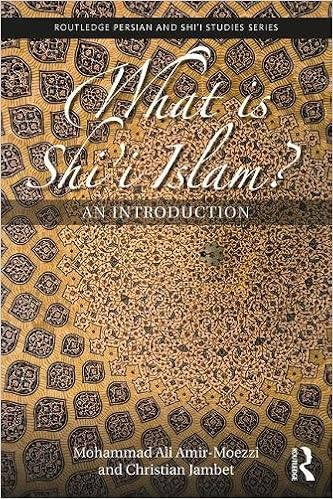
What is Shi'i Islam?: An Introduction
by Mohammad Ali Amir-Moezzi & Christian Jambet
on amazon
For the public at large Shi’ism often implies a host of confused representations, suggesting more often than not obscurantism, intolerance, political violence and other ignominies running hot or cold in response to world events. In fact for many people, Shi’ism stands for "radical Islam", or – worse – "Islamic terrorism". In some respects, nothing is more familiar than Shi’ism, and yet nothing is more misunderstood. For some twenty years the media have increased their coverage of the phenomenon. Never, or only rarely, do they formulate the question we ask here: what is Shi’ism? What is this belief that inspires millions of people dispersed throughout the world?
This book provides a broad based introduction to Shi’i Islam. It examines what the Shi’i believe, how they see themselves and how they view the world. It includes a thorough examination of doctrine, philosophy, the Shi’i approach to the Qur’an and the historical evolution of Shi’ism as a branch of Islam. Too often, and too quickly, the conclusion is drawn that Shi’ism is a marginal heretical sect, fundamentally alien to the deeper truth of the great religion of Islam, thrust by historical accident onto the political stage. Shi’ism either speaks the truth of Islam, meaning that it is a truth of terror, or it is entirely foreign to Islam and, therefore, merits outright rejection, as Islamic fundamentalists and some individuals repeatedly claim. This book intends to explain why such common misunderstandings of Shi’ism have taken root.
Written in an accessible format and providing a thorough overview of Shi’ism, this book will be an essential text for students and scholars of Islamic Studies or Iranian Studies.
Monday, May 14, 2018
Lecture/Workshop in Maine

Fri, Jun 1, 2018 7:00 PM
Sat, Jun 2, 2018 10:00 AM
The C.G. Jung Center
Brunswick, Maine
Fri, Jun 1, 2018 7:00 PM Sat, Jun 2, 2018 10:00 AM
Friday Evening Lecture: REGISTER
Saturday Workshop: REGISTER
Friday evening I will argue for three fundamental propositions: Imagination is Reality; our experience is historically and culturally variable; Language is the means by which we both receive and create the world. We will explore the consequences of this view of reality with the help of the work of C.G. Jung, Henry Corbin, James Hillman, Gaston Bachelard and a variety of poets and artists. We will consider Jung's Red Book, why he refused to think of it as "art," and its place within the artistic tradition. This will lead us to ask about the relation between abstract thought and our archaic, primary human potential. Saturday we will extend this analysis by considering why alchemy was such an important component of the work of all four of our canonical guides to the Imagination. We will consider historically and culturally variable versions of the experience of the "saturated phenomenon." I will end by suggesting practical steps we can take to help us all be more alive, open and compassionate.
Tuesday, May 1, 2018
Review of books on Scholem
THE HEDGEHOG REVIEW: VOL. 20 NO. 1 (SPRING 2018)
REVIEW OF
The Eternal Exile
Stranger in a Strange Land: Searching for Gershom Scholem and Jerusalem
George Prochnik
New York, NY: Other Press, 2017.
Gershom Scholem: An Intellectual Biography
Amir Engel
Chicago, IL: University of Chicago Press, 2017.
by
Nathan Goldman
Wednesday, April 25, 2018
Seven Types of Atheism
John Gray explores fixed idea, unquestioning atheism in his new book Seven Types of Atheism
THE IRISH TIMES
Tue, Apr 24, 2018, Patrick Freyne
John Gray is a self-described atheist who thinks that prominent advocates of atheism have made non-belief seem intolerant, uninspiring and dull. At the end of the first chapter of his new book, Seven Types of Atheism, he concludes that “the organised atheism of the present century is mostly a media phenomenon and best appreciated as a type of entertainment”.
He laughs when I remind him of this sick burn. “I wrote the book partly as a riposte to that kind of atheism,” he says. “There’s not much new in [new atheism] and what is in it is a tired recycled version of forms of atheism that were presented more interestingly in the 19th century. In the so-called new atheism people are [presented with] a binary option between atheism, as if there was only one kind, and religion, as if there was only one kind of religion. [It’s] historically illiterate.
“They don’t even know when they’re repeating ideas from the 19th or early 20th century . . .They don’t know anything of the history of atheism or religion. They’re also very parochial about religion. They take religion to be, not even monotheism or Christianity [but] contemporary American Protestant fundamentalism . . . It’s a parochial, dull debate. I thought of having a subtitle called Why the God Debate is Dead.”
In Seven Types of Atheism, Gray explores the rich philosophical history of non-belief and enlivens it with entertaining tales of humanists like August Comte who so believed in human co-operation he designed clothes that couldn’t be put on without assistance and “god-haters” like the Marquis de Sade whose life was lived in debased defiance of the divine. READ MORE
Friday, April 20, 2018
Every Sufi master is, in a sense, a Freudian psychotherapist
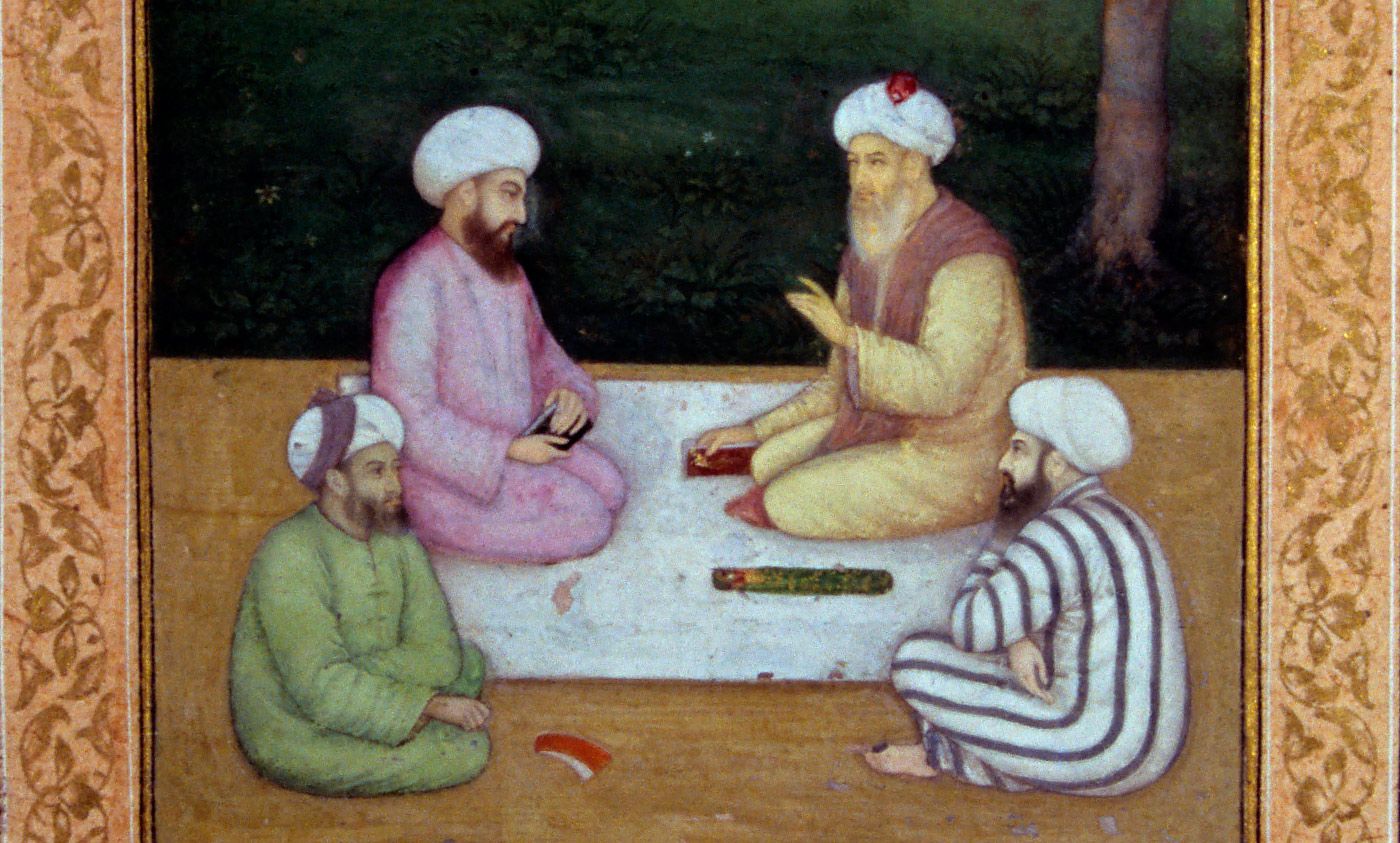

University of California, Davis.
Her latest book is
The Arabic Freud: Psychoanalysis and Islam in Modern Egypt
Even in the most revolutionary thinkers, you will find the uncannily familiar. Sigmund Freud was no exception. Arabs recognised in Freud’s body of thought ideas from classical Islamic thinkers. In the 1940s and ’50s, when intellectuals translated Freud’s work into Arabic, they reached out to Ibn Arabi, the great 12th-13th-century Sufi mystic philosopher. The Egyptian playwright and novelist Tawfiq al-Hakim dates the impulse to blend traditions as far back as Alexander’s conquest of Syria and the eventual translation of philosophical works from Greek to Syriac.
Under Roman rule, Egypt was a centre of learning and part of a shared classical intellectual world, which included Alexandria as much as it did Athens and Rome. Subsequently, Greek philosophy, and particularly the works of Plato and Aristotle, had been energetically translated into Arabic throughout the early Islamic period, contributing to the vitality of Hellenic philosophy. For al-Hakim, Greek ideas were poured into the mould of Islamic philosophy. This process was also evident in al-Hakim’s own work combining Greek tragedy and Islamic legends, in order to effect what he called an ‘intermarriage between two literatures and two mentalities’. It is not at all surprising, then, given this tendency to draw on shared traditions, that Arab intellectuals turned to a mystical Islamic vocabulary when translating Freud in the middle of the 20th century.
This includes the nice detail that Lacan knew of Ibn 'Arabi through reading Corbin.
Subscribe to:
Posts (Atom)


 Posts
Posts


