Friday, May 31, 2013


Thursday, May 30, 2013
Mohammed Rustom
Professor Rustom is, among many other things, an authority on Henry Corbin and Mulla Sadr and an editor of a recent anthology of the writings of Wiliam Chittick. His webpage is well worth your attention:

Wednesday, May 29, 2013
Monday, May 20, 2013
Thomas Arzt Website
Fine new website of my friend and colleague
Thomas Arzt
Princeton-educated Physicist and Jungian Therapist
in the Meditation Center of Karlfried Graf Dürckheim
in Todtmoos-Rütte, Germany
:
Thomas Arzt
Princeton-educated Physicist and Jungian Therapist
in the Meditation Center of Karlfried Graf Dürckheim
in Todtmoos-Rütte, Germany
:

Tuesday, May 14, 2013
A Discussion of the Corbin Quartet
As part of my presentation at Sonoma State University in April
I was interviewed by Michael Lerner of Commonweal.
We talked about Henry Corbin and the books in the quartet.
Tuesday, April 30, 2013
Monday, April 22, 2013
Coffee and qahwa: How a drink for Arab mystics went global

"Qahwa originally meant wine, and Sufi mystics in Yemen used coffee as an aid to concentration and even spiritual intoxication when they chanted the name of God."
Sunday, April 21, 2013
René Guénon, Une politique de l'esprit
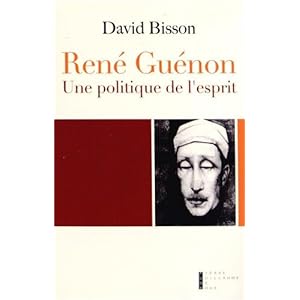
David Bisson, René Guénon, Une politique de l'esprit, PGDR, 526 p.
Abstract :
« ... l'Angleterre avait Shakespeare, l'Italie Dante, /'Allemagne Goethe, la France avait Guénon.» Jean Borella
Né à Blois en 1886 et enterré au Caire sous le nom d'Abd el-Wâhed Yahiâ en 1951, René Guénon est l'homme par qui le scandale arrive. Il dénonce la décadence de l'Occident moderne, fruit d'une lente dégénérescence de son héritage métaphysique et se tourne, au grand dam des catholiques, vers l'Orient devenu, selon lui, le refuge ultime de la« Tradition». Cette dernière notion, centrale chez Guénon, élève toutes les traditions religieuses de l'humanité au même niveau de transcendance tout en reconnaissant à chacune d'entre elles sa dimension spirituelle spécifique. Un point de vue tout simplement révolutionnaire dans les années 30. Dès lors, il appartient à l'individu de se déterminer spirituellement par un processus de connaissance graduée qui dépasse largement le seul exercice d'un rite religieux. C'est la voie ésotérique par essence, qui suscitera l'émergence à travers le monde (Europe, États-Unis, Russie, etc.) d'innombrables« chapelles» initiatiques se réclamant de Guénon, avec notamment les groupes soufis dirigés par Schuon, Vâlsan ou Pallavicini. Chose frappante, un lien inextricable s'est peu à peu tissé entre cette perspective ésotérique et l'horizon politique. En témoignent la« spiritualité héroïque» de Julius Evola dans l'Italie des années trente mais aussi les résonances guénoniennes qu'on découvre dans l'engagement politique de Simone Weil ou de Carl Schmitt. Parallèlement à l'activité des revues Le Voile d'lsis / Études Traditionnelles, les apports de Mircea Eliade, d'Henry Corbin ou de Raymond Abellio achèvent de perpétuer le rayonnement guénonien, si controversé soit-il. Cette mise en perspective monumentale de l'œuvre de René Guénon révèle, de manière décisive, une figure cardinale du XXe siècle et dévoile l'étendue de son rôle dans la construction de la pensée occidentale moderne.
L'auteur
Docteur en sciences politiques et historien des idées, David Bisson, né en 7 97 3, est spécialiste de /'histoire des courants ésotériques contemporains. Ses recherches portent sur les relations qui se nouent entre le politique et le religieux à travers, notamment, la notion de « métapolitique ».
Saturday, April 20, 2013
Thursday, April 18, 2013

Wednesday, April 10, 2013
Major Gnosis Conference - Moscow

Esotericism in Russia: “Ways of Gnosis” conference, April 10-13, 2013
Abstracts include this:
Арапов Александр Владиленович, доктор философских наук, доцент,
профессор кафедры философии, истории и права Финансового университета при
Правительстве РФ, Воронежский филиал (Воронеж).
Email: arpv@mail.ru
Анри Корбен: гностик и востоковед
Тексты Корбена всегда глубинным образом связаны с его личным
духовным опытом, который он хочет донести до родственных душ, до тех,
кто, как и он сам, принадлежит к мировой религии Гнозиса. Для Анри
Корбена Христос – Ангел, небесный полюс, небесная самость человека.
Человеческая сущность двухполюсная и образует двуединство земной и
небесной формы. Ангел Христос – его высшая вторая половина. Ангельский
статус человека не дан ему от рождения – он является целью, которую
необходимо достичь. Истинное жизненное путешествие человека – это
восхождение по духовной лестнице, Успех на данном пути зависит от способности любить и от неразрывно связанной с ней способности
воспринимать красоту. Таким образом, гностическая сотериология, учение о
спасении, говорит не о воплощении Христа, который становится человеком,
а о восхождении человека, который становится ангелом.
Henry Corbin: Gnostic and Orientalist
Corbin’s texts are always deeply connected to his personal spiritual
experiences, which he wants to share with all kindred souls, with all who, like
himself, are adherents of the world religion of Gnosis. In Corbin’s
weltanschauung, Christ is the Angel, the celestial pole, the heavenly self of a
human being. The human essence is bipolar, a unity of the celestial and the
terrestrial forms. The Angel Christ is the supreme celestial half of a human being.
The status of an Angel is the goal of a human life, something to strive for rather
than inherent by birth. The true human life journey is an ascension on the spiritual
ladder. The ability to love and the ability to see beauty are necessary requirements
for this ascension. Therefore, the Gnostic soteriology – salvation doctrine – is not
about the incarnation of Christ, not about the God who became a man. It is about
the ascension of a human being, about a man who will become an Angel.
Tuesday, April 9, 2013
Bunting's Persia

Edited by Don Share, this slim anthology collects Basil Bunting’s translations from Persian poetry by Rudaki, Ferdowsi, Manuchehri, Sa‘di, Hafiz, and Obaid-e Zakani, including some that are previously unpublished. Bunting, who is widely regarded as one of the most important British poets of the twentieth century, proved unusual in his deep and abiding interest in Middle Eastern culture. Here, he renders poetry of remarkable tonal and emotional range in characteristically clear and resolute language.
“Reading Bunting’s translations, I am struck again by how fresh and strong they are, how vivid in their feeling, and how he digs into the spirit of the originals—a kind of passionate excavation work.”—Dick Davis, translator of The Shahnameh: The Persian Book of Kings
Sunday, April 7, 2013
On John Clarke (in the series on Corbin & Poetry)
I have this note from Duncan McNaughton dating back a couple years in response to a question about Corbin's influence:
As far as I know - not far - Jack Clarke's book From Feathers to Iron and subsequent poetry is the most evident use of Corbin after Olson's. In a primary determination involving, obviously, several other primaries - Blake, the Dogon stuff, Novalis, di Santillana etc. All aimed at what is actually meant by what is called "interpretation."

From the back cover we have this from James Hillman:
"How rarely I come upon a truly useful book. Clarke has packed it all in here and wherever you open the pages, jewels, pearls, crowns tumble out. I see illustrations to the Arabian Nights. I have already picked up and walked off with treasures."
Also, in the current issue of Ken Warren's HOUSE ORGAN there is a very nice piece by Bruce Holsapple on Clarke's In the Analogy.
Friday, April 5, 2013
Thursday, April 4, 2013
"The Réalité-humaine of Henry Corbin" - Doctoral Thesis
Bligh, Rebecca. 2012. The Réalité-humaine of Henry Corbin. (full text available). Doctoral thesis, Goldsmiths, University of London.
This thesis sets out to correlate—to hyphenate, even—the dual and historically disparate personae of Henry Corbin the first French translator of Heidegger, and Henry Corbin, Iranian Islamist and pioneering comparative philosopher. The thesis’ cynosure is a case for the philosophicohistorically contextual reconsideration of Corbin’s infamous translation of Heidegger’s term Dasein as “réalité-humaine”, as the result of the young Corbin’s own profound engagement with Heidegger as informed by the then philosophically avant-garde.
A contextual reading of Corbin’s late “Biographical Post-Scriptum” is enriched by the introduction of a correspondence between Corbin and the Warburg Library (chiefly Gertrud Bing), discovered to lie in the Warburg Library Archive in London, but which to date does not appear in Corbinian literature.
The self-proclaimed point, and cause of Corbin’s divergence from Heidegger is examined further. Traces of Corbin’s own professed “debt” to Heidegger will be shown to have indeed persisted throughout Corbin’s oeuvre. Close readings of the ontological role accorded to the transcendental imagination by Heidegger (after Kant) in the Kant book, and Heidegger’s proofs of the finitude of both Being and Dasein, as set forth in (the majority of) those texts included in Corbin’s 1938 Gallimard translation of Heidegger, Qu’est-ce que la métaphysique? (including Part 4 of the Kant book) and Parts 1-3 of the Kant book are read against Corbin’s own philosophy of the imaginal.
Subscribe to:
Posts (Atom)


 Posts


