Thursday, September 26, 2013
Volume 1 is NOT out of print...
"I use Grammarly's plagiarism checker online because it works."
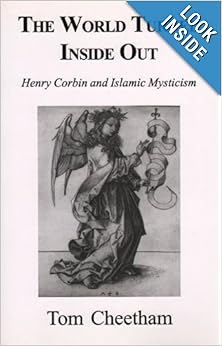
amazon tells us that the volume is only available used for $900... which seems a bit excessive and is in any case not true (if anyone wants to buy my copy for $700 I'd be happy to oblige) - the publisher will be sending them more shortly. This book keeps selling, albeit slowly, and will be due for another (3rd?) print run soon.


Tuesday, September 24, 2013
Corbin in Utah - November 2013

Reality at White Heat
Towards a Concrete Imagination
with
Tom Cheetham
A Program for The Jung Society of Utah
November 15 & 16, 2013
The experience of the “saturated object” (Marion) and the need for a perpetual recovery of the full range of our experience of the world occupy a central place in the account of the imagination that we will develop in these lectures and workshops. On one reading, a saturated object has the function of an icon, and we will begin with an account of the theology of the icon provided by Henry Corbin, one of the 20th century’s great scholars and philosophers of the imagination. Corbin was a colleague of C.G. Jung and a major figure at the Eranos Conferences for nearly three decades. His works have had a broad and and continuing influence on writers and artists worldwide.
We will expand our exploration by considering and developing various understandings of creative imagination in the works of Corbin, Jung and James Hillman. Our aim will be to recapture the reality of our world through as expansive and active an exercise of the imagination as possible.
Friday Evening Lecture: “Your Autonomy is a Fiction” - Henry Corbin On Being Human
Saturday Lecture/Workshop: Imaginal Love
Tom Cheetham, All the World An Icon: Henry Corbin & the Angelic Function of Beings
Henry Corbin, Alone with the Alone: Creative Imagination in the Sufism of In ‘Arabi
James Hillman, Archetypal Psychology: A Brief Account
--------------------, Re-Visioning Psychology
Tom Cheetham, Ph.D, holds degrees in philosophy and biology. He is the author of four books on Henry Corbin and the implications of his work for our understanding of ourselves and the world; the most recent is All the World an Icon: Henry Corbin and the Angelic Function of Beings (2012, North Atlantic Books). He compiled the Bibliography of Archetypal Psychology for James Hillman’s Archetypal Psychology: A Brief Account and is editing On Melancholy, a collection of Hillman’s seminars on the meaning of depression in modern society. He lectures frequently in Europe and the US. He and his wife have two grown children and live in rural Maine.
Monday, August 5, 2013
Tuesday, July 30, 2013
Monday, July 1, 2013
Tuesday, June 11, 2013
William Chittick - Major new book

The very heart of the Islamic tradition is love; no other word adequately captures the quest for transformation that lies at this tradition’s center. So argues esteemed professor of medieval Islam William C. Chittick in this survey of the extensive Arabic and Persian literature on topics ranging from the Qur’an up through the twelfth century. Bringing to light extensive foundational Persian sources never before presented, Chittick draws on more than a thousand pages of newly translated material to depict the rich prose literature at the center of Islamic thought.
William C. Chittick, professor of religious studies at Stony Brook University, is a leading translator and interpreter of classical Islamic texts. His books include The Sufi Path of Love and In Search of the Lost Heart. He lives in Mount Sinai, NY.
Monday, June 10, 2013
The Ocean of Nonexistence
I am delighted to flag a really interesting and lovely paper by Dr. Mohammed Rustom appearing in
Mawlana Rumi Review 4 (2013)
The Ocean of Nonexistence
Mohammed Rustom
In this article, I would like to offer some remarks on what Rumi has to say about love. What, in other words, is it? From his perspective, inquiring into the nature of love can only give one partial answers, since the very inquiry into what love is entails a partial question. The easiest way for Rumi to explain what love is, is by saying that we will know what it is when we get there. Consider these lines:
Someone asked, ‘What is Love?’ I said, ‘Do not ask about these meanings.
When you become like me, you will see. When you are invited by It, you will sing of It.’
Thankfully, Rumi himself left behind nearly 65,000 verses of poetry, most of which sing of the nature and reality of love. Yet, even after having attained to love, he acknowledges that some things are better left unsaid, precisely because love is too vast to be encompassed by human thought and language:
Whatever I say about Love by way of commentary and exposition,
Someone asked, ‘What is Love?’ I said, ‘Do not ask about these meanings.
When you become like me, you will see. When you are invited by It, you will sing of It.’
Thankfully, Rumi himself left behind nearly 65,000 verses of poetry, most of which sing of the nature and reality of love. Yet, even after having attained to love, he acknowledges that some things are better left unsaid, precisely because love is too vast to be encompassed by human thought and language:
Whatever I say about Love by way of commentary and exposition,
when I get to Love, I am ashamed at that
Although explanation with the tongue is clear,
that Love which is tongue-less is even clearer.
Since love is so difficult to pin down, Rumi finds an apt metaphor for what it is by referring to it as an ‘ocean’, which, incidentally, he does more so than any other poet in the Persian or Arabic language...
that Love which is tongue-less is even clearer.
Since love is so difficult to pin down, Rumi finds an apt metaphor for what it is by referring to it as an ‘ocean’, which, incidentally, he does more so than any other poet in the Persian or Arabic language...
Friday, May 31, 2013
Thursday, May 30, 2013
Mohammed Rustom
Professor Rustom is, among many other things, an authority on Henry Corbin and Mulla Sadr and an editor of a recent anthology of the writings of Wiliam Chittick. His webpage is well worth your attention:

Wednesday, May 29, 2013
Monday, May 20, 2013
Thomas Arzt Website
Fine new website of my friend and colleague
Thomas Arzt
Princeton-educated Physicist and Jungian Therapist
in the Meditation Center of Karlfried Graf Dürckheim
in Todtmoos-Rütte, Germany
:
Thomas Arzt
Princeton-educated Physicist and Jungian Therapist
in the Meditation Center of Karlfried Graf Dürckheim
in Todtmoos-Rütte, Germany
:

Tuesday, May 14, 2013
A Discussion of the Corbin Quartet
As part of my presentation at Sonoma State University in April
I was interviewed by Michael Lerner of Commonweal.
We talked about Henry Corbin and the books in the quartet.
Tuesday, April 30, 2013
Monday, April 22, 2013
Coffee and qahwa: How a drink for Arab mystics went global

"Qahwa originally meant wine, and Sufi mystics in Yemen used coffee as an aid to concentration and even spiritual intoxication when they chanted the name of God."
Sunday, April 21, 2013
René Guénon, Une politique de l'esprit
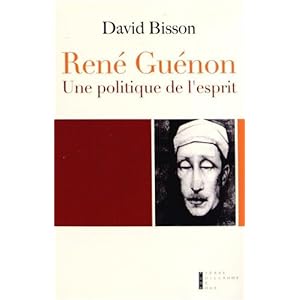
David Bisson, René Guénon, Une politique de l'esprit, PGDR, 526 p.
Abstract :
« ... l'Angleterre avait Shakespeare, l'Italie Dante, /'Allemagne Goethe, la France avait Guénon.» Jean Borella
Né à Blois en 1886 et enterré au Caire sous le nom d'Abd el-Wâhed Yahiâ en 1951, René Guénon est l'homme par qui le scandale arrive. Il dénonce la décadence de l'Occident moderne, fruit d'une lente dégénérescence de son héritage métaphysique et se tourne, au grand dam des catholiques, vers l'Orient devenu, selon lui, le refuge ultime de la« Tradition». Cette dernière notion, centrale chez Guénon, élève toutes les traditions religieuses de l'humanité au même niveau de transcendance tout en reconnaissant à chacune d'entre elles sa dimension spirituelle spécifique. Un point de vue tout simplement révolutionnaire dans les années 30. Dès lors, il appartient à l'individu de se déterminer spirituellement par un processus de connaissance graduée qui dépasse largement le seul exercice d'un rite religieux. C'est la voie ésotérique par essence, qui suscitera l'émergence à travers le monde (Europe, États-Unis, Russie, etc.) d'innombrables« chapelles» initiatiques se réclamant de Guénon, avec notamment les groupes soufis dirigés par Schuon, Vâlsan ou Pallavicini. Chose frappante, un lien inextricable s'est peu à peu tissé entre cette perspective ésotérique et l'horizon politique. En témoignent la« spiritualité héroïque» de Julius Evola dans l'Italie des années trente mais aussi les résonances guénoniennes qu'on découvre dans l'engagement politique de Simone Weil ou de Carl Schmitt. Parallèlement à l'activité des revues Le Voile d'lsis / Études Traditionnelles, les apports de Mircea Eliade, d'Henry Corbin ou de Raymond Abellio achèvent de perpétuer le rayonnement guénonien, si controversé soit-il. Cette mise en perspective monumentale de l'œuvre de René Guénon révèle, de manière décisive, une figure cardinale du XXe siècle et dévoile l'étendue de son rôle dans la construction de la pensée occidentale moderne.
L'auteur
Docteur en sciences politiques et historien des idées, David Bisson, né en 7 97 3, est spécialiste de /'histoire des courants ésotériques contemporains. Ses recherches portent sur les relations qui se nouent entre le politique et le religieux à travers, notamment, la notion de « métapolitique ».
Subscribe to:
Posts (Atom)


 Posts
Posts


