Monday, October 28, 2013
Jung & Corbin in Paris
« LE LIVRE ROUGE DE JUNG, HENRY CORBIN ET
LES VISIONS DE L’ISLAM IRANIEN »
Samedi 23 novembre 2013 de 14h à 18h
Forum 104
104, rue de Vaugirard - 75006 PARIS
LES VISIONS DE L’ISLAM IRANIEN »
Samedi 23 novembre 2013 de 14h à 18h
Forum 104
104, rue de Vaugirard - 75006 PARIS
Avec le soutien de la SFPA et le partenariat des associations « Autour de Marie-Louise von Franz » et « Groupe d’Etudes C.G. Jung ».

Jean-François Alizon, théologien, pédagogue, musicien et président du Centre Européen d’Etudes Jungiennes de Strasbourg mettra en parallèle le Livre Rouge de Jung avec les visions initiatiques d’Avicenne et de Sohrawardi, telles qu’on peut les trouver dans les livres d’Henry Corbin Avicenne et le récit visionnaire et L’Archange Empourpré. JF Alizon analysera les étonnantes résonnances et similitudes des parcours intérieurs et aussi le même recours à l’imagination active au 11ème siècle comme au 20ème siècle. L’exposé sera accompagné de lectures qui feront revivre les récits iraniens et les dialogues du Livre Rouge, avec projection d’images de ce même Livre Rouge. La musique de flûtes traversières renaissance ponctuera aussi l’après midi.
Tarif adhérent proposé aux Amis de Henry et Stella Corbin : 25€
Inscription préalable nécessaire irene.ponsoye@mailoo.org ou 06 19 14 92 90
Inscription préalable nécessaire irene.ponsoye@mailoo.org ou 06 19 14 92 90


Monday, October 7, 2013
Corbin & Pir Vilayat Inayat Khan
Many thanks to Muinuddin Smith for drawing my attention to this letter of considerable interest:
A letter of March, 1962
by
HENRY CORBIN
Tuesday, October 1, 2013
On Husayn ibn Mansur al-Hallaj

Husayn ibn Mansur al-Hallaj (Persian, 10th century A.D.): from The Divan
Thursday, September 26, 2013
Volume 1 is NOT out of print...
"I use Grammarly's plagiarism checker online because it works."
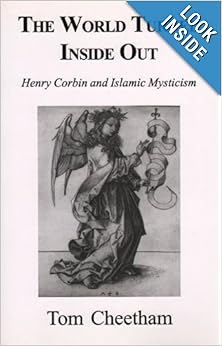
amazon tells us that the volume is only available used for $900... which seems a bit excessive and is in any case not true (if anyone wants to buy my copy for $700 I'd be happy to oblige) - the publisher will be sending them more shortly. This book keeps selling, albeit slowly, and will be due for another (3rd?) print run soon.
Tuesday, September 24, 2013
Corbin in Utah - November 2013

Reality at White Heat
Towards a Concrete Imagination
with
Tom Cheetham
A Program for The Jung Society of Utah
November 15 & 16, 2013
The experience of the “saturated object” (Marion) and the need for a perpetual recovery of the full range of our experience of the world occupy a central place in the account of the imagination that we will develop in these lectures and workshops. On one reading, a saturated object has the function of an icon, and we will begin with an account of the theology of the icon provided by Henry Corbin, one of the 20th century’s great scholars and philosophers of the imagination. Corbin was a colleague of C.G. Jung and a major figure at the Eranos Conferences for nearly three decades. His works have had a broad and and continuing influence on writers and artists worldwide.
We will expand our exploration by considering and developing various understandings of creative imagination in the works of Corbin, Jung and James Hillman. Our aim will be to recapture the reality of our world through as expansive and active an exercise of the imagination as possible.
Friday Evening Lecture: “Your Autonomy is a Fiction” - Henry Corbin On Being Human
Saturday Lecture/Workshop: Imaginal Love
Tom Cheetham, All the World An Icon: Henry Corbin & the Angelic Function of Beings
Henry Corbin, Alone with the Alone: Creative Imagination in the Sufism of In ‘Arabi
James Hillman, Archetypal Psychology: A Brief Account
--------------------, Re-Visioning Psychology
Tom Cheetham, Ph.D, holds degrees in philosophy and biology. He is the author of four books on Henry Corbin and the implications of his work for our understanding of ourselves and the world; the most recent is All the World an Icon: Henry Corbin and the Angelic Function of Beings (2012, North Atlantic Books). He compiled the Bibliography of Archetypal Psychology for James Hillman’s Archetypal Psychology: A Brief Account and is editing On Melancholy, a collection of Hillman’s seminars on the meaning of depression in modern society. He lectures frequently in Europe and the US. He and his wife have two grown children and live in rural Maine.
Monday, August 5, 2013
Tuesday, July 30, 2013
Monday, July 1, 2013
Tuesday, June 11, 2013
William Chittick - Major new book

The very heart of the Islamic tradition is love; no other word adequately captures the quest for transformation that lies at this tradition’s center. So argues esteemed professor of medieval Islam William C. Chittick in this survey of the extensive Arabic and Persian literature on topics ranging from the Qur’an up through the twelfth century. Bringing to light extensive foundational Persian sources never before presented, Chittick draws on more than a thousand pages of newly translated material to depict the rich prose literature at the center of Islamic thought.
William C. Chittick, professor of religious studies at Stony Brook University, is a leading translator and interpreter of classical Islamic texts. His books include The Sufi Path of Love and In Search of the Lost Heart. He lives in Mount Sinai, NY.
Monday, June 10, 2013
The Ocean of Nonexistence
I am delighted to flag a really interesting and lovely paper by Dr. Mohammed Rustom appearing in
Mawlana Rumi Review 4 (2013)
The Ocean of Nonexistence
Mohammed Rustom
In this article, I would like to offer some remarks on what Rumi has to say about love. What, in other words, is it? From his perspective, inquiring into the nature of love can only give one partial answers, since the very inquiry into what love is entails a partial question. The easiest way for Rumi to explain what love is, is by saying that we will know what it is when we get there. Consider these lines:
Someone asked, ‘What is Love?’ I said, ‘Do not ask about these meanings.
When you become like me, you will see. When you are invited by It, you will sing of It.’
Thankfully, Rumi himself left behind nearly 65,000 verses of poetry, most of which sing of the nature and reality of love. Yet, even after having attained to love, he acknowledges that some things are better left unsaid, precisely because love is too vast to be encompassed by human thought and language:
Whatever I say about Love by way of commentary and exposition,
Someone asked, ‘What is Love?’ I said, ‘Do not ask about these meanings.
When you become like me, you will see. When you are invited by It, you will sing of It.’
Thankfully, Rumi himself left behind nearly 65,000 verses of poetry, most of which sing of the nature and reality of love. Yet, even after having attained to love, he acknowledges that some things are better left unsaid, precisely because love is too vast to be encompassed by human thought and language:
Whatever I say about Love by way of commentary and exposition,
when I get to Love, I am ashamed at that
Although explanation with the tongue is clear,
that Love which is tongue-less is even clearer.
Since love is so difficult to pin down, Rumi finds an apt metaphor for what it is by referring to it as an ‘ocean’, which, incidentally, he does more so than any other poet in the Persian or Arabic language...
that Love which is tongue-less is even clearer.
Since love is so difficult to pin down, Rumi finds an apt metaphor for what it is by referring to it as an ‘ocean’, which, incidentally, he does more so than any other poet in the Persian or Arabic language...
Friday, May 31, 2013
Thursday, May 30, 2013
Mohammed Rustom
Professor Rustom is, among many other things, an authority on Henry Corbin and Mulla Sadr and an editor of a recent anthology of the writings of Wiliam Chittick. His webpage is well worth your attention:
Wednesday, May 29, 2013
Monday, May 20, 2013
Thomas Arzt Website
Fine new website of my friend and colleague
Thomas Arzt
Princeton-educated Physicist and Jungian Therapist
in the Meditation Center of Karlfried Graf Dürckheim
in Todtmoos-Rütte, Germany
:
Thomas Arzt
Princeton-educated Physicist and Jungian Therapist
in the Meditation Center of Karlfried Graf Dürckheim
in Todtmoos-Rütte, Germany
:

Tuesday, May 14, 2013
A Discussion of the Corbin Quartet
As part of my presentation at Sonoma State University in April
I was interviewed by Michael Lerner of Commonweal.
We talked about Henry Corbin and the books in the quartet.
Subscribe to:
Posts (Atom)


 Posts
Posts

