Saturday, December 27, 2008
Course on Henry Corbin
The following course is offered on occasion by Dr. Todd Lawson at the University of Torono:
NMC 2050Y ISLAMIC THEOLOGY AND PHILOSOPHY: HENRY CORBIN
This course will study the works of the great French student and scholar of Islamic thought, Henry Corbin (1903-1978). Corbin's scholarly output was enormous and profound, yet it has still failed to attract due attention from contemporary scholars. In this seminar we will study several of Corbin's books and focus our attention on a number of recurring themes in his scholarship (mundus imaginalis, the noetic role of the feminine, interpretation as revelation, the Hidden Imam, and oneness of being, among others). Students interested in Islamic religious thought, comparative "Abrahamic" mysticism, philosophical theology, Islam & the West and modern developments in philosophy East and West are welcome. A reading knowledge of French is highly recommended though not mandatory. - T. Lawson
(I remain interested in compiling a list of any other relevant courses. Please contact me at tcheetham@gmail.com).
NMC 2050Y ISLAMIC THEOLOGY AND PHILOSOPHY: HENRY CORBIN
This course will study the works of the great French student and scholar of Islamic thought, Henry Corbin (1903-1978). Corbin's scholarly output was enormous and profound, yet it has still failed to attract due attention from contemporary scholars. In this seminar we will study several of Corbin's books and focus our attention on a number of recurring themes in his scholarship (mundus imaginalis, the noetic role of the feminine, interpretation as revelation, the Hidden Imam, and oneness of being, among others). Students interested in Islamic religious thought, comparative "Abrahamic" mysticism, philosophical theology, Islam & the West and modern developments in philosophy East and West are welcome. A reading knowledge of French is highly recommended though not mandatory. - T. Lawson
(I remain interested in compiling a list of any other relevant courses. Please contact me at tcheetham@gmail.com).


Monday, December 15, 2008
Henry Corbin on Tolkien's Lord of the Rings
 What follows is from the Epilogue to « L'Elément dramatique commun aux cosmogonies gnostiques des religions du Livre », Cahiers de l'Université Saint Jean de Jérusalem 5, 1979, 141-174. It appears in English as "The Dramatic Element Common to Gnostic Cosmogonies of the Religions of the Book," Studies in Comparative Religion 14/3-4 (1980): 199-221. This is the last talk Corbin delivered. He presented this essay in June, four months before his death in October, 1978.
"…Is it right to speak, as is often the case, of the pessimism of Gnosis? Such a judgment assumes that one has forgotten what the struggle of the Gnostic is about, what its origin is and what its outcome will be. This outcome makes it clear that if gnosis despairs of this world it is in the form of a desperatio fiducialis, a confident desperation… Where then is the optimism of this despair rooted?
For this optimism is in contrast with the grandiose but hopeless perspective of the heroic Nordic epic, with its eschatological vision of Ragnorak, the Fate of the Gods. There too the gods are the allies of men, and both together are partners in the same struggle against monstrous cosmic powers; but they know that they will finally be killed by these monstrous powers, and that after that the world will be destroyed. “The victors are Chaos and Insanity, but the Gods who will be defeated consider that the defeat is not a refutation… They offer absolute resistance, perfect, because without hope…” [W.P. Ker, The Dark Ages, 1904] Certainly the predominance of Darkness is not a refutation of the Light. But inversely, when the Light prevails over Darkness, is this a refutation of Darkness? Does Darkness allow itself to be refuted? Will the Light simply be its refutation?
I would like to reply to these questions with the aid of a recent work, Tolkien’s Lord of the Rings. I think that this is the first time since the conclusion of the Grail cycle that there has appeared in the West an epic at once heroic, mystic and Gnostic, the narrative events of which can enchant the wise both young and old because they will recognize its hidden meaning. Throughout the epic is dominated by the theme of the maleficent Ring mislaid in the country of Light. This ring continually incites the best among the beings of the Light to submit to the temptation it represents: the will to power. Indeed the temptation is great to use the evil will to power in the service of the Light. Moreover it is not in the Darkness that the temptation of the Darkness can become virulent, but in the realm of light. It is in the world of Light that the drama, which for all gnoses initiates cosmogony, has its origin.
But the world of Light absolutely must not resort to the evil will to power in order to ensure its victory over Darkness. To resort to that desire would be to ensure the triumph of the Darkness. It is not even enough to hide, to bury the Ring in some secret and unknown place in the realm of Light: its malefic influence will continue to operate. It must be not simply rejected but destroyed. But to destroy is a negative action, and the world of Light does not permit negativity.
The weapon of the light is of another order: it is to compel the Darkness to destroy itself, to accomplish its negation by the negation of its own negativity. To destroy the evil Ring, representative of the will to power, is to cast it back into Darkness, so that the Darkness destroys what has issued from it. A fearless hero, overcoming the most terrifying apparitions and traps, must carry the Ring back to its place of origin: to the furnace which is in the crater of the mountain of the Lord of the Shadow, in the land of Darkness. When the hero finally casts the Ring into the abyss, the world of Light is delivered from the evil will to power. This is the theme of Tolkien’s epic.
What the hero performs in this epic appears as a Quest in reverse of the Quest for the Holy Grail. But at the same time this Quest seems to be a necessary prelude, a Quest without which the Quest for the Grail cannot succeed. Parsifal’s speech, at the end of Book XV of Wolfram von Eschenbach’s epic, warns us that “no one can obtain the Grail except him whom God himself has appointed.” From this time. Wolfram tells us, “this word traveled across all lands, that no one could win the Grail by fighting for it, and so, many knights gave up searching for it.” For the Elect are not appointed by God to become ‘possessors’ of the Grail by force of arms. They must first of all renounce such possession, and this is to destroy their will to power through their own powerlessness. Only then can they attain the vision of elsewhere to which they must commit themselves. “This is why the Grail still remains hidden to all eyes,” Wolfram tells us.
We know what he means: it is hidden to all eyes of the flesh. The epic of the Grail ends in occultation. Parsifal carries it back to a mystical East…that is not on our maps, or it is taken from this world and withdrawn to the “spiritual Palace” (Galahad). Must we then speak of the pessimism of the Grail cycle? To do so would be to forget…what is the nature of the struggle that opens to way towards the Grail, and what the eyes are that perceive this way. The world in which the Grail is occulted is still visible to the eyes of fire, and that is why there will always be secret Knights-Templar who pursue the Quest for the Grail… [F]or it is not with the weapons of the will to power but through knightly service that one is a partner of a God in exile and that one sets free the sparks of light imprisoned in… the world of shadows and defilement…"
(Translation slightly altered.)
Orodruin, Mount Doom, Mordor.
Thursday, December 11, 2008
Cahiers de l'Université Saint Jean de Jérusalem
In 1974 Corbin and a group of colleagues including Gilbert Durand and Antoine Faivre, founded the University of St. John of Jerusalem: The International Center for Comparative Spiritual Research. This organization operated until 1988 and published 14 volumes of Proceedings. Corbin's contributions, both opening remarks and essays, are in the first five Proceedings. The 14 volumes are devoted to the succession of topics originally proposed by Corbin. Having completed the original mission, the organization was succeeded by Les Cahiers du Groupe d'Etudes Spirituelles Comparées. Corbin's contributions and the various volumes published by both organizations are listed below.
Articles by Henry Corbin in Cahiers de l'Université Saint Jean de Jérusalem:
« L'Université Saint Jean de Jérusalem, Centre international de recherche spirituelle comparée » and « Science traditionnelle et renaissance spirituelle », Cahier de l'Université Saint Jean de Jérusalem 1, 1975, pp. 8-12 et 25-50. An English translation of the second text appears as "Traditional Knowledge and Spiritual Renaissance," in Temenos Academy Review 1 (1998).
« Spiritualité du Temple et tradition abrahamique », Cahiers de l'Université Saint Jean de Jerusalem 2, 1976, pp. 13-42.
« L'Evangile de Barnabé et la prophétologie islamique », Cahiers de l'Université de Saint Jean de Jérusalem 3, 1977, pp. 169-212.
« L'Orient des pèlerins abrahamiques », Cahiers de l'Université de Saint Jean de Jérusalem 4, 1978, pp. 67-98.
« L'Elément dramatique commun aux cosmogonies gnostiques des religions du Livre », Cahiers de l'Université Saint Jean de Jérusalem, 5, 1979, pp. 141-174. In English as "The Dramatic Element Common to Gnostic Cosmogonies of the Religions of the Book," Studies in Comparative Religion 14/3-4 (1980):199-221. Corbin's Opening Remarks have appeared in English as "Eyes of Flesh, Eyes of Fire: Science and Gnosis" in Material for Thought 8, 1980, Far West Institute, San Francisco, 5-10.
« Le combat pour l'Âme du monde ou urgence de la sophiologie », Cahiers de l'Université Saint Jean de Jérusalem 6, 1980, pp. 1-15.
Individual Volumes of Les Cahiers de l'Université Saint Jean de Jérusalem
Sciences Traditionelles et Sciences Profanes. Cahiers de l'Université Saint Jean de Jérusalem 1, 1975. Paris: Berg international, 1975.
Jérusalem, la cité spirituelle: colloque tenu à Cambrai/Vaucelles les 20, 21 et 22 juin 1975. Cahiers de l'Université Saint Jean de Jérusalem, 2. Paris: Berg international, 1976.
La Foi prophetique et le sacré: colloque tenu à Cambrai/Vaucelles les 25, 26 et 27 juin 1976. Paris: Berg International, 1977.
Les pèlerins de lO̓rient et les vagabonds de lO̓ccident: colloque tenu à Paris les 17, 18 et 19 juin 1977. Paris: Berg International, 1978.
Les Yeux de chair et les yeux de feu: la science et la gnose : colloque tenu à Paris les 2,3 et 4 juin 1978. Cahiers de l'Université Saint Jean de Jérusalem, 5. Paris: Berg international, 1979.
Le Combat pour l'âme du monde: urgence de la sophiologie : colloque tenu à Paris les 15, 16, et 17 juin 1979. Cahiers de l'Université Saint Jean de Jerusalem, 6. Paris: Berg International, 1980.
L'Hermeneutique permanente ou le buisson ardent. Colloque tenu à Paris les 6,7 et 8 juin 1980. Berg International, Paris, 1981, Cahiers de l'Université Saint Jean de Jérusalem, 7. [Textes de Ch. Jambet, A. Abécassis, J.-L. Leuba, P. Demange, H. Mongis, J.-L. Vieillard-Baron, D. Shayegan, L. Ashkenazi, Jean Brun, Gilbert Durand]
Le Désert et la queste: colloque tenu à Paris les 12, 13, 14 juin 1982. Cahiers de l'Université Saint Jean de Jérusalem, 8. Paris: Berg international, 1982.
Apocalypse et sens de l'Histoire. [Actes du] Colloque tenu à Paris les 11,12, 13 juin 1982. Berg International, Paris, 1983, Cahiers de l'Université Saint Jean de Jérusalem, 9. [Textes de J.-L. Vieillard-Baron, A. Abécassis, K. Raine, P. Deghaye, C. Jambet, O. Clément, R.Stauffer, G. Lardreau et J. Brun]
La Chevalerie spirituelle: colloque tenu à Paris les 10, 11 et 12 juin 1983. Cahiers de l'Université Saint Jean de Jérusalem, 10. Paris: Berg International, 1984.
La Contemplation comme action nécessaire: colloque tenu à Paris les 18, 19, 20 mai 1984. Cahiers de l'Université Saint Jean de Jérusalem, 11. Paris: Berg international, 1985.
Face de Dieu et théophanies: colloque tenu à Paris les 10, 11, 12 mai 1985. Cahiers de l'Université Saint Jean de Jérusalem, 12. Paris: Berg international, 1986.
La Matière spirituelle: colloque tenu à Paris les 6, 7, 8 juin 1986. Cahiers de l'Université Saint Jean de Jérusalem, 13. Paris: Berg International, 1987.
Temps et hiérohistoire: colloque tenu à Paris les 22, 23 24 mai 1987. Cahiers de l'Université Saint Jean de Jérusalem, 14. Paris: Berg international, 1988.
Proceedings of Le Groupe d'Études Spirituelles Comparées
Transmission culturelle, transmission spirituelle: colloque tenu en Sorbonne le 13 et 14 juin. Milano: Archè, 1993.
Images et valeurs: colloque tenu à Paris les 15 et 16 mai 1993. Milano: Archè, 1994.
Féminité et spiritualité: colloque tenu à Paris les 28 et 29 mai 1994. Milano: Archè, 1995.
La géographie spirituelle: colloque tenu à Paris les 20 et 21 mai 1995. Milano: Archè, 1997.
L'esprit et la nature: colloque tenu à Paris les 11 et 12 mai 1996. Cahiers du Groupe d'études spirituelles comparées, 5. Milano: Archè, 1997.
Animus et anima: colloque tenu à Paris les 31 mai et 1er juin 1997. Cahiers du Groupe d'études spirituelles comparées, 6. Milano: Archè, 1998.
L'un et le multiple: colloque tenu à Paris les 6 et 7 juin 1998. Cahiers du Groupe d'études spirituelles comparées, 7. Milano: Archè, 1999.
Henry Corbin et le comparatisme spirituel: Colloque tenu à Paris les 5 et 6 juin 1999. Cahiers du Groupe d'études spirituelles comparées, 8. Milan: Arché, 1999.
Hiérarchies et traditions: colloque tenu à Paris les 27 et 28 mai 2001. Cahiers du Groupe d'études spirituelles comparées, 9. Milan: Archè, 2001.
Témoins et témoignages: Colloque tenu à Paris les 27 et 28 mai 2001. Cahiers du groupe d'études spirituelles comparées, 10. Milano: Archè, 2003.
La figure d'Adam: Colloque tenu à la Sorbonne les 24 et 25 mai 2003. Cahiers du goupe d'études spirituelles comparées, 11. Milan: Archè, 2005.
Métamorphose et conversion: Colloque tenu à la Sorbonne les 21 et 22 mai 2005. Actes. Cahiers du groupe d'études spirituelles comparées, 12. Milan: Archè, 2008.
Articles by Henry Corbin in Cahiers de l'Université Saint Jean de Jérusalem:
« L'Université Saint Jean de Jérusalem, Centre international de recherche spirituelle comparée » and « Science traditionnelle et renaissance spirituelle », Cahier de l'Université Saint Jean de Jérusalem 1, 1975, pp. 8-12 et 25-50. An English translation of the second text appears as "Traditional Knowledge and Spiritual Renaissance," in Temenos Academy Review 1 (1998).
« Spiritualité du Temple et tradition abrahamique », Cahiers de l'Université Saint Jean de Jerusalem 2, 1976, pp. 13-42.
« L'Evangile de Barnabé et la prophétologie islamique », Cahiers de l'Université de Saint Jean de Jérusalem 3, 1977, pp. 169-212.
« L'Orient des pèlerins abrahamiques », Cahiers de l'Université de Saint Jean de Jérusalem 4, 1978, pp. 67-98.
« L'Elément dramatique commun aux cosmogonies gnostiques des religions du Livre », Cahiers de l'Université Saint Jean de Jérusalem, 5, 1979, pp. 141-174. In English as "The Dramatic Element Common to Gnostic Cosmogonies of the Religions of the Book," Studies in Comparative Religion 14/3-4 (1980):199-221. Corbin's Opening Remarks have appeared in English as "Eyes of Flesh, Eyes of Fire: Science and Gnosis" in Material for Thought 8, 1980, Far West Institute, San Francisco, 5-10.
« Le combat pour l'Âme du monde ou urgence de la sophiologie », Cahiers de l'Université Saint Jean de Jérusalem 6, 1980, pp. 1-15.
Individual Volumes of Les Cahiers de l'Université Saint Jean de Jérusalem
Sciences Traditionelles et Sciences Profanes. Cahiers de l'Université Saint Jean de Jérusalem 1, 1975. Paris: Berg international, 1975.
Jérusalem, la cité spirituelle: colloque tenu à Cambrai/Vaucelles les 20, 21 et 22 juin 1975. Cahiers de l'Université Saint Jean de Jérusalem, 2. Paris: Berg international, 1976.
La Foi prophetique et le sacré: colloque tenu à Cambrai/Vaucelles les 25, 26 et 27 juin 1976. Paris: Berg International, 1977.
Les pèlerins de lO̓rient et les vagabonds de lO̓ccident: colloque tenu à Paris les 17, 18 et 19 juin 1977. Paris: Berg International, 1978.
Les Yeux de chair et les yeux de feu: la science et la gnose : colloque tenu à Paris les 2,3 et 4 juin 1978. Cahiers de l'Université Saint Jean de Jérusalem, 5. Paris: Berg international, 1979.
Le Combat pour l'âme du monde: urgence de la sophiologie : colloque tenu à Paris les 15, 16, et 17 juin 1979. Cahiers de l'Université Saint Jean de Jerusalem, 6. Paris: Berg International, 1980.
L'Hermeneutique permanente ou le buisson ardent. Colloque tenu à Paris les 6,7 et 8 juin 1980. Berg International, Paris, 1981, Cahiers de l'Université Saint Jean de Jérusalem, 7. [Textes de Ch. Jambet, A. Abécassis, J.-L. Leuba, P. Demange, H. Mongis, J.-L. Vieillard-Baron, D. Shayegan, L. Ashkenazi, Jean Brun, Gilbert Durand]
Le Désert et la queste: colloque tenu à Paris les 12, 13, 14 juin 1982. Cahiers de l'Université Saint Jean de Jérusalem, 8. Paris: Berg international, 1982.
Apocalypse et sens de l'Histoire. [Actes du] Colloque tenu à Paris les 11,12, 13 juin 1982. Berg International, Paris, 1983, Cahiers de l'Université Saint Jean de Jérusalem, 9. [Textes de J.-L. Vieillard-Baron, A. Abécassis, K. Raine, P. Deghaye, C. Jambet, O. Clément, R.Stauffer, G. Lardreau et J. Brun]
La Chevalerie spirituelle: colloque tenu à Paris les 10, 11 et 12 juin 1983. Cahiers de l'Université Saint Jean de Jérusalem, 10. Paris: Berg International, 1984.
La Contemplation comme action nécessaire: colloque tenu à Paris les 18, 19, 20 mai 1984. Cahiers de l'Université Saint Jean de Jérusalem, 11. Paris: Berg international, 1985.
Face de Dieu et théophanies: colloque tenu à Paris les 10, 11, 12 mai 1985. Cahiers de l'Université Saint Jean de Jérusalem, 12. Paris: Berg international, 1986.
La Matière spirituelle: colloque tenu à Paris les 6, 7, 8 juin 1986. Cahiers de l'Université Saint Jean de Jérusalem, 13. Paris: Berg International, 1987.
Temps et hiérohistoire: colloque tenu à Paris les 22, 23 24 mai 1987. Cahiers de l'Université Saint Jean de Jérusalem, 14. Paris: Berg international, 1988.
Proceedings of Le Groupe d'Études Spirituelles Comparées
Transmission culturelle, transmission spirituelle: colloque tenu en Sorbonne le 13 et 14 juin. Milano: Archè, 1993.
Images et valeurs: colloque tenu à Paris les 15 et 16 mai 1993. Milano: Archè, 1994.
Féminité et spiritualité: colloque tenu à Paris les 28 et 29 mai 1994. Milano: Archè, 1995.
La géographie spirituelle: colloque tenu à Paris les 20 et 21 mai 1995. Milano: Archè, 1997.
L'esprit et la nature: colloque tenu à Paris les 11 et 12 mai 1996. Cahiers du Groupe d'études spirituelles comparées, 5. Milano: Archè, 1997.
Animus et anima: colloque tenu à Paris les 31 mai et 1er juin 1997. Cahiers du Groupe d'études spirituelles comparées, 6. Milano: Archè, 1998.
L'un et le multiple: colloque tenu à Paris les 6 et 7 juin 1998. Cahiers du Groupe d'études spirituelles comparées, 7. Milano: Archè, 1999.
Henry Corbin et le comparatisme spirituel: Colloque tenu à Paris les 5 et 6 juin 1999. Cahiers du Groupe d'études spirituelles comparées, 8. Milan: Arché, 1999.
Hiérarchies et traditions: colloque tenu à Paris les 27 et 28 mai 2001. Cahiers du Groupe d'études spirituelles comparées, 9. Milan: Archè, 2001.
Témoins et témoignages: Colloque tenu à Paris les 27 et 28 mai 2001. Cahiers du groupe d'études spirituelles comparées, 10. Milano: Archè, 2003.
La figure d'Adam: Colloque tenu à la Sorbonne les 24 et 25 mai 2003. Cahiers du goupe d'études spirituelles comparées, 11. Milan: Archè, 2005.
Métamorphose et conversion: Colloque tenu à la Sorbonne les 21 et 22 mai 2005. Actes. Cahiers du groupe d'études spirituelles comparées, 12. Milan: Archè, 2008.
Sunday, December 7, 2008
50th Anniversary: Creative Imagination in the Sufism of Ibn 'Arabi
 1958-2008
ALONE WITH THE ALONE: CREATIVE IMAGINATION IN THE SUFISM OF IBN 'ARABI
by
Henry Corbin
by
Henry Corbin
First published in French as L’Imagination Creatrice dans le Soufisme d’Ibn ‘Arabi this profoundly moving and beautiful volume stands as one of the great works of theology and comparative philosophy of the 20th century.
"Henry Corbin's works are the best guide to the visionary tradition.... Corbin, like Scholem and Jonas, is remembered as a scholar of genius. He was uniquely equipped not only to recover Iranian Sufism for the West, but also to defend the principal Western traditions of esoteric spirituality." From the 1997 Introduction by Harold Bloom
Among the more than 200 critical editions, translations, books and articles published in his lifetime, his magnum opus is without doubt the four volume En islam iranien: Aspects spirituels et philosophiques, Paris: Gallimard, 1971-73. But this has not yet been translated and its scope and magnitude make it ill-suited as an introduction to his work. Creative Imagination is the most comprehensive and accessible guide to the profoundly important and powerful spiritual treasures to be found in his writings. It is indispensible for those seeking a deeper understanding of the religious imagination and the relations among Judaism, Christianity and Islam in the modern world. Indeed, a close reading of this text may provide something of an initiation for those hoping to enter into the visionary tradition which Corbin's work represents.
A recent review here is evidence of the continuing relevance and accessibility of this masterpiece of the thought of the Heart.
CONTENTS
INTRODUCTION
1. Between Andalusia and Iran: A Brief Spiritual Topography
2. The Curve and Symbols of Ibn ‘Arabi’s Life
3. The Situation of Esotericism
PART ONE: SYMPATHY AND THEOPATHY
Ch. I. Divine Passion and Compassion
Ch II. Sophiology and Devotio Sympathetica
PART TWO: CREATIVE IMAGINATION AND CREATIVE PRAYER
Ch. III. The Creation and Theophany
Ch. IV. Theophanic Imagination and Creativity of the Heart
Ch. V. Man’s Prayer and God’s Prayer
Ch. VI. The “Form of God”
EPILOGUE
The opening paragraph sets the stage for a penetrating and life-giving examination of the phenomenology of the religious Imagination:
“A more complete title for the present book would have been “Creative Imagination and Mystical Experience in the Sufism of Ibn ‘Arabi.” An abbreviation, however, is permissible, since the mere word “Sufism” suffices to place “Imagination” in our specific context. Here we shall not be dealing with imagination in the usual sense of the word: neither with fantasy, profane or otherwise, nor with the organ which produces imaginings identified with the unreal; nor shall we even be dealing exactly with what we look upon as the organ of esthetic creation. We shall be speaking of an absolutely basic function, correlated with a universe peculiar to it, a universe endowed with a perfectly “objective’ existence and perceived precisely through the Imagination.”
In the Epilogue Corbin concludes his masterwork with a damning assessment of modern agnosticism and nihilism:
"…we can see how imaginatively and spiritually disarmed we are in comparison with those Spirituals whose certainties we have evoked in the course of these pages. What we experience as an obsession with nothingness or as acquiescence in a non-being over which we have no power, was to them a manifestation of divine anger, the anger of the mystic Beloved. But even that was a real Presence, the presence of that Image which never forsook our Sufis. Sa‘di, one of the greatest poets of Persia, who was also a great mystic though not among the greatest, expressed this best in a few poignant verses:
If the sword of your anger puts me to death,
My soul will find comfort in it.
If you impose the cup of poison upon me,
My spirit will drink the cup.
When on the day of Resurrection
I rise from the dust of my tomb,
the perfume of your love
Will still impregnate the garment of my soul.
For even though you refused me your love,
You have given me a vision of You
Which has been the confidant of my hidden secrets.
PUBLICATION HISTORY
Part One was originally delivered as “Sympathie et théophanie chez les ‘Fideles d’Amour’ en Islam,” at the 1955 Eranos Conference, and published in Der Mensch und die Sympathie aller Dinge, Vorträge gehalten auf der Eranos-Tagung in Ascona, 24 August bis 1 September 1955; Eranos-Jahrbuch XXIV/1955, Rhein-Verlag, Zürich, 1956.
Part Two was delivered as “Imagination creatrice et prière creatrice dans le soufisme d’Ibn Arabi,” and published in Der Mensch und das Schöpferische, Vorträge gehalten auf der Eranos-Tagung in Ascona 22 bis 30 August 1956; Eranos-Jahrbuch XXV/1956; Rhein-Verlag, Zürich, 1957.
 An introduction was added and the complete work first appeared as L’Imagination Creatrice dans le Soufisme d’Ibn ‘Arabi, Paris: Flammarion, 1958. The most recent French edition (Broché, 2006) has a preface by Gilbert Durand. (The announcement here has a good short biography of Corbin in French).
 The first English edition appeared as Creative Imagination in the Sufism of Ibn ‘Arabi. Translated from the French by Ralph Manheim. Bollingen Series XCI. Princeton: Princeton University Press, 1969; 1st paperback printing in 1981. The volume was re-issued by Princeton University Press in 1997 as Alone with the Alone: Creative Imagination in the Sufism of Ibn ‘Arabi (A Google Book Search Link) with an Introduction by Harold Bloom.
PLATES
 Frontispiece The Image of the Ka’aba. Miniature from the Bibliothèque Nationale, Paris, Supplement Persan 1389, fol. 19, sixteenth century. (A very similar miniature can be found online at the Islamic Art Image Gallery of the Chester Beatty Library in Dublin, MS Per 249, f. 19b)
 1 Elijah and Khidr at the Fountain of Life. Persian, School of Herat, late fifteenth century. Freer Gallery of Art. Facing page 56.
“[Khidr] leads each disciple to his own theophany, the theophany of which he personally is the witness, because that theophany corresponds to his own ‘inner heaven’…” (61)
 2 The Philoxeny of Abraham. Detail from a mosaic, Cathedral of St. Mark, Venice, thirteenth century. Facing page 136.
“[Ibn ‘Arabi’s] mental iconography represents the service incumbent on the fidele d’amore in the person of Abraham ministering to the three Angels seated at the mystic banquet to feed God or His Angels on His creatures, and that service is at the same time to feed the creatures on God.” (131)
 3 Joseph and His Brothers in Egypt. Persian miniature from Fariduddin Attar, Mantiq al-Tayr. Staatsbiliothek, Marburg, MS or. oct. 268, fol. 114, fifteenth century. Facing page 232.
“…[T]he ta’wil that Joseph thought he had discovered was the work of a man who was still asleep, who dreamed that he had awakened from a dream and began to interpret it, though actually he was still dreaming.” (240)
 4 Three Angels Offering Three Cups to the Prophet. Bibliothèque Nationale, Paris, MS supplement turc 190, fol. 34, verso. Facing page 240. (Used as the cover in the 1997 Princeton Edition)
“Just as he had done in a dream on the occasion of his assumption to heaven…when an Angel had brought him a vessel with milk in it, so every time milk was brought to him, he ‘interpreted’ it as he had done in his dream, for all sensible things become subject to interpretation once they take on the value and meaning of dream visions.” (242)
SOME CRITICAL ASSESSMENTS
Henry Corbin was not only a scholar of the first rank, but also a proponent of the visionary tradition which his works have done so much to bring to light. As such he is perhaps best understood not only as a scholarly interpreter of the traditions and the theologians and mystics he presents, but as a creative philosopher, Christian theologian and visionary in his own right. He occupies, perhaps uniquely, a position that mediates between mystical Christianity and the visionary and esoteric traditions in Islam and Judaism. As such, his work is open to critiques, some more sympathetic than others. The great Western Scholar of Sufism William Chittick has written as follows:
"Corbin performed the great service of introducing the Western world to many uniquely Islamic ways of expressing philosophical positions, but it is beyond the capacity of a single individual to bring out everything worthy of consideration. Moreover, in his zeal to revive the honor due to the imaginal realm, Corbin tended to de-emphasize the cornerstone of Islamic teachings, tawid, the 'declaration of God's Unity.' It is as if Corbin was so entranced by the recovery of the imaginal that he had difficulty seeing beyond it.
From the point of view of the Islamic intellectual tradition, the tendency to become transfixed by the multiple apparitions of the One represents a danger inherent in the current revival of interest in imagination. It is clear, for example, that certain varieties of Jungianism divinize the imaginal world, giving to the soul an autonomous status never granted to it by the great traditions. Man's own domain of microcosmic imagination is posited as the Real, since 'God' is merely the soul's projection. But this - in the Islamic view - is to fall into the error of associating other gods with God (shirk), the opposite of tawid. We are left with polytheistic multiplicity, and the 'gods' are reinstated as real entities possessing insuperable differences.
Corbin never fell into such a position, which would have betrayed the central teaching of the texts with which he was concerned. Nevertheless, if his approach to Islamic thought is to be understood as reflecting the concerns of his sources, it needs to be tempered by more attention to the ultimate Unity lying behind the theophanic facade of created existence." (William Chittick, The Sufi Path of Knowledge: Ibn 'Arabi's Metaphysics of the Imagination, Albany: SUNY Press, 1989, x.).
And Corbin's interpretation of Ibn 'Arabi in particular is controversial. Of Creative Imagination in the Sufism of Ibn 'Arabi, Chittick writes:
"Corbin's rhetorical flourishes and passion for his subject put his work into a unique category... [He] is concerned with his own philosophical project... Any reader of Creative Imagination soon begins to wonder where Ibn al-Arabi ends and Corbin begins. The lines are not clear, especially if one does not have access to the Arabic texts. Certainly we come to realize that Ibn al-Arabi is a precious larder from which all sorts of delicious vittles can be extracted. But most people familiar with the original texts would agree that Corbin has highly individual tastes." (Chittick, xix).
In the years since Corbin's death there has been an enormous amount of scholarly work devoted to Ibn 'Arabi in Europe and the US. For an entry into this vast universe see the Ibn ‘Arabi Society.
It is in the end not only his vast contribution to our knowledge of Islamic mystical traditions, but the power and beauty of Corbin's unique "philosophical project" and his own visionary Imagination that guarantee his lasting significance for modern theology, philosophy and spirituality.
Friday, December 5, 2008
Additions to the Bibliographies
 NEW: "Henry Corbin's Teaching on Angels," by Roberts Avens, translated from the German by Hugo M. Van Woerkom; from Gorgo 18 (1988). pdf file available from Scribd requires (free) registration.
Also of Interest:
About the Imaginary by Ivor Pinto Iranzo. On Gilbert Durand.
Imagination, Imaginaire, Imaginal: Three Concepts for Defining Creative Fantasy by Corin Braga. (pdf file) at Phantasma: Center for Imagination Studies (Romanian), with a subsection "Mundus Imaginalis" referencing Henry Corbin.
And American poet Edward Hirsch comments on Corbin's influence on his poem "Late March" (audio link on this page) in Poetry Magazine, Q&A. By: Hirsch, Edward, Poetry, Jul/Aug2007, Vol. 190, Issue 4:
Q: Why does the idea of Aloneness feel so desirable in this poem?
A: The book of the Alone that I was thinking of when I wrote the poem was Henry Corbin's Alone with the Alone: Creative Imagination in the Su-fism of Ibn 'Arabi-. The phrase "alone with the alone" was coined by Plotinus in the third century and refers to a state of ecstatic transcendence. (Full text here.)
Fatima's Haram, Qom. From the Wade Photo Archive, Pattern in Islamic Art.
Thursday, December 4, 2008
Islamic themes in Frank Herbert's "Dune"
 Of interest to some readers may be the suggestion of a connection between elements in Frank Herbert's best-selling science fiction novel Dune (1965) and its many sequels and ideas to be found in Corbin's work. For instance, the 'alam al-mithal as a transcendent realm is of great importance in the novel and appears in the glossary. It is not clear how Herbert knew of the term. It seems that he knew Alan Watts and may have heard something of the Illuminationist tradition and perhaps of Henry Corbin through him. There is however, as far as I am aware, no reason to think that Herbert read Corbin. Norman Spinrad talks a bit about Islamic elements in here.
Image of the Central Alborz Mtns., Aatashgah Region, Karaj, Iran from Ali Madjfar here.
Wednesday, December 3, 2008
The Green Bird & the Resurrection Body
 What follows is the NOTE ON ILLUSTRATIONS from Corbin's Spiritual Body and Celestial Earth (lacking diacritical marks), pp. xxxi-xxxii, with some additions of my own in brackets [] and some hyperlinks that may be of interest:
"The design of the frontispiece is reproduced from a silk textile in the collection of the Cleveland Museum of Art, purchased from the J.H. Wade Fund. It also appears in a book by Gaston Wiet entitled Soieries Persan (Mémoires de l'Institut d'Egypte, Vol. 52, Cairo, 1947, Pl. XI and pp. 55-63). The original figure on silk was discovered in 1925, together with many other extraordinary pieces, when certain graves accidentally came to light in the hills adjoining the sanctuary of Shahr-Banu, not far from Ray [also see this] (the Rhages of the Book of Tobias), a few miles to the south of Teheran. [On this see my post of Dec. 18, 2008 on the "Buyid Silks" controversy.]
It can be inferred from the place of the discovery that this was a precious material offered by friends or relatives for wrapping the body of the deceased person (cf. Issa Behnam, in Revue de la Faculté des Lettres de l'Université de Téhéran, October, 1956). It is said to date from the fifth century (eleventh century C.E.) and was found in a state of perfect preservation. Iconographically, it is interesting as a motif in the Sasanid style on material dating from the great Islamic period. The site of the discovery makes it even more interesting, for, according to Iranian tradition, the princess Shahr-Banu, daughter of the last Sasanid ruler, Yazdgard III, became the wife of Husayn ibn 'Ali the Third Imam of the Shi'ites, and here we find an expression, iconographic and topographic, of the union of Mazdean [Zoroastrian] Iran and Shi'ite Iran.
Beyond doubt the design represents the theme of the ascent to Heaven: a youth, with a royal head of hair as a halo, is carried off into space by a great fantastic bird that holds him enclosed in his breast. Certain stylized details suggest that this bird be identified, not merely as a two-headed eagle, but as the 'anqa' (the phoenix) or simurgh, which, already in the Avesta as in the later Persian mystical epics, assumes so many symbolic functions, even
 becoming the emblem of the Holy Spirit. It would be useless to multiply examples based on outer analogies (which would lead us far afield, even to the abduction of Ganymede, for instance). But it is of direct interest to draw attention to an episode in the heroic epic of Iran [the Shahnama], namely, the abduction of Zal, son of Sam [left], who was nurtured and reared by the bird Simurgh. Suhrawardi developed at great length in one of his mystical romances the spiritual meaning of this episode [See L'Incantation de la Simorgh, with introduction & notes by Corbin, pp. 441-69 in L'archange empourpré: Quinze traités et récits mystiques]. And in this sense it comes finally into full accord with the hadith which, without further reference, can best lead us to meditation on the symbolism of this image. The hadith in question alludes to the green Bird whose breast offers shelter, in the other world, to the spirits of the 'witnesses of truth' [the martyrs]. As interpreted by Simnani, one of the Iranian Sufi masters, this is an allusion to the formation of the "resurrection body." Thus the hieratic movement of being taken up to Heaven, which the Iranian artist has represented here, reveals the meaning of what Wiet so rightly calls its "triumphant gravity."
 We should not omit pointing out that exactly the same motif, with all the features justifying reference to the hadith interpreted by Simnani, figures among the paintings adorning the ceiling of the Palatine Chapel in Palermo, [Byzantine, Sicily (1130-1140 C.E.) - an example is reproduced on the left] (cf. Ugo Monneret de Villard, Le pitture musulmane al soffito della Cappella Palatina in Palermo [Rome, 1950], pp. 47-48 and Figs 52-55, 245). Whether or not the Palermo painters came from Fatimid Egypt, it is known that they were inspired by themes originating for the post part in Iran, and often, as in the present case, did no more than reproduce them." - Henry Corbin
From the Topkapi Museum comes The Abduction of Zal by the Simurgh, from the Shah-nama. From the Sarai Albums, Tabriz, ca. 1370, Hazine 2153, folio 23a. The image from the Palatine Chapel is taken from wikimedia. - TC
Monday, November 24, 2008
Corbin's Poetics
 In his late writings Henry Corbin articulated particularly clearly a powerful vision of the unity of the religions of Abraham. It is a mystical and esoteric view of these religions, in that it gives precedence to the inner significance of religious experience rather than to the social forms that contain and channel the potent forces to which religious experience can give rise. These logocentric religions share a story that centers on the revelation of the Word of God. Corbin writes,
"The drama common to all the ‘religions of the Book,’ or better said, to the community that the Qur’an designates as Ahl al-Kitab, the community of the Book, and that encompasses the three great branches of the Abrahamic tradition (Judaism, Christianity and Islam), can be designated as the drama of the “Lost Speech.” And this because the whole meaning of their life revolves around the phenomenon of the revealed holy Book, around the true meaning of this Book. If the true meaning of the Book is the interior meaning, hidden under the literal appearance, then from the instant that men fail to recognize or refuse this interior meaning, from that instant they mutilate the unity of the Word, of the Logos, and begin the drama of the ‘Lost Speech.’ "
For Corbin much of Judaic, Christian and Islamic history can only be understood if we see it as the theater in which the drama of the conflict between the literal and the hidden meaning of the Word is played out. To the degree that the Word becomes only public property, to that degree is the true meaning lost. I think it is fair to say that all Corbin’s work was at root devoted to illustrating deep commonalities between the mystical and often heretical traditions within Christianity and Islam, and of both with similar movements in Judaism. This effort he understood as akin to the attempts of early Christian hermeneuts to reconcile the stories in the four canonical Gospels. The original work of harmonization written by the Syrian Tatian in the 2nd century took its name from Greek musical theory: his Diatessaron means “according to four.” The traditional name for the underlying unity of the Gospels is the Harmonia evangelica. Corbin suggests that his own work is based upon an underlying Harmonia Abrahamica.
One of Corbin’s early influences, whose importance for his work can’t be over-emphasized, is Johann Georg Hamann. It is Hamann’s view of language I want to single out. In a short but crucial essay that Corbin in fact translated, Hamann writes,
"Poetry is the mother-tongue of the human race; even as the garden is older than the ploughed field, painting than script; as song is more ancient than declamation; parables older than reasoning; barter than trade. A deep sleep was the repose of our farthest ancestors; and their movement a frenzied dance. Seven days they would sit in the silence of deep thought or wonder; - and would open their mouths to utter winged sentences. The senses and passions speak and understand nothing but images. The entire store of human knowledge and happiness consists in images. The first outburst of creation, and the first impression of its recording scribe; - the first manifestation and the first enjoyment of Nature are united in the words: Let there be Light! Here beginneth the feeling for the presence of things. … Speak, that I may see Thee! This wish was answered by Creation, which is an utterance to created things through created things… . The fault may lie where it will (outside us or within us): all we have left in nature for our use is fragmentary verse and disjecta membra poetae. To collect these together is the scholar’s modest part; the philosopher’s to interpret them; to imitate them, or – bolder still – to adapt them, the poet’s. To speak is to translate – from the tongue of angels into the tongue of men, that is to translate thoughts into words – things into names – images into signs… ."
The language of poetry is as close as we can get to the language of the angels. It is a language of images, of imagination. And the imagination is central to the psycho-cosmology that Corbin describes in the Sufism of Ibn ‘Arabi and in Shi’ism. Nature itself speaks, and it takes a special kind of attention to hear it. As Hamann wrote elsewhere,
"It takes more than physics to explain nature. Physics is only the abc. Nature is an equation of unknowable grandeur; a Hebrew word of which only the consonants are written, and to which the understanding must add the diacritical vowels. "
Corbin’s account of Western history traces the progressive loss of the Breath of Compassion that articulates those vowels and so gives life and soul to the world. He warns us that the history of the West has been the theater for the Battle for the Soul of the World. He calls us to struggle in that long combat by turning towards the inner recesses where the Angel of the Earth and the Angel of Humanity dwell. His emphasis is on the Light that illuminates the path of the mystic out of this world in which we are in exile. On his view, perhaps the most crucial event in this long history was the loss in the Christian West in the 12th century, of the angelic hierarchies of Avicenna and Neoplatonism that had provided the connection between the individual and the divine. The loss of the intermediate world of the Imagination that they inhabit, of the realm of the imaginal, occasioned all the schisms that split the West: religion and philosophy, thought and being, intellect and ethics, God and the individual.
From the first to the last then, Corbin tells a tale of human life in which the place of language and the Word is central, and in which the quest for the lost language of God and the angels is the fundamental problem. It is the question that underlies the unity of the three branches of the Abrahamic tradition.
From: Green Man, Earth Angel adapted by the author.
Tuesday, November 18, 2008
Henry Corbin and American Poetry - Part 1
 The American poet Charles Olson (1910-1970) is known to have been influenced by the work of Henry Corbin though little has been written on the connection. I offer these notes as a guide for the interested reader.
This from Dr. Donald Wellman at Daniel Webster College:
"The key text for Olson seems to have been an article, "Cyclical Time in Mazdaism and Ismailism." [this is in Cyclical Time and Ismaili Gnosis, Trans. R. Manheim, J. Morris, London: Kegan Paul International, 1983. The essay was delivered at Eranos in 1951 and published in 1952 in the Eranos Jahrbuch]. Olson shared his thoughts on Ismaili philosophy with Leroy Jones (later Amiri Baraka) who published an essay on the topic in his literary journal Floating Bear [originally edited with Diane Di Prima who took over in 1963]. Ralph Maud has published a complete inventory of Olson's readings including his markings in the margins of different texts. He produces a Minutes of the Olson Society with fascinating detail. [See The Charles Olson Society]. Most who have commented on Olson and Corbin refer to the book on Avicenna. See also Tom Clark's book Charles Olson: The Allegory of a Poet's Life. New York: Norton, 1991, pp. 282-3."
Clark writes as follows:
"In late 1960 Olson found a new spiritual guide to the ritual work of verse, a French scholar of medieval Arabic thought, Henry Corbin, whose essay 'Cyclical Time in Mazdaism and Ismailism' he discovered in a Jungian yearbook. Corbin's formulation of medieval Muslim mystical belief offered a fresh response to 'that question of a poet's images and his coming into possession of them leading to ...cosmology,' increasingly the central question of poetics for Olson. In Corbin's description of the Ismaili angelology of person, each personified angel or spiritual adept, observing a particularized 'total time of his own measure,' rode the cyclic homing-beams of a cosmic 'thought that is thought through him' back into soul origins in a timeless paradise of genesis. The process of spiritual exegesis or perpetual return, called by the medievel Ismaili philosophers ta'wil, was identified by Olson - as hinted in his largely baffling essay "Gramar - 'a book,'" published in LeRoi Jones' Floating Bear in 1961 - with his own idea of a poetic 'middle voice,' syntax of autonomic measure. The concept of ta'wil also provided him a talisman of the personal meaning of eternity: on the page margins of Corbin's definition of the term he scrawled an exultant "WOW," and beneath it the underscored summary comment "history." Like Corbin's Arabs, he had himself long stubbornly construed history not as a linear progression but as an endless circling back to an "obdurate, or ...archaic time or condition." To see, and experience, history as cyclic return allowed one to simultaneously escape its power "as a 'fate,'" in these years as much a motive in Olson's poetry as (he now learned from Jung) it had once been in archaic mystery rites designed to "break the 'compulsion of the stars' by magic power." The cosmological imagery derived from Corbin entered Olson's epic in 1961, with "Maximus at the Harbor." Written during a dramatic early-winter storm on Cape Ann, it was an anthem of the "progressive rise" of self and soul through the chaotic whirl of natural process: "Paradise is a person. Come into this world. / The soul is a magnificent Angel, / And the thought of its thought is the rage / of Ocean...." " (Clark, 282-3.)
Olson also refers to the Ismailis in "A Plan for a Curriculum of the Soul" (1968) which can be found in Rothenberg & Joris, Poems for the Millennium Volume 2, 410-11.
I have recently been alerted to this very interesting essay, "Divining Word" by Dale Smith on Robert Duncan, Charles Olson, Edward Dorn and their relation to Corbin.
In Charles Olson's Reading: A Biography, by Ralph Maud we find that Corbin's Avicenna and the Visionary Recital was also an important text for Olson. He listed it, along with a diverse array of other books, including Jung's Psychology & Alchemy as an essential text for a proposed graduate seminar. It also served as a reference for the Maximus poem of 11 Feb 1966 which begins "the Mountain of no difference" (p. 501 in the Maximus Poems). It is also a source for a late addition to "The Animate versus the Mechanical, and Thought" (30 April 1969) p. 368 in Olson's Collected Prose.
NOTE: I find no mention of Corbin in the indexes to any of ten volumes of the Olson - Creeley Correspondence: Olson, Charles, Robert Creeley, George F. Butterick, and Richard Blevins. Charles Olson & Robert Creeley: The Complete Correspondence. Santa Barbara: Black Sparrow Press, 1980-1996.
Thursday, October 23, 2008
Progressio Harmonica: Music and Spiritual Experience
 I call your attention to an excellent essay by Francoise Bonardel (in French) available through Les Amis de Stella et Henri Corbin, "Progressio harmonica et expérience spirituelle chez Henry Corbin."
Also see the posts on this blog from July 30 & August 19.
Photo: The Music Room of the Palace of Ali Ghapou.
Tuesday, October 21, 2008
Request for Information
I would like to compile a list of institutions which are offering or have in the past offered courses on Henry Corbin. If you offer, or have participated in such a course please send a note (in English or French) with all relevant details to tcheetham@gmail.com. - Tom Cheetham
Monday, October 6, 2008
Mary to Myself
 Theophanic prayer is creative - it is a means of bringing into being the Angelic countenance whose Face is actualized by our act of Imagination - and precisely because this Imagination is a divine, personal and personified gift whose powers only we can exercise. Corbin presents Suhrawardi and Ibn 'Arabi, among others in the Islamic tradition, as masters of this power, but he is fond of citing excerpts from the Cherubinic Wanderer by the 17th century Christian mystic Angelus Silesius. Here too we find the idea of companionship and "chivalry" bonding the Angel and the human soul to whom it corresponds. Corbin cites these striking verses:
I know God cannot live one instant without Me:
If I should come to naught, needs must He cease to be.
God's need of me, my need of God,
Are equal in degree.
He helps to bear my being up
And I help Him to be.
Naught is but I and Thou. Were there nor Thou nor I,
Then God is no more God, and Heaven falls from the sky.
Corbin's theology of Angelic mediation makes these remarkable lines more transparent than they can be for traditional monotheism. It is not the "God of Gods" who does not exist without us - it is the Lord, the Angel Holy Spirit whose fiery face opens out into a myriad theophanies to bring to light the diversity of creation. We are necessary partners in this creative, intimate and personal relationship with the transcendent. The bond with the Angel requires everything from us. The Annunciation is not an event in history - it is a call:
"Hail Mary!" so thou greetedst Her:
Yet, Gabriel, what doth this avail
To me, unless thou likewise come
And greet me with the self-same "Hail!"
I must be Mary and myself
Give birth to God, would I possess
-Nor can I otherwise-God's gift
Of everlasting Happiness.
The power of the creative imagination, the gift of Gabriel, the Angel Holy Spirit, enables each of us, if we consent, to give birth to the Angel whose grace allows us to see all the world as an icon. For we give birth not only to God, but to the world itself, transfigured in the light of a personal vision.
Adapted from After Prophecy by the author. Selections from Angelus Silesius, The Cherubinic Wanderer, Selections. Translated and with an Introduction by J. E. Crawford Flitch. London, 1932. (Online at the Internet Sacred Text Archive). Texts here are as follows: I, 8; I, 100; II, 178; II, 102 and I, 23.
Diptych: The Annunciation (The Angel and the Virgin), Macha Chakoff.
Monday, September 29, 2008
The Visionary Recital
 Corbin was a master of the thought of the heart, of the récit, the visionary recital. The récit, as he intends the term, is the archetypal personal narrative. The ability to live this drama of the soul guarantees each of us our individuality. The paradigmatic examples for Corbin are the recitals of Suhrawardi and Avicenna. The collected works of both masters, he tells us, have this in common:
"side by side with extremely solid systematic works, they both contain a cycle of brief spiritual romances, narratives of inner initiations, marking a rupture of plane with the level on which the patencies successively acquired by theoretical expositions are interconnected."
The accounts bear such titles as The Recital of the Bird, The Recital of Occidental Exile, The Crimson Archangel, and The Reverberations of the Wings of Gabriel. These narrative dramas are not subsidiary to the philosophical systems, they are not allegorical tales meant to "illustrate" or explain. Quite the reverse. They perhaps bear the same relation to a "story" as an icon does to a picture. They are in fact the culmination, the summit of the imaginative universe which the rational mind has produced. Corbin says, "By substituting a dramaturgy for cosmology, the recitals guarantee the genuineness of this universe." The recital is not a fiction, it is not an objective history of facts, and it is not an allegory in which personified figures stand for abstract concepts. It is "the soul's own story… the soul can tell it only in the first person."
Text adapted from After Prophecy by the author. Quotations from Corbin, Avicenna and the Visionary Recital.
The "Antioch Chalice", first half of the 6th century, Byzantine; Made in Antioch or Kaper Koraon, The Cloisters Collection. "When it was discovered at the beginning of the twentieth century, this "chalice" was argued to have been found in Antioch … and was ambitiously identified as the Holy Grail, the cup used by Christ at the Last Supper… The identification of the "Antioch Chalice" as the Holy Grail has not been sustained, and its authenticity has even been challenged, but the work has usually been considered a sixth-century chalice meant to be used in the Eucharist."
Thursday, September 25, 2008
Corbin Related Book List
The following list posted on amazon.com may be of interest to some readers: "Henry Corbin's Visionary Spirituality"
Monday, September 22, 2008
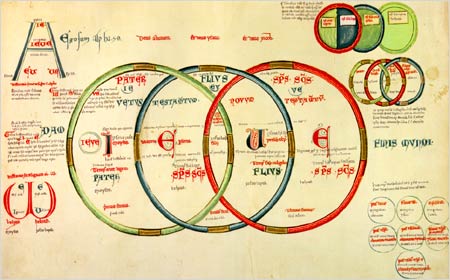
The Age of the Spirit
 "What animates the doctrine of the Eternal Gospel of Joachim de Flore (1145-1202), the celebrated founder of the Ordo florensis, is the idea of a development of humanity that is the continuous work of the Holy Spirit and the final end of which will be the reign of the Paraclete announced in the Gospel of John. The state of man at the end of this process realizes the perfect liberty of the Spirit which results from the love awakened by the Holy Spirit in the heart of man… The development of the ‘history of salvation’ by no means consists in the development of a principle immanent in history, progressing in a linear way according to laws that today we call ‘historical causality’. Far from that, the history of salvation is only realized by the active and continuous intervention of the Holy Spirit, a creative intervention that each time breaks anew the course imposed on things by the carnal will and worldly ambition."
"The three Ages of which Joachim de Flore speaks [of the Father, the Son and the Holy Spirit] are not successive periods of historical time…(and Berdiaev observes this in a profound remark...) ... the three Ages represent unities of existential time, interior time… The succession of these Ages plays itself out in the interior of souls, in the mystery of each soul… In historical time in fact these Ages coexist."
Henry Corbin, En Islam Iranien: Aspects spirituels et philosophiques, Tome IV: L'Ecole d'Ispahan - L'Ecole Shaykhie - Le Douzieme Imam, Gallimard, Bib. Des Idees, 1973, 444 & 448.
Joachim de Fiore, Trinitarian Circles from Heiligenlexicon. See also The International Center for Joachimist Studies featuring these pages from the Liber Figurarum. Also this excellent Nikolai Berdiaev source. The Berdiaev text to which Corbin refers is Le sens de la création : un essai de justification de l'homme; traduit du russe par Lucienne Julien Cain; préface de Stanislas Fumet. Bruxelles : Desclée de Brouwer, 1955, 405-6.
Subscribe to:
Posts (Atom)


 Posts
Posts