Showing posts sorted by relevance for query Ibn 'Arabi. Sort by date Show all posts
Showing posts sorted by relevance for query Ibn 'Arabi. Sort by date Show all posts
Monday, August 31, 2015
Ibn 'Arabi Conference October 2015
2015 Annual Conference of the Ibn 'Arabi Society USA
A Living Legacy: Ibn 'Arabi in Today's World
October 23-24, 2015
Columbia University, New York
For the 850th anniversary of the birth of Muhyiddin Ibn ’Arabi, the Ibn ‘Arabi Society in the U.S. is pleased to announce a major conference on his legacy.
As one of history’s greatest universal mystics and interpreters of the human condition, Ibn ’Arabi’s teachings can offer us a window into a form of Islam that we in the West are rarely exposed to, as well as a more sophisticated understanding of the more exalted aspects of the Islamic cultural heritage.
This conference will explore Ibn 'Arabi's legacy as a living reality with profound implications for the modern world.
This year's conference, the third in a series on the same theme after those held in Murcia, Spain and Oxford, England, includes talks and workshops from some of the foremost experts on Ibn 'Arabi, poetry readings from Ibn 'Arabi's works, and a musical performance.

The Ibn 'Arabi Society is pleased to partner this year with the Institute for Religion, Culture and Public Life, Columbia University.
Where & When
Davis Auditorium, The Schapiro Center, Columbia University, NY 10027
October 23-24, 2015Friday, October 23, 2015, from 7:00pm to 9:30pm (EST)
Saturday, October 24, 2015, from 9:00am to 5:00pm (EST)
Saturday, October 24, 2015, from 9:00am to 5:00pm (EST)
Speakers
We pleased to host some of the most respected speakers and scholars in the field.


Registration
Early Bird discount ends August 30. Take advantage now of the special $100 rate while it lasts!
A check can also be mailed to the Society for registration. Further details, including Sponsorship, on the registration page.
Contact
For all inquiries, please send email to the Secretary at mias.usa@ibnarabisociety.org


Thursday, September 1, 2016
Todd Lawson at the Ibn Arabi Symposium, 2016
The Muhyiddin Ibn 'Arabi Society 33rd Symposium 'Light & Knowledge'
Wolfson College, Oxford March 2016.
Video by Ayman Saey
The purpose of this talk is to explore what appear to be similarities among three different Quranic elements which acquire significant importance in the writings of Ibn Arabi and to speculate on the nature of knowing, how it comes to be and what are its proper focii. Through considering the poetics of the Quran and the poetics of Ibn Arabi we hope to deepen our understanding of his teaching and, of course, the teaching of Islam. In this we will try to explicate how these three elements “hang together” to communicate something essential about the nature of the world we live in and the nature of the instrument we use to consider that world. Furthermore, we will offer some suggestions about the relationship between the dynamics of water, light and knowledge in conjunction with the imaginal activity of the Real and learning from Ibn ‘Arabi that the circulation of these metaphorical realities throughout the cosmos is the very life of the world and those in it. Some focus, toward the end of the talk, will fall on the “immutable entities” and their role in the ecological toning of the imagination.
Dr. Todd Lawson
Professor Emeritus
University of Toronto
1509 Sherbrooke St W
Apartment 34
Montreal, Quebec
H3G1M1
Canada
Sunday, December 7, 2008
50th Anniversary: Creative Imagination in the Sufism of Ibn 'Arabi
 1958-2008
ALONE WITH THE ALONE: CREATIVE IMAGINATION IN THE SUFISM OF IBN 'ARABI
by
Henry Corbin
by
Henry Corbin
First published in French as L’Imagination Creatrice dans le Soufisme d’Ibn ‘Arabi this profoundly moving and beautiful volume stands as one of the great works of theology and comparative philosophy of the 20th century.
"Henry Corbin's works are the best guide to the visionary tradition.... Corbin, like Scholem and Jonas, is remembered as a scholar of genius. He was uniquely equipped not only to recover Iranian Sufism for the West, but also to defend the principal Western traditions of esoteric spirituality." From the 1997 Introduction by Harold Bloom
Among the more than 200 critical editions, translations, books and articles published in his lifetime, his magnum opus is without doubt the four volume En islam iranien: Aspects spirituels et philosophiques, Paris: Gallimard, 1971-73. But this has not yet been translated and its scope and magnitude make it ill-suited as an introduction to his work. Creative Imagination is the most comprehensive and accessible guide to the profoundly important and powerful spiritual treasures to be found in his writings. It is indispensible for those seeking a deeper understanding of the religious imagination and the relations among Judaism, Christianity and Islam in the modern world. Indeed, a close reading of this text may provide something of an initiation for those hoping to enter into the visionary tradition which Corbin's work represents.
A recent review here is evidence of the continuing relevance and accessibility of this masterpiece of the thought of the Heart.
CONTENTS
INTRODUCTION
1. Between Andalusia and Iran: A Brief Spiritual Topography
2. The Curve and Symbols of Ibn ‘Arabi’s Life
3. The Situation of Esotericism
PART ONE: SYMPATHY AND THEOPATHY
Ch. I. Divine Passion and Compassion
Ch II. Sophiology and Devotio Sympathetica
PART TWO: CREATIVE IMAGINATION AND CREATIVE PRAYER
Ch. III. The Creation and Theophany
Ch. IV. Theophanic Imagination and Creativity of the Heart
Ch. V. Man’s Prayer and God’s Prayer
Ch. VI. The “Form of God”
EPILOGUE
The opening paragraph sets the stage for a penetrating and life-giving examination of the phenomenology of the religious Imagination:
“A more complete title for the present book would have been “Creative Imagination and Mystical Experience in the Sufism of Ibn ‘Arabi.” An abbreviation, however, is permissible, since the mere word “Sufism” suffices to place “Imagination” in our specific context. Here we shall not be dealing with imagination in the usual sense of the word: neither with fantasy, profane or otherwise, nor with the organ which produces imaginings identified with the unreal; nor shall we even be dealing exactly with what we look upon as the organ of esthetic creation. We shall be speaking of an absolutely basic function, correlated with a universe peculiar to it, a universe endowed with a perfectly “objective’ existence and perceived precisely through the Imagination.”
In the Epilogue Corbin concludes his masterwork with a damning assessment of modern agnosticism and nihilism:
"…we can see how imaginatively and spiritually disarmed we are in comparison with those Spirituals whose certainties we have evoked in the course of these pages. What we experience as an obsession with nothingness or as acquiescence in a non-being over which we have no power, was to them a manifestation of divine anger, the anger of the mystic Beloved. But even that was a real Presence, the presence of that Image which never forsook our Sufis. Sa‘di, one of the greatest poets of Persia, who was also a great mystic though not among the greatest, expressed this best in a few poignant verses:
If the sword of your anger puts me to death,
My soul will find comfort in it.
If you impose the cup of poison upon me,
My spirit will drink the cup.
When on the day of Resurrection
I rise from the dust of my tomb,
the perfume of your love
Will still impregnate the garment of my soul.
For even though you refused me your love,
You have given me a vision of You
Which has been the confidant of my hidden secrets.
PUBLICATION HISTORY
Part One was originally delivered as “Sympathie et théophanie chez les ‘Fideles d’Amour’ en Islam,” at the 1955 Eranos Conference, and published in Der Mensch und die Sympathie aller Dinge, Vorträge gehalten auf der Eranos-Tagung in Ascona, 24 August bis 1 September 1955; Eranos-Jahrbuch XXIV/1955, Rhein-Verlag, Zürich, 1956.
Part Two was delivered as “Imagination creatrice et prière creatrice dans le soufisme d’Ibn Arabi,” and published in Der Mensch und das Schöpferische, Vorträge gehalten auf der Eranos-Tagung in Ascona 22 bis 30 August 1956; Eranos-Jahrbuch XXV/1956; Rhein-Verlag, Zürich, 1957.
 An introduction was added and the complete work first appeared as L’Imagination Creatrice dans le Soufisme d’Ibn ‘Arabi, Paris: Flammarion, 1958. The most recent French edition (Broché, 2006) has a preface by Gilbert Durand. (The announcement here has a good short biography of Corbin in French).
 The first English edition appeared as Creative Imagination in the Sufism of Ibn ‘Arabi. Translated from the French by Ralph Manheim. Bollingen Series XCI. Princeton: Princeton University Press, 1969; 1st paperback printing in 1981. The volume was re-issued by Princeton University Press in 1997 as Alone with the Alone: Creative Imagination in the Sufism of Ibn ‘Arabi (A Google Book Search Link) with an Introduction by Harold Bloom.
PLATES
 Frontispiece The Image of the Ka’aba. Miniature from the Bibliothèque Nationale, Paris, Supplement Persan 1389, fol. 19, sixteenth century. (A very similar miniature can be found online at the Islamic Art Image Gallery of the Chester Beatty Library in Dublin, MS Per 249, f. 19b)
 1 Elijah and Khidr at the Fountain of Life. Persian, School of Herat, late fifteenth century. Freer Gallery of Art. Facing page 56.
“[Khidr] leads each disciple to his own theophany, the theophany of which he personally is the witness, because that theophany corresponds to his own ‘inner heaven’…” (61)
 2 The Philoxeny of Abraham. Detail from a mosaic, Cathedral of St. Mark, Venice, thirteenth century. Facing page 136.
“[Ibn ‘Arabi’s] mental iconography represents the service incumbent on the fidele d’amore in the person of Abraham ministering to the three Angels seated at the mystic banquet to feed God or His Angels on His creatures, and that service is at the same time to feed the creatures on God.” (131)
 3 Joseph and His Brothers in Egypt. Persian miniature from Fariduddin Attar, Mantiq al-Tayr. Staatsbiliothek, Marburg, MS or. oct. 268, fol. 114, fifteenth century. Facing page 232.
“…[T]he ta’wil that Joseph thought he had discovered was the work of a man who was still asleep, who dreamed that he had awakened from a dream and began to interpret it, though actually he was still dreaming.” (240)
 4 Three Angels Offering Three Cups to the Prophet. Bibliothèque Nationale, Paris, MS supplement turc 190, fol. 34, verso. Facing page 240. (Used as the cover in the 1997 Princeton Edition)
“Just as he had done in a dream on the occasion of his assumption to heaven…when an Angel had brought him a vessel with milk in it, so every time milk was brought to him, he ‘interpreted’ it as he had done in his dream, for all sensible things become subject to interpretation once they take on the value and meaning of dream visions.” (242)
SOME CRITICAL ASSESSMENTS
Henry Corbin was not only a scholar of the first rank, but also a proponent of the visionary tradition which his works have done so much to bring to light. As such he is perhaps best understood not only as a scholarly interpreter of the traditions and the theologians and mystics he presents, but as a creative philosopher, Christian theologian and visionary in his own right. He occupies, perhaps uniquely, a position that mediates between mystical Christianity and the visionary and esoteric traditions in Islam and Judaism. As such, his work is open to critiques, some more sympathetic than others. The great Western Scholar of Sufism William Chittick has written as follows:
"Corbin performed the great service of introducing the Western world to many uniquely Islamic ways of expressing philosophical positions, but it is beyond the capacity of a single individual to bring out everything worthy of consideration. Moreover, in his zeal to revive the honor due to the imaginal realm, Corbin tended to de-emphasize the cornerstone of Islamic teachings, tawid, the 'declaration of God's Unity.' It is as if Corbin was so entranced by the recovery of the imaginal that he had difficulty seeing beyond it.
From the point of view of the Islamic intellectual tradition, the tendency to become transfixed by the multiple apparitions of the One represents a danger inherent in the current revival of interest in imagination. It is clear, for example, that certain varieties of Jungianism divinize the imaginal world, giving to the soul an autonomous status never granted to it by the great traditions. Man's own domain of microcosmic imagination is posited as the Real, since 'God' is merely the soul's projection. But this - in the Islamic view - is to fall into the error of associating other gods with God (shirk), the opposite of tawid. We are left with polytheistic multiplicity, and the 'gods' are reinstated as real entities possessing insuperable differences.
Corbin never fell into such a position, which would have betrayed the central teaching of the texts with which he was concerned. Nevertheless, if his approach to Islamic thought is to be understood as reflecting the concerns of his sources, it needs to be tempered by more attention to the ultimate Unity lying behind the theophanic facade of created existence." (William Chittick, The Sufi Path of Knowledge: Ibn 'Arabi's Metaphysics of the Imagination, Albany: SUNY Press, 1989, x.).
And Corbin's interpretation of Ibn 'Arabi in particular is controversial. Of Creative Imagination in the Sufism of Ibn 'Arabi, Chittick writes:
"Corbin's rhetorical flourishes and passion for his subject put his work into a unique category... [He] is concerned with his own philosophical project... Any reader of Creative Imagination soon begins to wonder where Ibn al-Arabi ends and Corbin begins. The lines are not clear, especially if one does not have access to the Arabic texts. Certainly we come to realize that Ibn al-Arabi is a precious larder from which all sorts of delicious vittles can be extracted. But most people familiar with the original texts would agree that Corbin has highly individual tastes." (Chittick, xix).
In the years since Corbin's death there has been an enormous amount of scholarly work devoted to Ibn 'Arabi in Europe and the US. For an entry into this vast universe see the Ibn ‘Arabi Society.
It is in the end not only his vast contribution to our knowledge of Islamic mystical traditions, but the power and beauty of Corbin's unique "philosophical project" and his own visionary Imagination that guarantee his lasting significance for modern theology, philosophy and spirituality.
Thursday, September 24, 2009
 UPDATED
The New York Open Center and the Muhyiddin Ibn ’Arabi Society present
A C O N F E R E N C E
F R I D AY – S ATURDAY, N O V E M B E R 6 & 7
William C. Chittick, Stephen Hirtenstein, Salman Bashier,
Sachiko Murata and Mohamed Haj Yousef
F R I D AY – S ATURDAY, N O V E M B E R 6 & 7
William C. Chittick, Stephen Hirtenstein, Salman Bashier,
Sachiko Murata and Mohamed Haj Yousef
This groundbreaking event, held at the beautiful Gothic cathedral of the historic interdenominational Riverside Church, will explore the wisdom and contemporary relevance of the 13th century mystic and teacher Ibn ’Arabi, who is considered the greatest master of Gnostic and philosophical Sufism.
It will bring together some of the world’s leading Ibn ’Arabi scholars, and will include talks, workshops, Sufi musicians from the US and the UK, poetry, and three films presented by the award-winning Tunisian director, Nacer Khemir. The conference will include presentations such as: Ibn ’Arabi and the Quest for Human Perfection; How Ibn al-Arabi’s Mystical Love Can Overcome Fundamentalism; Ibn ’Arabi in Dialogue with the Confucian Tradition, and much more.
Ibn ’Arabi was born in Medieval Spain, then home to an extraordinarily enlightened culture of religious tolerance among Muslims, Jews and Christians, a period that can serve us today as an inspiring example of the possibility of fruitful co-existence and cooperation among different cultures. As one of history’s greatest universal mystics and interpreters of the human condition, Ibn ’Arabi’s teachings can offer us a window into a form of Islam that we in the West are rarely exposed to, as well as a more sophisticated understanding of the more exalted aspects of the Islamic cultural heritage.
Please join us for this exceptional presentation of cross-cultural dialogue and come deepen your awareness of the very important part of the Islamic tradition that is one of humanity’s richest veins of mystical spirit and ecstatic beauty.
Post-Conference Events
Tunisian filmmaker Nacer Khemir will be presenting his highly acclaimed series of films, the Desert Trilogy, of which the most well-known is “Bab’Aziz.” The films are filled with exquisite scenery and elements of a mystical fairy tale, showing us a more open, tolerant and friendly view of Islamic culture, full of love and wisdom.Friday–Saturday, November 6 & 7 $145 (after October 8)
Early Bird Price $125 by October 8
A conference co-sponsored with Riverside Church of New York
and The Middle East Institute at Columbia University.
and The Middle East Institute at Columbia University.
Sufi Brochure EDITS 09-10(5)
Monday, February 2, 2009
Corbin - Dante - i Fedeli d'Amore
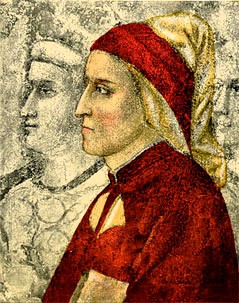 Corbin invokes Dante and the group of poets known in Italian as the Fedeli d'Amore time and again throughout his work. The primary source is Volume 3 of En Islam Iranien, Book 3, Les Fideles d'Amour. For the English speaking reader the best place to begin is his profound and beautiful book on the great Islamic mystic Ibn ‘Arabi, Creative Imagination in the Sufism of Ibn 'Arabi (now published as Alone with the Alone). Here he recounts an incident from the Master’s life that illuminates the question at the heart of the soul’s journey. In Mecca in the year 1201 (A.H. 598) the mystic and poet was a guest in the home of an Iranian family originally from Isfahan. The daughter of the house was a figure of surpassing intelligence, beauty and spiritual discernment. Her name was Nizam, ‘ayn al-Shams wa’l-Baha’, which is Harmonia, Eye of the Sun and of Beauty. As Beatrice did for Dante, so she revealed the human face of the eternal Sophia for Ibn ‘Arabi. Of his discussion of this incident, and of much else besides, Corbin writes,
"There is [one] term which perhaps calls for special justification: Fedeli d'amore. We have already had occasion to speak of the Fedeli d'amore, Dante's companions, and we shall speak of them again, for the the theophanism of Ibn 'Arabi has a good deal in common with the ideas of the symbolist interpreters of Dante (Luigi Valli) , though it is secure against such criticism as that of the literalist philologists, who were alarmed to see the person of Beatrice fade into pale allegory… In any case the young girl who was for Ibn ‘Arabi in Mecca what Beatrice was for Dante , was a real young girl, though at the same time she was “in person” a theophanic figure, the figure of the Sophia aeterna (whom certain of Dante’s companions invoked as the Madonna Intelligenza)…
It has not been our intention to re-open the great debate inaugurated by Asin Palacios, concerning the actual historical relations between those to whom we can give the name of the Fedeli d’amore in the East and West. It has seemed more important to indicate the undeniable typological affinities between them. We shall observe that this term Fedeli d’amore… does not apply indiscriminately to the entire community of Sufis; it does not, for example, apply to the pious ascetics of Mesopotamia who in the first centuries of Islam took the name of Sufi. In making this distinction we only conform to the indications provided by the great Iranian mystic Ruzbehan Baqli of Shiraz (d. 1209) in his beautiful Persian book entitled the Jasmine of the Fedeli d’amore. Ruzbehan distinguishes between the pious ascetics or Sufis, who never encountered the experience of human love, and the Fedeli d’amore for whom the experience of a cult of love dedicated to a beautiful being is the necessary initiation to divine love, from which it is inseparable. Such an initiation does not indeed signify anything in the nature of a monastic conversion to divine love; it is a unique initiation, which transfigures eros as such, that is, human love for a human creature. Ruzbehan’s doctrine falls in with Ibn ‘Arabi’s dialectic of love. It … makes Ruzbehan the precursor of that other famous man of Shiraz, the great poet Hafiz, whose Diwan is still observed today by the Sufis of Iran as a bible of the religion of love, whereas in the West it has been solemnly debated whether or not this Diwan has a mystic meaning. This religion of love was and remained the religion of all the minstrels of Iran and inspired them with the magnificent ta’wil [spiritual hermeneutic] which supplies a link between the spiritual Iran of the Sufis and Zoroastrian Iran, for according to this ta’wil the Prophet of Islam in person proclaims Zarathustra to b the prophet of the Lord of love; the altar of Fire becomes the symbol of the Living Flame in the temple of the heart." (Alone with the Alone, 100-101)
A few pages further on Corbin writes that those among the Sufis whom “we group as the Fedeli d’amore… [are] dominated by two great figures: Ibn ‘Arabi, the incomparable master of mystic theosophy, and Jalaluddin Rumi, the Iranian troubadour of that religion of love whose flame feeds on the theophanic feeling for sensuous beauty. Fedeli d’amore struck us as the best means of translating into a Western language the names by which our mystics called themselves in Arabic or Persian (‘ashiqun, muhibbun, arbab al-hawa, etc.) Since it is the name by which Dante and his companions called themselves, it has the power of suggesting the traits which were common to both groups and have been analyzed in memorable works. " (Alone with the Alone, 110)
The "memorable works" that Corbin cites in a note are by Miguel Asin Palacios, Enrico Cerulli and Luigi Valli. Asin Palacios first suggested Arabic sources for Dante's Commedia in 1919. The spirited debate that his thesis sparked is ongoing even today in the context of discussions about Western "Orientalism" in general. A history of the controversies up to 1965 is provided by Vincente Cantarino in his essay "Dante and Islam: History and Analysis of a Controversy," in De Sua, William J., and Gino Rizzo. A Dante Symposium in Commemoration of the 700th Anniversary of the Poet's Birth (1265-1965). Chapel Hill: University of North Carolina Press, 1965. More recently Maria Rosa Menocal has argued for Islamic influences in Medieval literature in her book Arabic Role in Medieval Literary History: A Forgotten Heritage. The Middle Ages series. Philadelphia: University of Pennsylvania Press, 1987. Also useful are these short articles: Otfried Lieberknecht, A Medieval View of Islam: Dante's Encounter with Mohommed in Inferno XXVIII and Paul Cantor, The Uncanonical Dante: The Divine Comedy and Islamic Philosophy.
Corbin himself was perfectly willing to accept the idea of Arabic influences on Dante, but he characteristically remained largely indifferent to any strictly historical analysis, and was concerned, unlike most modern scholars, with the"typological affinities" involved, as he remarks above. It is the spiritual similarity based on the archetype of Sophia that is important, not the existence or non-existence of historical influences, which he would nonetheless be inclined to accept.
For a concise and detailed overview of the relations among Dante and the Fedeli d'amore as well as the Arabic sources of the troubadour traditions from the point of view of someone who accepts Asin Palacios' basic account see Dante and the Fedeli d'Amore by Bruce MacLennan. The figure said to have been the leader of the Fedeli was Guido Cavalcanti. Also useful is this piece on the Troubadours.
For more on Ruzbehan see Henry Corbin, "The Jasmine of the Fedeli d'Amore: A Discourse on Ruzbehan Baqli of Shiraz," Sphinx 3: A Journal of Archetypal Psychology and the Arts, (London) 1990.
The portrait of Dante (from wikimedia) is atttribued to Giotto.
Sunday, February 13, 2011
Ibn 'Arabi & Rumi Conference

Ibn ’Arabi and Rumi
Wisdom of the Sufis – Teachings for the Modern World
Co-sponsored by the Middle East Institute at Columbia University
A CONFERENCE
Friday & Saturday, November 4 & 5
In 2009, The Muhyiddin Ibn ‘Arabi Society and the New York Open Center began the first of a series of conferences on the great mystic Muhyiddin Ibn ‘Arabi (1165–1240). We now present the second conference in this series, this one focusing on the teachings of both Ibn ‘Arabi and Jalaluddin Rumi (1207–1273), the other giant of Sufi mysticism.
Muhyiddin Ibn ‘Arabi and Jalaluddin Rumi are unquestionably the two great pillars of Islamic mysticism, known as Sufism. They appeared in the same century, one from the Muslim West, the other from the East, bringing a glorious new vision of human potential and realization that has been a source of inspiration ever since. Their words continue to touch us directly, inviting us to explore the heart as the place of wisdom and love. This first symposium ever dedicated to both these spiritual masters will be a uniquely exciting opportunity to learn about and discuss their teachings with leading scholars in the field, which include James Morris, Pablo Beneito, Mahmut Killic, Stephen Hirtenstein, Franklin Lewis, Cecilia Twinch, and several others. There will be lectures and workshops as well as an evening concert with traditional and original musical/artistic performances, which will include performers such as Coleman Barks, Grammy Award winner, David Darling and other artists.
1st Early Bird price $125 by June 10
2nd Early Bird price $145 by October 10
$165 after October 10
Evening Concert
7:30
Price TBA
Location of all events: Columbia University
To register call 212-219-2527 x 0 or 2 or visit www.opencenter.org.
also see www.ibnarabisociety.org and visit conference website: www.opencenter.org/ibn-arabi
Enoe Aracely Brown
Program Director
New York Open Center
22 East 30 Street
New York, NY 10016
212-219-2527 ext 140 or 0
Fax:212-226-4056
email: aracelybrown@yahoo.com
Friday, October 13, 2017
"This Vast Earth: Ibn 'Arabi's Ecology of Consciousness"


Friday, Nov 10, 2017
Founders Room, Carillo Recreation Center
100 East Carillo Street
Santa Barbara, CA, 93101
Founders Room, Carillo Recreation Center
100 East Carillo Street
Santa Barbara, CA, 93101
- 7:00pm Welcome
- 7:10pm Keynote Speech: Michael Sells
- 7:45pm Selected Readings from the poetry of Ibn ‘Arabi
- 8:00pm Performance by musicians from UCSB Middle East Ensemble
Saturday, Nov 11, 2017
McCune Room
6020 Humanities and Social Sciences Building
El Colegio Rd
UC Santa Barbara
Santa Barbara, CA 93106
McCune Room
6020 Humanities and Social Sciences Building
El Colegio Rd
UC Santa Barbara
Santa Barbara, CA 93106
- 9:00am Welcome
- 9:15am - 12:10pmPlenary Session
- 12:10pm Lunch
- 1:30pm - 4:30pmWorkshops
- 4:30pm Panel Discussion
- 5:00pm End

2017 Annual conference
"This Vast Earth:
Ibn 'Arabi's Ecology of Consciousness"
November 10-11, 2017
UC Santa Barbara, California, USA
As one of history’s greatest universal mystics and interpreters of the human condition, Ibn ’Arabi’s teachings offer a window into a form of Islam that the West is rarely exposed to, as well as a more sophisticated understanding of the more exalted aspects of the Islamic cultural heritage.
This conference will explore Ibn 'Arabi's ideas on consciousness with particular focus on his articulation of the "Vast Earth" as a living reality, and the landscape through which the awakened human travels.
The Ibn 'Arabi Society is pleased to partner this year with the Center for Middle Eastern Studies at UCSB
Registration
Don't miss this special evening of spoken word and music.
- Hear Michael Sells' keynote speech, Speaking Stone: Kaʿba, Love, Talk, and Consciousness in the Writings of Ibn ʿArabi
- Hear to poetry readings in the original Arabic, and Michael Sells' incomparable translations into English, recited by John Mercer
- Hear members of UCSB's own Middle East Ensemble
Register for the Friday Night Concert and Keynote, or for the Full Conference which includes Friday and Saturdayevents.

Thursday, January 22, 2009
Annotated Bibliography
 This is a list of contemporary scholars and others who have written about Henry Corbin or whose work has been significantly influenced by his vision. Entries for individuals are representative and not complete.
(Sadly, I have not updated this since 2009 - TC)
A Complete Bibliography of Corbin's own works is available from
Les Amis de Stella et Henry Corbin
Les Amis de Stella et Henry Corbin
Timurid Watercolor, Shiraz. Freer & Sackler Galleries
Abaza, Mona. "Henry Corbin, the absent centre", Ch. 7 in Debates on Islam and Knowledge in Malaysia and Egypt: Shifting Worlds, London: Routledge, 2002.
Adams, Charles J., "The Hermeneutics of Henry Corbin," in Approaches to Islam in Religious Studies, Martin, ed., Univ. Arizona, 1985.
Algar, Hamid. “The Study of Islam: The Work of Henry Corbin.” Religious Studies Review 6(2) 1980: 85-91.
Aminrazavi, Mehdi. Suhrawardi and the School of Illumination, Richmond : Curzon, 1997.
Amir-Moezzi, M., Christian Jambet et Pierre Lory, (Editors). Henry Corbin: Philosophies et Sagesses des Religions du Livre. Brepols, 2005. Essays by Christian Jambet, Jean-Michel Hirt, James W. Morris, Jean Francois Marquet, Jean-Louis Viellard-Baron, Mohammad Amir-Moezzi, Michel Chodkiewicz, Guy Monnot, Daniel De Smet, Paul Ballanfat, Charles-Henri Fouchecour, Hermann Landolt, Paul B. Fenton, Simon C. Mimouni, Gerard Wiegers, Maria E. Subtelney.
Avens, Roberts, Imagination as Reality: Western Nirvana in Jung, Hillman, Barfield & Cassirer, Spring Publications, 1980.
____ The New Gnosis, Spring Publications, 1984.
____ "Things and Angels, Death and Immortality in Heidegger and in Islamic Gnosis," Hamdard Islamicus VII(2): 3-32, Summer, 1984
____ "Theosophy of Mulla Sadra," Hamdard Islamicus IX(3): 3-30, Autumn, 1986
____ "Henry Corbin and Suhrawardi's Angelology," Hamdard Islamicus XI(1): 3-20, Spring 1988
____ "Corbin's Interpretation of Imamology and Sufism," Hamdard Islamicus XI(2): 67-79, Summer, 1988
____ "The Subtle Realm: Corbin, Sufism and Swedenborg," in Immanuel Swedenborg: A Continuing Vision, ed. Robin Larson, Swedenborg Foundation, New York, 1988.
____ "Henry Corbin's Teaching on Angels," translated from the German by Hugo M. Van Woerkom; Gorgo 18 (1988). pdf file available from Scribd requires (free) registration.
Azadpur, Mohammad. "Unveiling the hidden. On the Meditations of Descartes and Ghazzali", in Tymieniecka, Anna-Teresa (Ed.) - The Passions of the Soul: In the Metamorphosis of Becoming, Dordrecht: Kluwer Academic Publishers, 2003.
Bamford, Christopher, "Esoterism Today: The Example of Henry Corbin," Introduction to The Voyage and the Messenger: Iran and Philosophy, 1998, trans. Joseph Rowe, North Atlantic Books, Berkeley [translation of L'Iran et La Philosophie, Fayard, 1990]
Băncilă,Ionuţ Daniel. "Some Aspects of Manichaeism as Religion of Beauty [in English]," Caietele Echinox (Romania) Issue no.12 /2007. "The study investigates the aspects of Beauty in Manichaean teachings, following certain intuitions by Henry Corbin and Ilya Gershevitch. The Living Soul imprisoned in this material word, the Manichaean dissemination of the Zoroastrian figure of the Virgin of the Good Deeds, as well as the descriptions of the otherworldly ”Gardens of Light” offer as many instances and occasions for the Manichaeans to praise Beauty, although always as situated above and out of this world."
Bloom, Harold, Omens of Millennium: The Gnosis of Angels, Dreams and Resurrection, Riverhead Books, New York, 1996.
_____ Preface to Princeton Mythos re-issue of Creative Imagination in the Sufism of Ibn 'Arabi, with the new title, Alone with the Alone, 1997.
Bosnak, Robert - Analyst in private practice, Sydney, Australia. Corbin & Dreamwork.
(rbosnak@mindspring.com). Author of A Little Course in Dreams and Tracks in the Wilderness of Dreaming both discuss Corbin. His latest book Embodiment: Creative Imagination in Medicine Art and Travel (Routledge, 2007) is written as a tribute to Henry Corbin.
_____ "My Eranos," (With several mentions of Corbin. Bosnak's own work has been profoundly influenced by Corbin). The San Francisco Jung Institute Library Journal, Winter 1987, Vol. 7, No. 1, Pages 25–29.
Braga, Corin. Imagination, Imaginaire, Imaginal: Three Concepts for Defining Creative Fantasy by Corin Braga. (pdf file) at Phantasma: Center for Imagination Studies (Romanian), with a subsection "Mundus Imaginalis" referencing Henry Corbin.
Brown, Norman O., "The Prophetic Tradition," in Apocalypse &/or Metamorphosis, University of California Press, Berkeley, 1991.
____ "The Apocalypse of Islam," in op. cit.
Brown, Vahid, "A Counter-History of Islam: Ibn 'Arabi within the Spiritual Topography of Henry Corbin," Journal of Ibn Arabi Society,Volume XXXII, Autumn 2002. (Brown adopts Wassertrom's methods and is critical of Corbin's approach to Ibn 'Arabi).
Cheetham, Tom. The World Turned Inside Out: Henry Corbin and Islamic Mysticism. New Orleans: Spring Journal Books, 2003.
_____ Green Man, Earth Angel: The Prophetic Tradition and the Battle for the Soul of the World. With an Introduction by Robert Sardello. SUNY Series in the Western Esoteric Tradition, SUNY Press, Albany, NY, 2005.
_____ After Prophecy: Imagination, Incarnation and the Unity of the Prophetic Tradition. Lectures for the Temenos Academy. Spring Journal Books, 2007.
Chittick, William, The Sufi Path of Knowledge: Ibn 'Arabi's Metaphysics of the Imagination, SUNY Press, Albany, 1989.
____ Imaginal Worlds: Ibn al-'Arabi and the Problem of Religious Diversity, SUNY Press, Albany, 1994.
____ The Self-Disclosure of God: Principles of Ibn 'Arabi's Cosmology, SUNY Press, Albany, 1998.
Cobb, Noel. Archetypal Imagination: Glimpses of the Gods in Life and Art, Hudson, NY: Lindisfarne Press, 1992.
Copjec, Joan. SUNY Buffalo, Area of interest: Corbin & Lacan
Davies, Paul. Romanticism & Esoteric Tradition: Studies in Imagination, Hudson: Lindisfarne, 1998.
Durand, Gilbert. Founder of Le Centre de recherche sur l'imaginaire. Colleague of Jung, Corbin and Gaston Bachelard.
____ Les Structures anthropologiques de l'imaginaire, Paris, Dunod (1re édition Paris, P.U.F., 1960).
____ Champs de l’imaginaire. Textes réunis par Danièle Chauvin, Grenoble, Ellug, 1996. Includes complete bibliography.
El-Bizri, Nader. The Phenomenological Quest: Between Avicenna and Heidegger, Binghamton, N.Y.: Global Publ., 2000.
Ernst, Carl W. Rūzbihān Baqlī: Mysticism and the Rhetoric of Sainthood in Persian Sufism, Richmond, Surrey : Curzon Press, 1996.
Faivre, Antoine. Access to Western Esotericism, SUNY Press, Albany, 1994.
____
Giuliano, Glauco. Il Pellegrinaggio in Oriente di Henry Corbin. Con una scelta di testi. Lavis (Trento-Italia), La Finestra editrice, 2003.
_____ Nîtârtha. Saggi per un pensiero eurasiatico. Lavis (Trento-Italia), La Finestra editrice, 2004.
Green, Nile. Department of History, UCLA. "Between Heidegger and the Hidden Imam: Reflections on Henry Corbin's Approaches to Mystical Islam", in Mohammad-Reza Djalili, Alessandro Monsutti & Anna Neubauer (eds), Le Monde turco-iranien en question (Paris: Karthala, forthcoming 2008). [Unauthorised draft version previously published in Method and Theory in the Study of Religion 17, 3 (2005), pp.219-226]
Hajhosseini, Morteza. Analytic Comparison between 'Allahmah Tabataba's's View and that of Henry Corbin concerning Human Perfection, Transcendent Philosophy 1: 31-45
Hillman, James - The Uniform Edition of the Writings of James Hillman. Although he makes use of the concept of the mundus imaginalis in ways of which Corbin would not necessarily have approved, Hillman's entire work is profoundly marked by Corbin's influence.
Hughes, Aaron W. & Abraham ben Meïr Ibn Ezra. The Texture of the Divine: Imagination in Medieval Islamic and Jewish Thought, Bloomington: Indiana Univ. Press, 2004.
Hume, Lynne. Assoc. Prof., University of Queensland, Brisbane, Australia. Portals: Opening Doorways to Other Realities Through the Senses. Berg, 2007.
Idel, Moshe, Kabbalah: New Perspectives, Yale University Press, New Haven 1998.
____ Absorbing Perfections. New Haven: Yale University Press, 2002.
Iranzo, Ivor Pinto. About the Imaginary . On Gilbert Durand.
Jambet, Christian. Institut d'Etudes Iraniennes (University de Paris III) and l'Ecole Pratiques des Hautes Etudes. Henry Corbin, edited by Christian Jambet, Cahier de l'Herne, no. 39. Consacré à Henry Corbin, 1981.
____ La Logique des Orientaux: Henry Corbin et la Science des Formes. Paris: Seuil, 1983.
____ La Grande résurrection d’Alamût: Les formes de la liberté dans le shî’isme ismaélien, Verdier, Paris, 1990.
____ "The Stranger and Theophany," (English translation of Le Caché et l'Apparent). Umbr(a): A Journal of the Unconscious 2005 - The Dark God: 27-41. (Publication of Center for the Study of Psychoanalysis and Culture - SUNY Buffalo).
____ The Act of Being: The Philosophy of Revelation in Mulla Sadra. New York: Zone Books, 2006.
Landolt, Hermann, "Henry Corbin, 1903-1978: Between Philosophy and Orientalism," Journal of the American Oriental Society, 119(3): 484-490 (1999).
Laude, Patrick. An Inner Islam: Insights in Massignon, Corbin, Guénon and Schuon. Albany, New York: State University of New York Press, 2009 (forthcoming).
Lawson, Todd. Associate Professor, University of Toronto, Dept. of Near and Middle Eastern Civilizations.
____ Reason and Inspiration in Islam: Philosophy, Theology and Mysticism in Muslim Thought, London & New York, I.B. Taurus, 2005.
____ The Crucifixion and the Qu'ran: A Study in the History of Muslim Thought, Oxford, One World, 2009.
Lory, Pierre. Directeur scientifique des études médiévales, modernes et arabes, Institut francais du Proche-Orient, Damascus; Directeur d'études à l'EPHE, 5e section, chaire de mystique musulmane, Paris.
____ Alchimie et mystique en terre d'Islam , Lagrasse, Verdier, Collection " Islam spirituel ", 1989.
____ Le rêve et ses interprétations en Islam, Paris, Albin Michel, 2003.
____ La science des lettres en terre d’Islam, Paris, Dervy, 2004.
____ « Henry Corbin, explorateur des terres d’émeraude », in Symbole, n° 1 (May 2007).
____ Review of Wasserstrom, 1999, at amiscorbin.com.
____ Jean-Louis Vieillard-Baron, Gregoire Lacaze, Jean-Francois Marquet, Antoine Faivre (eds.) Henry Corbin et le Comparatisme Spirituel, Paris, Arche, 2000.
Mahmoud, Samir. PhD Candidate, Faculty of Divinity, University of Cambridge, UK. Interests: Islamic mystical philosophy (Ibn 'Arabi and Suhrawardi); Henry Corbin; Platonism; Islamic Aesthetics; Comparative Aesthetics; History of Art and Architecture; History of cross-cultural exchanges in ideas, art, and architecture between the Muslim world and Europe. email: delphi93@hotmail.com, samir.mahmoud.cantab@gmail.com. Recent Work: "From Heidegger to Suhrawardi: An Introduction to the Thought of Henry Corbin," (2006, published on official website of Henry Corbin edited by Pierre Lory); "'Alam al-Mithal or the Mundus Imaginalis," (paper presented to conference on Philosophy of Religion at the University of Marburg, 2006 to be published in 2008); "Ta'wil and the Angel," paper to be published in 2008; "Suhrawardi and Plotinus on Self-Knowledge as Illumination," (paper presented at Prometheus Trust Conference, Glastonbury, England 2007 to be published under same title in 2008 currently under peer review); "Carl Gustav Jung in the Light of Traditional Psychology or Pneumatology: Some Explorations on Self and Salvation," (paper to be published in 2008 currently under peer review); Currently working on a PhD on the topic of medieval Islamic Philosophical Aesthetics. Dissertation title is: The Art of Remembrance and the Aesthetics of Unity. The thesis draws heavily on Corbin's interpretation of Ibn 'Arabi, Suhrawardi, and Avicenna and it is also indebted to Corbin's dispersed remarks on Islamic art, architecture, and aesthetics.
Mann, Mary Pat. The Door to the Imaginal Realm, Mytholog 4(3): 2006.
Marcotte, R. "Phenomenology through the eyes of an Iranologist: Henry Corbin," The Bulletin of The Henry Martyn Institute of Islamic Studies (1995)14,1-2,55-70. The journal's editor states that this article is both an "insightful and comprehensive analysis of the types and schools of thought which helped to shape the views of one of the best known Islamic scholars of the mid-twentieth century". "Although Corbin's methodological approach is devalued by many scholars today, Marcotte points out that his attempt to form a 'spiritual-type phenomenology' offered fresh and challenging ways of interpreting Islamic thought which, despite their inherent limitations, are still worthy of consideration".
Miller, David. L., The New Polytheism, Dallas: Spring Publications, 1991.
Morris, James Winston. The Reflective Heart: Discovering Spiritual Intelligence in Ibn 'Arabi's Meccan Illuminations. Fons Vitae, 2005.
____ Religion After Religions?: Henry Corbin and the Future of the Study of Religion. In Philosophies et Sagesses des Religions du Livre, ed. P. Lory and M. Amir-Moezzi, Tournhout, Brépols Publishers, 2005, pp. 21-32. Online here.
Nasr, Seyyed Hossein, "Henry Corbin: The Life and Works of the Occidental Exile in Quest of the Orient of Light," Ch. 17, in Traditional Islam in the Modern World, Kegan Paul International, London, 1987.
Norton, Felicia and Charles Smith, An Emerald Earth: Cultivating a Natural Spirituality and Serving Creative Beauty in Our World. TwoSeasJoin Press, New York, 2008. ISBN 978-0-6152-3546-2
Peña-Velasco, Elizabeth. "An End to Ordinary History: Comments on a Philosophical Novel by Michael Murphy", (at amiscorbin.com) translated by Christine Rhone. This article discusses Murphy's novel of 1982, which drew inspiration from Corbin's Corps Spirituel et Terre Céleste. Our ordinary historical perspective can be transformed into the Imaginal History as Corbin has shown.
Raine, Kathleen, Golgonooza: City of Imagination. Last Studies in William Blake, Lindisfarne Press, Hudson, N.Y., 1991.
Romanyshyn, Robert. Technology as Symptom and Dream. London: Routledge, 1989.
____ Mirror and Metaphor. Amherst NY: Trivium, 2002.
Rustom, Mohammed. University of Toronto.
"The Metaphysics of the Heart in the Sufi Doctrine of Rumi." Studies in Religion 37/1 (2008): 3-14.
"The Symbology of the Wing in Suhrawardi's The Reverberation of Gabriel's Wing." Transcendent Philosophy 7 (2006): 189-202.
Review of The World Turned Inside Out: Henry Corbin and Islamic Mysticism by Tom Cheetham. The Muslim World Book Review 26/2 (2006): 26-27.
Review of An Introduction to Islamic Cosmological Doctrines by Seyyed Hossein Nasr. Parabola 31/3 (2006): 120-124.
Shaw, Gregory - Theurgy and the Soul: The Neoplatonism of Iamblichus, 1995 . Stonehill College, Areas of interest: Neoplatonism, Iamblichus. Also see "Containing Ecstasy: Strategies of Iamblichean Theurgy," Dionysius XXI. This article compares neoplatonic theurgy to contemporary dreamwork and includes references to and a critique of archetypal psychology using Corbin as the criterion for crticism and as the figure who reveals the theurgic element in Ibn Arabi, Avicenna, etc.
Shariat, Ali. "Henry Corbin and the Imaginal: A Look at the Concept and Function of Creative Imagination in Iranian Philosophy," Diogenes, Vol. 39, No. 156, 83-114 (1991)
Shayegan, Daryush. Henry Corbin: La topographie spirituelle de l'Islam Iranien, Ed. de la Difference, Paris, 1990.
Sherrard, Philip. The Eclipse of Man and Nature, Hudson NY: Lindisfarne Press, 1987.
____ Christianity: Lineaments of a Sacred Tradition. Brookline, MA: Holy Cross Orthodox Press, 1998.
Soster, Maria. "Henry Corbin in the 1930s: Questions and Perspectives", (at amiscorbin.com), translated by Christine Rhone. This paper traces the development of the concept of existence in Corbin's articles of the 1930s, when he pursued enquiries into Existenzphilosophie and stayed in Germany for some time.
Subtelny, Maria E. “History and Religion: The Fallacy of Metaphysical Questions (A Review Article).” Iranian Studies: March 2003, 36(1): 91-101.
Velasco, Ismael. "A Prolegomenon to the Study of Babi and Baha’i Scriptures: The Importance of Henry Corbin to Babi and Baha’i Studies," Baha'i Studies Review, Vol. 12, 2004.
Versluis, Arthur.Theosophia: Hidden Dimensions of Christianity, Hudson NY: Lindisfarne Press, 1994.
Walbridge, John. The Wisdom of the Mystic East: Suhrawardī and Platonic Orientalism, Albany: State Univ. of New York Press, 2001.
Wasserstrom, Steven M. Religion After Religion: Gershom Scholem, Mircea Eliade, and Henry Corbin at Eranos, Princeton University Press, Princeton, 1999.
Wellman, Donald - Daniel Webster College, Area of interest: Corbin & Charles Olson
Wolfson, Elliot - New York University, Areas of Interest: Kabbalah, Jewish Mysticism. Dr. Wolfson writes, "Corbin has been a major influence on my work on Kabbalah and Jewish mysticism, beginning with Through a Speculum that Shines: Vision and Imagination in Medieval Jewish Mysticism (Princeton, 1994) -- specifically, I avail myself of his notion of the imaginal. Other essays which follow the path of Corbin include: "Iconic Visualization and the Imaginal Body of God: The Role of Intention in the Rabbinic Conception of Prayer," Modern Theology 12 (1996): 137-162; "Sacred Space and Mental Iconography: Imago Templi and Contemplation in Rhineland Jewish Pietism," in Ki Baruch Hu: Ancient Near Eastern, Biblical, and Judaic Studies in Honor of Baruch A. Levine, 593-634. Edited by R. Chazan, W. Hallo, and L. H. Schiffman. Winona Lake: Eisenbrauns, 1999; "Seven Mysteries of Knowledge: Qumran E/sotericism Reconsidered,” in The Idea of Biblical Interpretation: Essays in Honor of James L. Kugel, 173-213. Edited by H. Najman. Leiden: Brill, 2003; "Imago Templi and the Meeting of the Two Seas: Liturgical Time-Space and the Feminine Imaginary in Zoharic Kabbalah," RES (Journal of Anthropology & Aesthetics) 51 (2007): 121-135. In the last essay, I have an extended discussion of Corbin's thought."
Subscribe to:
Posts (Atom)


 Posts

