Friday, August 29, 2008
Harmonia Abrahamica
 Henry Corbin devoted his life to articulating a vision of the essential harmony of all of the religions of the Book, the vision of what he was to call in his late work the Harmonia Abrahamica. It is based on a Christology radically different from the one that became dogma. It requires a return to the Christology of the Ebionites, who had no doctrine of the Trinity, or of the substantial union of the divine and human in Jesus. For these Jewish-Christians, Jesus was a manifestation of the celestial Son of Man, the Christos Angelos, who was consecrated as Christ at his baptism. Jesus then takes his place in the lineage of the True Prophets. Corbin writes
“for Ebionite Christianity…sacred history, the hierology of humanity, is constituted by the successive manifestations…of the celestial Anthropos, of the eternal Adam-Christos who is the prophet of Truth, the True Prophet. We count seven of these manifestations, eight if we include the terrestrial person of Adam himself. They are Adam, Noah, Enoch, Abraham, Isaac, Jacob, Moses, Jesus… . The fundamental basis of this prophetology is therefore the idea of the True Prophet who is the celestial Anthropos, the Christus aeternus, hastening from christophany to christophany 'toward the place of his repose.' Now, this is the same structure that Islamic prophetology presents, with this difference, that the succession of christophanies is no longer completed with the prophet Jesus of Nazareth, but with the prophet of Islam, the 'Seal of the Prophets' whose coming Jesus himself announced, and who is the 'recapitulation' of all the prophets… .” (Corbin, 1977, 11)
Thus Mohammad has been identified with the figure of the Paraclete in the Gospel of John. Among the Shi'ites, the Twelfth Imam, the Hidden Imam, is sometimes identified with this final manifestation of the True Prophet, the central figure of the Eternal Gospel.
The death of Christ then signifies something utterly different from what we have come to accept. Corbin relates with evident approval the story of Christ's death told in the Medieval Gospel of Barnabas. Jesus is taken up by the Angels, before Good Friday. Judas Iscariot, transformed to resemble Jesus, is arrested and killed upon the Cross. And so His followers believe that He has died. It must be this way, since, Corbin argues,
“in making of him the 'Son of God' it is Man himself that humanity has equated with God, and it was only possible to expiate this blasphemy through succumbing to the belief that his God was dead. Everything occurs as if the Ebionite-Islamic prophetology here went ahead to denounce and refute the false news of the 'death of God.' ...It is undeniable that this vision overturns from top to bottom some eighteen centuries of the Christian theology of History.” (Corbin, 1977, 15)
Without any illusions about the magnitude of the transformation he is suggesting, this vision is Corbin's answer to those who wonder whether Christianity itself is capable of surviving. It is only by being open to a radically reformed Christianity in harmony with the mystical traditions of the rest of the Abrahamic tradition, that the religion of Christ can find its fulfillment. Only a Christianity based on theophany can survive.
Corbin tells us that the event of the Great Resurrection, the parousia of the Paraclete, which has its origins in the Final Battle proclaimed by Zoroaster, and the expectation of which is in common in various forms to Judaism, Islam and Christianity, is symbolized for Shi'ism in the person of the Hidden Imam. But, Corbin writes, this cosmic Return
"is not an event which may suddenly erupt one fine day; it is something that happens day after day in the consciousness of the Shi'ite faithful... The Advent-to-come of the Imam presupposes...the metamorphosis of men's hearts; on the faith of his followers depends the progressive fulfillment of this parousia, through their own act of being...
"...The parousia of the awaited Imam signifies a plenary anthropological revelation, unfolding within the man who lives in the Spirit." (Corbin, 1993, 71-73)
"The Imam has said: 'I am with my friends wherever they seek me, on the mountain, in the plain, and in the desert. The man to whom I have revealed my Essence, that is to say, the mystical knowledge of myself, has no further need of my physical proximity. And this is the Great Resurrection.'" (Corbin, 1993, 102)
[Citations from Corbin in "Harmonia Abrahamica," preface to Évangile de Barnabé: Recherches sur la composition et l'origine, par Luigi Cirillo, Texte et Traduction par Luigi Cirillo and Michel Frémaux, Paris : Éditions Beauchesne, 1977, and A History of Islamic Philosophy, Trans. L. Sherrard & P. Sherrard, London: Kegan Paul International, 1993.]
Text adapted from The World Turned Inside Out and Green Man, Earth Angel by the author.
The final chapter of my book Green Man, Earth Angel can be read here: "Harmonia Abrahamica: The Lost Speech and the Battle for the Soul of the World."
Illustration: La Pentecôte: Heures d'Étienne Chevalier, enluminées par Jean Fouquet. Musée Condé, Chantilly, R.-G. Ojeda, RMN / musée Condé, Chantilly.
Suzuki, Swedenborg, Ibn 'Arabi
 Delighting in one of the wonderful comparisons of which he was so fond, Corbin recounts a conversation with D. T. Suzuki in Ascona in 1954: "...we asked him what homologies in structure he found between Mahayana Buddhism and the cosmology of Swedenborg in respect of the symbolism and correspondences of worlds: I can still see Suzuki suddenly brandishing a spoon and saying with a smile 'This spoon now exists in Paradise... We are now in Heaven,' he explained. This was an authentically Zen way of answering the question; Ibn 'Arabi would have relished it. " - Creative Imagination in the Sufism of Ibn 'Arabi, 354
For more on this see:
D.T. Suzuki, Swedenborg: Buddha of the North, trans. and introduced by Andrew Bernstein. Afterword by David Loy, West Chester: Swedenborg Foundation, 1996, and Roberts Avens, "The Subtle Realm: Corbin, Sufism and Swedenborg," in Immanuel Swedenborg: A Continuing Vision, ed. Robin Larson, New York: Swedenborg Foundation, 1988. Also pertinent is Sachiko Murata and WIlliam Chittick, Chinese Gleams of Sufi Light : Wang Tai-yü's Great learning of the pure and real and Liu Chih's Displaying the concealment of the real realm ; with a new translation of J¯am¯i's Law¯a'ih from the Persian; with a foreword by Tu Weiming. Albany, NY : State University of New York Press,2000.
Boddhisatvas in the Bezeklik Thousand Buddha Caves in Turfan, on the Silk Road, Xinjiang, western China.
Wednesday, August 27, 2008
Suhrawardi
 "Thus it was that one day - it was, I think, in the year 1927-28 - I spoke to [Louis Massignon] of the reasons that had led me as a philosopher to the study of Arabic, questions that posed themselves to me concerning the connections between philosophy and mysticism, and that I knew, through a scanty resume in German, of a certain Suhrawardi... Then Massignon had an inspiration from Heaven. He had brought back from a trip to Iran a lithographed edition of the major work of Suhrawardi, Hikmat al'Ishraq, 'The Oriental Theosophy.' With commentaries, it formed a large volume of more than 500 pages. 'Take it,' he said to me, 'I think there is in this book something for you.' This 'something' was the company of the young Shaykh al-Ishraq, who has not left me my whole life. I had always been a Platonist (in the broad sense of the term); I believe that one is born a Platonist as one is born an atheist, a materialist etc. Unfathomable mystery of pre-existential choices! The young Platonist that I was then could only t
 ake fire at contact with the one who was the 'Imam of the Platonists of Persia...' ...through my meeting with Suhrawardi, my spiritual destiny for the passage through this world was sealed. Platonism, expressed in terms of the Zoroastrian angelology of ancient Persia, illuminated the path that I was seeking."
in Christian Jambet, (ed.) 1981, Henry Corbin, Cahier de l'Herne, no. 39. Consacré à Henry Corbin, 40-41. English translation of the entire interview with Philip Nemo available here courtesy of Les Amis de Stella et Henry Corbin.
Circular Ornament: Iran, 16th-17th Century. The Freer Gallery of Art & the Arthur Sackler Gallery. "In the name of God, the Merciful and Compassionate."
Manuscript Page, Suhrawardi ms. given to Henry Corbin, from Henry Corbin, ed. Jambet.
Monday, August 25, 2008
Alamut!
 Certainly Corbin knew well that Islam, as any religion, requires a doctrine, a "literal" outside, a Law, which must exist in order for there to be anything in which to conceal the "hidden meanings." Nonetheless, it is clear enough where his sympathies lie. The Ismailis have long been known among detractors and supporters both, for the priority which they give to the esoteric at the expense of the exoteric. Corbin calls to our attention more than once, with a kind of longing, to aone of several symbolic events of the epochal 12th century, the Ismaili Declaration at Alamut.
"Alamut! The stronghold lost in the high solitary summits of the Elburz mountain chain, to the southwest of the Caspian Sea, where, on 8 August 1164, the Great Resurrection was proclaimed... Undoubtedly a proclamation of this type pertains to that spiritual history, the events of which occur unnoticed by external official history, because their implications cannot be suspected by historians whose attention is given exclusively to the latter. In any case, the proclamation of the Great Resurrection was intended to be the triumph of absolute spiritual hermeneutics, since it purely and simply abolished the shari'a and its observances, in order to permit the reign of the spiritual Idea...alone to subsist."
But, he continues,
"Here again, the impatience of the soul provoked a premature anticipation of eschatology... [The major Shi'ite traditions] continued carefully to maintain...the coexistence of the esoteric and the exoteric, for as long as the human condition remains what it is in the present world, the soul cannot manifest itself without being contained in a material body."
Citations from Corbin in Swedenborg & Esoteric Islam, 1995, translated by Leonard Fox, West Chester, PA: Swedenborg Foundation, 95.
Excerpted from The World Turned Inside Out by the author. Also see Christian Jambet, 1990. La Grande rsurrection d' alamut: les formes de la liberte dans le shiisme ismaelien. Francia: Verdier.
The Fortress at Alamut: From the Iranian Cultural Heritage And Tourism Organization, Alamut Cultural Heritage Base
Sunday, August 24, 2008
Spiritual Chivalry
 "Every physical or moral entity, every complete being or group of beings belonging to the world of Light ... has its Fravarti. What they announce to earthly beings is ... an essentially dual structure that gives to each one a heavenly archetype or Angel, whose earthly counterpart he is." - Spiritual Body & Celestial Earth, 9
The Darkness of evil is not a mere absence of Light; it is its contrary, and would exist even in the absence of Light. We ally ourselves with one side or the other. While we cannot destroy the Angel, we can turn away from it, from our responsibility to ourselves and to what is best in us:
"It is not in the power of a human being to destroy his celestial Idea; but it is in his power to betray it, to separate himself from it, to have, at the entrance to the Chinvat Bridge, nothing face to face with him but the abominable and demonic caricature of his 'I' delivered over to himself without a heavenly sponsor.“ - Le Paradoxe du Monotheisme, 246.
 In a theme which stretches from Mazdean Iran to contemporary Shi'ism, "the God of Light has need of the aide of all [of his fravartis]" because the "menace of active nihilism" is terrifying. As in pre-Eternity the Fravartis chose to give up their purely celestial existence and incarnate as Angel-Souls, so we must choose to help combat the horrors of Darkness. There is a mystical solidarity between the paired beings who comprise the cosmic hierarchy: between God and His Fravartis, in the ranks of the Archangels with their bonds of love and devotion, and between the human soul and its Angel. This bond is what the Shi'ites call "spiritual chivalry." It was Corbin's hope that this shared responsibility will ultimately unite the followers of the three Abrahamic religions in a single diversely determined purpose.
Figure 1: Sikandar and the Dragon. Princeton Islamic MSS., Third Series, no. 310. FOLIO: 296:2. From the Princeton Shahnama Project. Figure 2: St. George and the Dragon. Late XVthe Century. From the Russian State Museum. Wikipedia.
Friday, August 22, 2008
The Lost Speech
 "The drama common to all the 'religions of the Book' ... can be designated as the drama of the "Lost Speech." And this because the whole meaning of their life revolves around the phenomenon of the revealed holy Book, around the true meaning of this Book. If the true meaning of the Book is the interior meaning, hidden under the literal appearance, then from the instant that men fail to recognize or refuse this interior meaning, from that instant they mutilate the unity of the Word, of the Logos, and begin the drama of the 'Lost Speech.'" - Henry Corbin
From "L'Initiation Ismaèlienne ou l'Esoterisme et le Verbe," 81. In Henry Corbin, L'Homme et Son Ange: Initiation et Chevalerie Spirituelle, Paris: Fayard, 1983.
Book with Wings - Anselm Kiefer. The Modern Art Museum Ft Worth Texas. Photo by Timothy Boss.
Tuesday, August 19, 2008
Progressio Harmonica
 "One does not penetrate into the Angelic World by housebreaking, one does not move around mentally in the world of Hurqalya by the assistance of a formal logic or of a dialectic which leads from one concept to the next by deduction." - Spiritual Body & Celestial Earth, xix
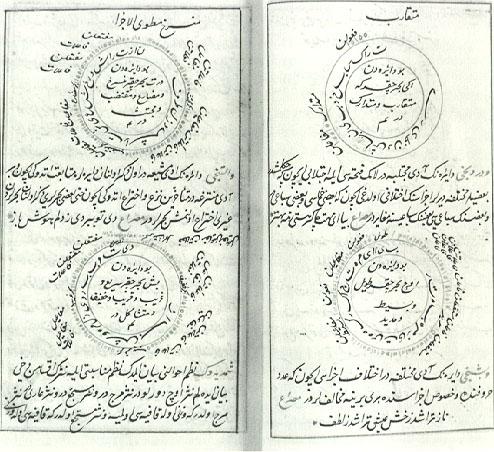
How one does move in such a world is perhaps best suggested by the dynamics of music and dance. Events in time are exemplars of eternal Events in the time of the Soul, and these can only be evaluated by a measure that varies with their intensity. The harmonies and rhythms of music provide such a measure.
"And this intensity measures a time in which the past remains present to the future, in which the future is already present to the past, just as the notes of a musical phrase, though played successively, nevertheless all persist together in the present and thus form a phrase." - Creative Imagination in the Sufism of Ibn 'Arabi, 35-36
"The homologation of forms in time with forms in space offers a particularly subtle case of isomorphism. It is this, in reality, which leads us to conceive of many modes of spatiality, among which the visual mode, corresponding to sensible perception, is not perhaps even the privileged case. Speech, the Divine Word...is the sonorous incantation which evokes beings and which remains the profound and secret nature of each being. Stabilized in this being, this nature does not reveal itself, however, to the empirical point of view, but to another visual sense, to an interior vision perceiving other spaces. But precisely these spaces, and this psycho-spiritual spatiality, which has other properties than sensible space, require in their turn a homologation of sonorous space to supersensible spaces where the vibrations of the Word propagate as 'arpeggios charged by distant lights.'" - En Islam Iranien, vol.1, 141.
The "theophanic method of discourse" recommended by Ibn 'Arabi is perhaps itself "nothing other than a form or an appeal of the progressio harmonica." "Something in the nature of harmonic perception is needed in order to perceive a world of many dimensions." - En Islam Iranien, Vol. 1, xxviii.
Page from the Topkapi Scroll - Topkapi Museum, Istanbul. Diagrams of metric circles representing rhythmic patterns of sound. Muslih al-Din Mustafa Sururi. From his "Bahr el-maarif" (Sea of knowledge), written for the Ottoman prince Mustafa in 1549, copied in 1585, red and black ink on paper. MS H. 659, Fols. 17v-18r.
Monday, August 18, 2008
The Battle for the Soul of the World
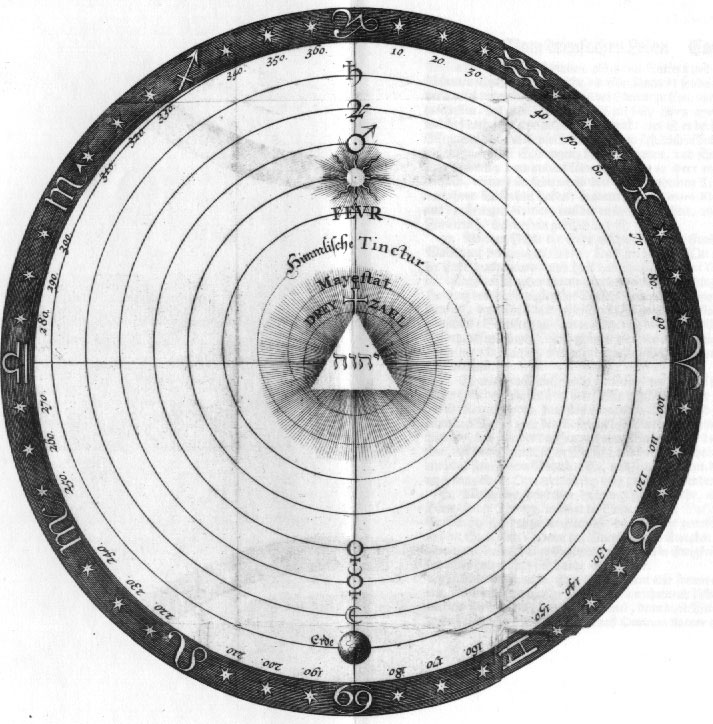 "Our western philosophy has been the theater of what we may call the “battle for the Soul of the World.” … Is it a matter of a battle that has finally been lost, the world having lost its soul, a defeat whose consequences weigh upon our modern visions of the world without compensation? If there has been a defeat, a defeat is still not a refutation." – Henry Corbin, Spiritual Body & Celestial Earth, xiv.
Centrum naturae - Jacob Boehme
Thursday, August 14, 2008
Alchemy is the Sister of Prophecy
 "...The mundus imaginalis is the place, and consequently the world, where not only the visions of the prophets, the visions of the mystics, the visionary events which each human soul traverses at the time of his exitus from the world, the events of the lesser Resurrection and the Greater Resurrection "take place" and have their "place," but also the gestes of the mystical epics the symbolic acts of all the rituals of initiation, litrugies in general with their symbols, the "composition of the ground" in various methods of prayer..., the spiritual filiations whose authenticity is not within the competence of documents and archives, and equally the esoteric processus of the Alchemical Work, in connection with which the First Imam of the Shi'ites was able to say 'Alchemy is the Sister of Prophecy.'" Henry Corbin, Spiritual Body & Celestial Earth, xi.
"We have here a mineralogy, a crystallography, a botany, a zoology whose 'objects' are used and studied as mirrors. The beings of the three Kingdoms are mirrors that render visible the constellations of the superior world..." "The alchemist operates - meditates - on all the metals as the hermeneut practices the symbolic exegesis... of a text." "...[I]t is the true imagination that makes the link between the alchemical operation and the interior transmutation." Henry Corbin, Lectures, 1973 - Quoted by Pierre Lory, Introduction to Corbin, l'Alchimie comme Art Hieratique, Paris: l'Herne, 1986, 11-13.
Image: Alchemists at work, 15th century. British Library, London. From artresource.
Wednesday, August 13, 2008
Khidr
 In Sura XVIII the figure that came to be interpreted as Khidr appears in an enigmatic episode. Moses and his servant travel to "the meeting place of the two seas." There he meets an unnamed messenger. Corbin explains:
"He is represented as Moses' guide, who initiates Moses into 'the science of predestination.' Thus he reveals himself to be the repository of an inspired divine science, superior to the law (shari'a). Thus Khidr is superior to Moses in so far as Moses is a prophet invested with revealing a shari'a. He reveals to Moses the secret mystic truth...that transcends the shari'a, and this explains why the spirituality inaugurated by Khidr is free from the servitude of literal religion."
The function of Khidr as a "person-archetype" is "to reveal each disciple to himself... He leads each disciple to his own theophany...because that theophany corresponds to his own 'inner heaven,' to the form of his own being, to his eternal individuality... Khidr's mission consists in enabling you to attain to the 'Khidr of your being,' for it is in this inner depth, in this 'prophet of your being,' that springs the Water of Life at the foot of the mystic Sinai, pole of the microcosm, center of the world."
"It goes without saying that the form in which each of us receives the master's thought conforms to his 'inner heaven'; that is the very principle of the theophanism of Ibn 'Arabi, who for that reason can only guide each man individually to what he alone is capable of seeing, and not bring him to any collective pre-established dogma..."
If the soul attains to the "Khidr of its being" to its perfection, then "you can indeed do what Khidr does."
"And this is perhaps the secret reason for which the doctrine of Ibn 'Arabi was so feared by the adepts of the literal religion, of the historical faith...of the dogma imposed uniformly on all. He...who is the disciple of Khidr possesses sufficient inner strength to seek freely the teaching of all the masters."
Quotations from Henry Corbin, Creative Imagination in the Sufism of Ibn 'Arabi. (Adapted from The World Turned Inside Out: Henry Corbin and Islamic Mysticism by the author).
Figure: From the Topkapi Scroll, Timurid Persia, 15th or 16th Century C.E., Topkapi Palace Museum, Istanbul. In Kufic script. Upper panel reads "Mohammed, 'Ali" rotated four times; Lower panel: in various patterns: "There is no God but God and Mohammed is his Prophet," "Mohammed" and "God's." See Necipoğlu, Gülru, and Mohammad Al-Asad. 1995. The Topkapı scroll: geometry and ornament in Islamic architecture : Topkapı Palace Museum Library MS H. 1956. Sketchbooks & albums. Santa Monica, CA: Getty Center for the History of Art and the Humanities, 268-9.
Tuesday, August 12, 2008
Orientation
 "Orientation is a primary phenomenon of our presence in the world. A human presence has the property of spatializing a world around it, and this phenomenon implies a certain relationship of man and the world, his world, this relationship being determined by the very mode of his presence in the world. The four cardinal points, east and west, north and south, are not things encountered by this presence, but directions which express its sense, man's acclimatization to the world, his familiarity with it. To have this sense is to orient oneself in the world." The Man of Light in Iranian Sufism, 1.
"Prophetic philosophy looks for the meaning of history not in 'horizons,' that is, not by orienting itself in the latitudinal sense of a linear development, but vertically, by a longitudinal orientation extending from the celestial pole to the earth, in the transparency of the heights or depths in which the spiritual individuality experiences the reality of its celestial counterpart, its 'lordly' dimension, its 'second person,' its 'Thou'." Creative Imagination in the Sufism of Ibn 'Arabi, 81.
"Then it may happen, just as we have learned to understand alchemy as signifying something quite different from a chapter in the history or prehistory of our sciences, that a geocentric cosmology will also be revealed in its true sense, having likewise no connection with the history of our sciences. Considering the perception of the world and the feeling of the universe on which it is based, it may be that geocentrism should be meditated upon and evaluated essentially after the manner of the construction of a mandala. It is this mandala upon which we should meditate in order to find again the northern dimension with its symbolic power, capable of opening the threshold of the beyond." The Man of Light in Iranian Sufism, 3.

The quest for the Orient "is the ascent out of cartographical dimensions, the discovery of the inner world which secretes its own light, which is the world of light; it is an innerness of light as opposed to the spatiality of the outer world which, by contrast, will appear as Darkness." The Man of Light in Iranian Sufism, 5
Figure 1: Turkish Map of Mecca; Manuscript of the Dala'il al-Khayrat (Guides to Good Things), by al-Jazuli, A.D. 1787/A.H. 1201; Ink, opaque watercolor and gold on paper. The Edward Binney, 3rd, Collection of Turkish Art at the Los Angeles County Museum of Art, M.85.237.54. From wikimedia. Figure 2: The New Jerusalem, from The Trinity College Apocalypse. Manuscript on parchment, London? c.1255-60, Cambridge, Trinity College MS R 16 2
The Accursed Tree
 Corbin writes, "The seriousness of the role of the Imagination is stressed by our philosophers when they state that it can be 'the Tree of Blessedness' or on the contrary 'the Accursed Tree' of which the Qur'an speaks, that which means Angel or Demon in power. The imaginary can be innocuous, the imaginal can never be so." Spiritual Body & Celestial Earth, x.
The spiritual path requires that we "must pass through the Darkness; this is a terrifying and painful experience, for it ruins and destroys all the patencies and norms on which the natural man lived and depended - a true 'descent into hell,' the hell of the unconscious.: Avicenna and the Visionary Recital, 159.
Mulla Sadra has written: "Of all the realities that man sees and contemplates in the world beyond, those which delight, like houris, castles, gardens, green vegetation, and steams of running water - as well as their opposites - the horrifying kinds of which Hell is composed - none of these is extrinsic to him, to the very essence of his soul, none is distinct or separated from his own act of existing." Spiritual Body & Celestial Earth, 165
And Najm Razi tells us this: "Know that the soul, the devil, the angel are not realities outside you: you are they. Likewise Heaven, Earth and the Throne are not outside you, nor paradise nor hell, nor death nor life. They exist in you; when you have accomplished the mystical journey and have become pure you will become conscious of that." in Corbin, The Man of Light in Iranian Sufism, 60.
Engraving: The Temptation of St. Anthony, Martin Schongauer, c. 1491. from wikimedia.
Beauty is the Supreme Theophany
 "As for the theophanic function invested in men, it is the secret of the dialectic of love. In the nature of mystic love this dialectic discovers the encounter (con-spiration) between sensory, physical love and spiritual love. Beauty is the supreme theophany, but it reveals itself as such only to a love which it transfigures. Mystic love is the religion of Beauty, because Beauty is the secret of theophanies and because as such it is the power which transfigures. Mystic love is as far from negative asceticism as it is from the estheticism or libertinism of the possessive instinct. But the organ of theophanic perception, that is, of the perception through which the encounter between Heaven and Earth in the mid-zone, the 'alam-al-mithal takes place, is the Active Imagination. It is the active Imagination which invests the earthly Beloved with his "theophanic function"; it is essentially a theophanic Imagination and, as such, a creative Imagination, because creation itself is theophany and theophanic Imagination. From this idea of Creation as theophany … arises the idea of a sophiology, the figure of Sophia aeterna … as she appears in the theosophy of Ibn 'Arabi."
"In place of the negative connection that we habitually understand between Christian asceticism and the Greek consciousness of beauty, it is necessary to speak here of a valorization that confers a prophetic function on beauty."
Henry Corbin, Creative Imagination in the Sufism of Ibn 'Arabi, 98 and En Islam Iranien: Aspects spirituels et philosophiques, Tome III: Les fideles d'amour - Shi'isme et sufisme. Paris: Gallimard, Bib. des Idees, 1972, 16.
Sculpture of Sophia, Ephesus Library, Anatolia (Turkey) 135 C.E. from wikimedia.
Monday, August 11, 2008
The Cross of Light
 In the Acts of Peter the apostle speaks to a group of the faithful of the Transfiguration he had witnessed on Mount Tabor. All he can say of it is "I saw him in such a form as I was able to take in." As they began to pray Peter told them to perceive in their mind what they do not see with their eyes. The hall became filled with an invisible light that shone into the eyes of some women who stood amidst the prostrate group. When they were later asked what they saw, some said an old man, others a youth, still others a child. This phenomenon lies at the heart of Corbin's theology. He writes,
"We are dealing with visions, theophanic visions. There is actual perception of an object, of a concrete person: the figure and the features are sharply defined; this person presents all the 'appearances' of a sensuous object, and yet it is not given to the perception of the sense organs. This perception is essentially an event of the soul, taking place in the soul and for the soul. As such its reality is essentially individuated for and with each soul; what the soul really sees, it is in each case alone in seeing... The community of vision will be established not by reference to an external object... but by reason of a dimension of being that is common to this or that group or family of souls. This adequation of vision to the dimension and capacity of the soul in which it takes place is the foundation of what we may call the metamorphosis of theophanic visions."
Another non-canonical text, the Acts of John, describes a theophany that holds the secret of the diversity of these visions, and of the prophetic tradition itself. It is Good Friday, and while in Jerusalem Jesus is crucified on a cross of wood, in a grotto on the Mount of Olives the Angel Christos appears to the apostle in a glory of light and reveals the vision and the mystery of the Cross of Light. Corbin paraphrases for us,
"This cross is called sometimes Word, sometimes Mind, sometimes Jesus and sometimes Christ, sometimes Door, sometimes Way, sometimes Son, Father, Spirit, sometimes Life and sometimes truth. It separates the things on high that are from the thing below that become ... and at the same time, being one, streams into all things."
Jesus the man must be distinguished from Christ the Angel. The True Prophet is that multiform angelic figure who appears uniquely to everyone; a figure described by one ancient source thus: "Running through the ages since the beginning of the world, he hastens toward the place of his repose."
Citations are from Corbin, "Divine Epiphany and Spiritual Birth in Ismaili Gnosis," in Cyclical Time and Ismaili Gnosis. Trans. R. Manheim, J. Morris, London: Kegan Paul International, 1983a, 60-61, 66.
Image: Giusto de Menabuoi, Holy Ghost. 1360-1370. Fresco, Baptistery, Padua, Italy. Photo Credit : Alinari / Art Resource, NY
(Adapted from After Prophecy: Imagination, Incarnation and Unity of the Prophetic Tradition by the author).
On Phenomenology
 On the first page of Creative Imagination in the Sufism of Ibn 'Arabi Corbin writes that
"Today, with the help of phenomenology, we are able to examine the way in which man experiences his relationship to the world without reducing the objective data of this experience to data of sense perception or limiting the field of true and meaningful knowledge to the mere operations of the rational understanding. Freed from an old impasse, we have learned to register and to make use of the intentions implicit in all the acts of consciousness or transconsciousness. To say that the Imagination (or love, or sympathy, or any other sentiment) induces knowledge, and knowledge of an "object" which is proper to it, no longer smacks of paradox. Still, once the full noetic value of the Imagination is admitted, it may be advisable to free the intentions of the Imagination from the parentheses in which a purely phenomenological interpretation encloses them, if we wish, without fear of misunderstanding, to relate the imaginative function to the view of the world proposed by the Spiritualists to whose company the present book invites us."
Seyyed Hossein Nasr, who taught with Corbin in Teheran for many years tells us that
"Corbin...used to translate phenomenology...to the Persian speaking students as kashf al-mahjub, literally 'rending asunder of the veil to reveal the hidden essence,' and considered his method...to be spiritual hermeneutics as understood in classical Sufi and Shi'ite thought."
(In Nasr, Religion and the Order of Nature, New York: Oxford University Press, 1996, 26, n. 19).
Miniature: Mourners at the funeral of Majnun, who died for the love of Layla; Probably painted by Shaykh Zadeh; From a Khamsa of Nizami, 1494 in Herat. From wikimedia.
English Translations from Les Amis de Stella et Henry Corbin
These previously untranslated and important works by Corbin are now available in English courtesy of Les Amis:
Apophatic Theology as Antidote to Nihilism
The Paradox of Monotheism
They have also posted online copies of two works in English:
History of Islamic Philosophy (in English), in two parts:
Part 1
Part 2
and
Cyclical Time in Ismaili Gnosis
Apophatic Theology as Antidote to Nihilism
The Paradox of Monotheism
They have also posted online copies of two works in English:
History of Islamic Philosophy (in English), in two parts:
Part 1
Part 2
and
Cyclical Time in Ismaili Gnosis
Friday, August 8, 2008
Christus iuvenis

 In Creative Imagination in the Sufism of Ibn 'Arabi Corbin writes:
There is indeed a remarkable conformity between the Image in the "hadith of the vision" and the Image of the youthful Christ, Christus iuvenis, in which the Christianity of the first centuries represented Christ. It is quite possible that the spiritual circles in which the hadith made its appearance knew of the Christian iconography which, precisely, illustrates a theophanic conception according perfectly with that of our Spirituals, but like theirs entirely different from the official dogma of the Incarnation, which was to triumph. Of this "Form of God" as Christus iuvenis there are still many exquisite illustrations, notably the mosaics of Ravenna, which, it will be recalled, present a complex problem because they represent iconographically the transition from a theophanic to an incarnationist Christology.
Very briefly we may say this: The theophanic conception…is that of an Apparition which is a shining of the Godhead through the mirror of humanity, after the manner of the light which becomes visible only as it takes form and shines through the figure of a stained-glass window. This union is perceived not on the plane of sensory data, but on the plane of the Light which transfigures them, that is to say, in "Imaginative Presence."
Creative Imagination, 275
Fig. 1: Cupola of the choir : Christ offers the martyr crown to San Vitale, while an angel offers a model of the church to bishop Ecclesius; Basilica of San Vitale, Ravenna, Italy. From wikimedia.
Fig. 2: Baptism and apostles, c. 500-25. Dome mosaic, Baptistery of the Arians (now Sta Maria in Cosmedin). From wikipedia.


James Hillman on Henry Corbin
 "You who have been privileged at some time during his long life to have attended a lecture by Henry Corbin have been present at a manifestation of the thought of the heart. You have been witness to its creative imagination, its theophanic power of bringing the divine face into visibility. You will also know in your hearts that the communication of the thought of the heart proceeds in that fashion of which he was master, as a récit, an account of the imaginal life as a journey among imaginal essences, an account of the essential. In him imagination was utterly presence. One was in the presence of imagination itself, that imagination in which and by which the spirit moves from the heart towards all origination."
From James Hillman, The Thought of the Heart and the Soul of the World. Dallas: Spring Publications, 1992, 3. For more on Hillman's debt to Corbin see Archetypal Psychology, Volume 1 of the Uniform Edition of Hillman's works. Photo of Corbin lecturing from Les Amis de Stella et Henry Corbin
Thursday, August 7, 2008
Theology by the Lakeside
 Here are excerpts from a haunting meditation, written by a young Henry Corbin in 1932 at the edge of Lake Siljan in Sweden. He called it Theology by the Lakeside:
Everything is but revelation; there can only be re-velation. But revelation comes from the Spirit, and there is no knowledge of the Spirit.
It will soon be dusk, but for now the clouds are still clear, the pines are not yet darkened, for the lake brightens them into transparency. And everything is green with a green richer than pulling all the organ stops in recital. It must be heard seated, very close to the Earth, arms crossed, eyes closed, pretending to sleep.
For it is not necessary to strut about like a conqueror and want to give a name to things, to everything; it is they who will tell you who they are, if you listen, yielding like a lover; for suddenly for you, in the untroubled peace of this forest of the North, the Earth has come to Thou, visible as an Angel that would perhaps be a woman, and in this apparition, this greatly green and thronging solitude, yes, the Angel too is robed in green, the green of dusk, of silence and of truth. Then there is in you all the sweetness that is present in the surrender to an embrace that triumphs over you…
…[A]t each moment where you read in truth as now what is there before you, where you hear the Angel, and the Earth and Woman, then you receive Everything, Everything, in your absolute poverty…
… you are the poor one, you are man; and he is God, and you cannot know God, or the Angel, or the Earth, or Woman. You must be encountered, taken, known, that they may speak, otherwise you are alone…
In Christian Jambet, Ed., Henry Corbin, Cahier de l'Herne, no. 39. Consacré à Henry Corbin, 62-3.
Excerpt translated by T. Cheetham. Photograph by Rainer Kleinedawe - Near Lake Siljan, Sweden
Templum & Mirror
 Speaking of the Friday Mosque at Isfahan, Corbin writes,
"At the geometrical center of the enclosure we find a basin whose fresh water is perpetually renewed. This is a water-mirror, reflecting at the same time the dome of heaven, which is the real dome of the templum, and the many-colored ceramic tiles which cover the surfaces. It is by means of this mirror that the templum brings about the meeting of heaven and earth. The mirror of the water here polarizes the symbol of the center. Now this phenomenon of the mirror at the center of the structure of the Templum is also central to the metaphysics professed by a whole lineage of Iranian philosophers, among whom the most famous lived at one time or another in Isphahan. Thus there must certainly have been a link between the different forms of the same Iranian conception of the world, perhaps a link so essential that it will explain how the painters and miniaturists of Islamic Iran felt in no way that their art was subject to the traditional anti-iconic interdict. They had produced neither sculptures in space nor easel-paintings."
From "Emblematic Cities: A Response to the Images of Henri Steirlin," trans. Kathleen Raine, in Temenos Journal 10: 16. Originally in Steirlin, Henri, Ispahan: Image du Paradis, Geneva: Editions SIGMA, 1976. Image from wikimedia
An Emblematic City
 Corbin held in high regard a figure nearly forgotten in Western philosophy except among specialists. The Neoplatonist philosopher Proclus, born in Constantinople in 412 C.E., had an enormous influence on Platonist thought both East and West. Nicolas of Cusa and Hegel may be counted among his admirers. In his Commentary on Plato's Parmenides he discusses the symbolic meaning of the dramatic setting of that dialogue. Corbin condenses this as follows:
"On the one hand there are the philosophers of the school of Ionia; [they] have studied every aspect of Nature, but they have scarcely given thought to spiritual matters... And there are, on the other hand, philosophers of the Italian school, represented above all by Parmenides and Zeno. These are exclusively concerned with things of the intelligible order. Between the two is the Attic school, which holds a middle position, because, under the stimulus of Socrates and Plato, a synthesis has been made between the findings of the other two schools... [T]he middle ground is symbolized by Athens, by whose mediation awakened souls ascend from the world of Nature to that of nous, intellect...
"These [Ionians] are types of those souls who have descended into this world who are really in need of the aid of the daimons... This is why they abandon their house, the body: they emigrate to Athens..., they set out on the way from ignorance to knowledge, from agnosis to gnosis... They come for the Goddess, whose sacred peplum is carried in the theoria, or procession of the Panatheneia in celebration of victory over the Titans who unloose chaos. The aim of the Parmenides is precisely to unite everything to the One, and to demonstrate how all things proceed from the One. To come [to Athens] is, for them, to know that it is within the soul that the battle of the giants takes place, in which [Athene] is victorious. Athens is an Emblematic City."
The quotation from Corbin is from "Emblematic Cities: A Response to the Images of Henri Steirlin," trans. Kathleen Raine, in Temenos Journal 10: 11-2. Originally in Steirlin, Henri, Ispahan: Image du Paradis, Geneva: Editions SIGMA, 1976. The sculpture is from the east frieze of the Parthenon (East V, 31-35): The presentation of the peplos of Athena. British Museum. Image from Institut für Klassische Archäologie. (Adapted from The World Turned Inside Out: Henry Corbin and Islamic Mysticism by the author.)
Monday, August 4, 2008
Rilke's Angels
 There is, Corbin tells us, a remarkable concordance between certain mystical Islamic accounts of the Angel and the late poetry of Ranier Maria Rilke. Rilke indeed believed that his vision of the Angel had more in common with the Angels of Islam than with those of the Christianity he knew. Rilke’s mystic vision implies a cosmology that denies any gulf between Heaven and Earth - they are, rather, continuous. It is I think this fundamental intuition that makes his work so important for Corbin. Corbin, whose knowledge of German theology, philosophy and literature was astonishingly broad and deep, believed that the Elegies “formulate exactly, literally” the central themes of the Islamic mystic vision which he so passionately defended. He quotes from a well known letter Rilke wrote a year before his death: “our task is to stamp this provisional, perishing earth into ourselves so deeply, so painfully and passionately, that its being may rise again, ‘invisibly,’ in us.” We must perform a transfiguration of the visible into the invisible. It is in the figure of the Angel, central to the Elegies, that this transformation appears already accomplished. Rilke wrote,
The Angel of the Elegies is the being who vouches for the recognition in the invisible of a higher order of reality. – Hence “terrible” to us, because we, its lovers and transformers, do still cling to the visible. – All the worlds of the universe are plunging into the invisible as into their next deepest reality… We are these transformers of the earth; our entire existence, the flights and plunges of our love, everything qualifies us for this task (besides which there is, essentially, no other).
Corbin says that this is precisely the view of Avicenna, Suhrawardi, Mulla Sadra and Ibn ‘Arabi. In language that mirrors Rilke’s, the 20th century Shi’ite theologian Mohammad Hosayn Tabataba’i said that the function of the Gnostic in this world is to be the workshop for the production of the invisible, the transcendent. The imagination in us provides the necessary meeting place between this world and the Divine. Corbin tells of a Shi’ite tradition which holds that the blood of Imam Hosayn, Prince of Martyrs, must remain suspended forever between Heaven and Earth, for if it were ever to fall, the world would come to an end. The Angel allows us to perceive all things as suspended between Heaven and Earth in the mundus imaginalis. The Imagination establishes the reality of the “meeting place of the two seas” where Moses meets Khidr, the Verdant One.
(Adapted from After Prophecy: Imagination, Incarnation and the Unity of the Prophetic Tradition by the author.) Seated Angel, Iran, 1575–1600, Opaque watercolor and gold on paper. From the Freer Gallery of Art and the Arthur M. Sackler Gallery. Lent by the Art and History Trust LTS1995.2.72
Solzhenitsyn & the Grail Castle
In an important essay presented at the Eranos Conference in 1974 Corbin wrote as follows:
The norm of the Temple may doubtless appear fragile or absurd in a world like ours, and the state of the "guardians of the Temple", of the contemplatives "at the meeting-place of the two seas" may seem infinitely precarious... What will the future of this norm be? The answer, it seems to me, comes at the end of Albrecht von Scharfenberg's great epic, "the New Titurel"... Here, there is an episode which has all the impact of a parable of the Imago Templi. When Titurel and Parsifal take the Holy Grail back to the East, they pass through a certain city. Parsifal leaves the inhabitants of this city with an image of the castle-temple of the Grail at Montsalvat. And with the aid of the single image the inhabitants set about building their own Temple of the Grail.
This Image is also what remains to us. No more; but no less. No less, because it provides the answer to our question: what will happen in the future to the norm of the Temple? And it answers this question because this Image is imperishable, to the extent that we see it rise triumphant in the "waste land", from an earth that is spiritually more devastated than the domain of the Grail ever was before the coming of Parsifal. I call to witness the extraordinary vision of the castle-temple at Montsalvat which comes in one of the most moving pages written by Alexander Solzhenitsyn. Here the Imago Templi, rising like a challenge to dominate the norms of a hostile landscape, can be contemplated in all its purity. The vision takes the form of a study made by a painter who is trying to set down the moment when Parsifal "contemplates" the castle-temple of the Holy Grail for the first time.
"In shape the picture was twice as high as it was long. It showed a wedge-shaped ravine dividing two mountain crags. Above them both to right and left, could just be seen the outermost trees of a forest - a dense, primeval forest. Some creeping ferns, some ugly, menacing prehensile thickets clung to the very edge, and even to the overhanging face of the rock. Above and to the left a pale grey horse was coming out of the forest, ridden by a man in helmet and cape. Unafraid of the abyss the horse had raised its foreleg, before taking the final step, prepared at its rider's command to gather itself and jump over - a leap that was well within its power. But the rider was not looking at the chasm that faced the horse. Dazed, wondering, he was looking into the middle distance, where the upper reaches of the sky were suffused with an orange-gold radiance which might have been from the sun or from something else even more brilliant hidden from view by a castle. Its walls and turrets growing out of the ledges of the mountainside, visible also from below through the gap between the crags, between the ferns and trees, rising to a needle-point at the top of the picture - indistinct in outline, as though woven from gently shimmering clouds, yet still vaguely discernible in all the details of its unearthly perfection, enveloped in a shining and lilac-colored aureole - stood the castle of the Holy Grail."
This visionary page written by Solzhenitsyn is evidence that the Imago Templi, the image of the castle-temple left to mankind by Parsifal, will never be lost. It is in some sense the response to the geste of Parsifal, and both together are the response to the desperate cry of the Templar knights... Together they reply: No! the temple is not destroyed forever. This was known to Suhravardi also [who]... composed an entire "Book of hours" in honour of the "guardians of the Temple", who are unknown to the majority of men. They guard a secret Temple, and those who find their way to it can join in the invocation which returns, like a refrain, in one of the most beautiful psalms composed by Suhravardi: "O God of every God! Make the litany of the Light arise. Make the people of Light triumphant. Guide the Light towards the Light. Amen."
From Henry Corbin, "The Imago Templi in Confrontation with Secular Norms," in Temple and Contemplation, London: KPI, 1986, 389-90. The passage by Alexander Solzhenitsyn is from The First Circle, trans. Michael Guybon, London: Collins & Harvill Press, 1968, 259.
The norm of the Temple may doubtless appear fragile or absurd in a world like ours, and the state of the "guardians of the Temple", of the contemplatives "at the meeting-place of the two seas" may seem infinitely precarious... What will the future of this norm be? The answer, it seems to me, comes at the end of Albrecht von Scharfenberg's great epic, "the New Titurel"... Here, there is an episode which has all the impact of a parable of the Imago Templi. When Titurel and Parsifal take the Holy Grail back to the East, they pass through a certain city. Parsifal leaves the inhabitants of this city with an image of the castle-temple of the Grail at Montsalvat. And with the aid of the single image the inhabitants set about building their own Temple of the Grail.
This Image is also what remains to us. No more; but no less. No less, because it provides the answer to our question: what will happen in the future to the norm of the Temple? And it answers this question because this Image is imperishable, to the extent that we see it rise triumphant in the "waste land", from an earth that is spiritually more devastated than the domain of the Grail ever was before the coming of Parsifal. I call to witness the extraordinary vision of the castle-temple at Montsalvat which comes in one of the most moving pages written by Alexander Solzhenitsyn. Here the Imago Templi, rising like a challenge to dominate the norms of a hostile landscape, can be contemplated in all its purity. The vision takes the form of a study made by a painter who is trying to set down the moment when Parsifal "contemplates" the castle-temple of the Holy Grail for the first time.
"In shape the picture was twice as high as it was long. It showed a wedge-shaped ravine dividing two mountain crags. Above them both to right and left, could just be seen the outermost trees of a forest - a dense, primeval forest. Some creeping ferns, some ugly, menacing prehensile thickets clung to the very edge, and even to the overhanging face of the rock. Above and to the left a pale grey horse was coming out of the forest, ridden by a man in helmet and cape. Unafraid of the abyss the horse had raised its foreleg, before taking the final step, prepared at its rider's command to gather itself and jump over - a leap that was well within its power. But the rider was not looking at the chasm that faced the horse. Dazed, wondering, he was looking into the middle distance, where the upper reaches of the sky were suffused with an orange-gold radiance which might have been from the sun or from something else even more brilliant hidden from view by a castle. Its walls and turrets growing out of the ledges of the mountainside, visible also from below through the gap between the crags, between the ferns and trees, rising to a needle-point at the top of the picture - indistinct in outline, as though woven from gently shimmering clouds, yet still vaguely discernible in all the details of its unearthly perfection, enveloped in a shining and lilac-colored aureole - stood the castle of the Holy Grail."
This visionary page written by Solzhenitsyn is evidence that the Imago Templi, the image of the castle-temple left to mankind by Parsifal, will never be lost. It is in some sense the response to the geste of Parsifal, and both together are the response to the desperate cry of the Templar knights... Together they reply: No! the temple is not destroyed forever. This was known to Suhravardi also [who]... composed an entire "Book of hours" in honour of the "guardians of the Temple", who are unknown to the majority of men. They guard a secret Temple, and those who find their way to it can join in the invocation which returns, like a refrain, in one of the most beautiful psalms composed by Suhravardi: "O God of every God! Make the litany of the Light arise. Make the people of Light triumphant. Guide the Light towards the Light. Amen."
From Henry Corbin, "The Imago Templi in Confrontation with Secular Norms," in Temple and Contemplation, London: KPI, 1986, 389-90. The passage by Alexander Solzhenitsyn is from The First Circle, trans. Michael Guybon, London: Collins & Harvill Press, 1968, 259.
Subscribe to:
Posts (Atom)


 Posts
Posts


